


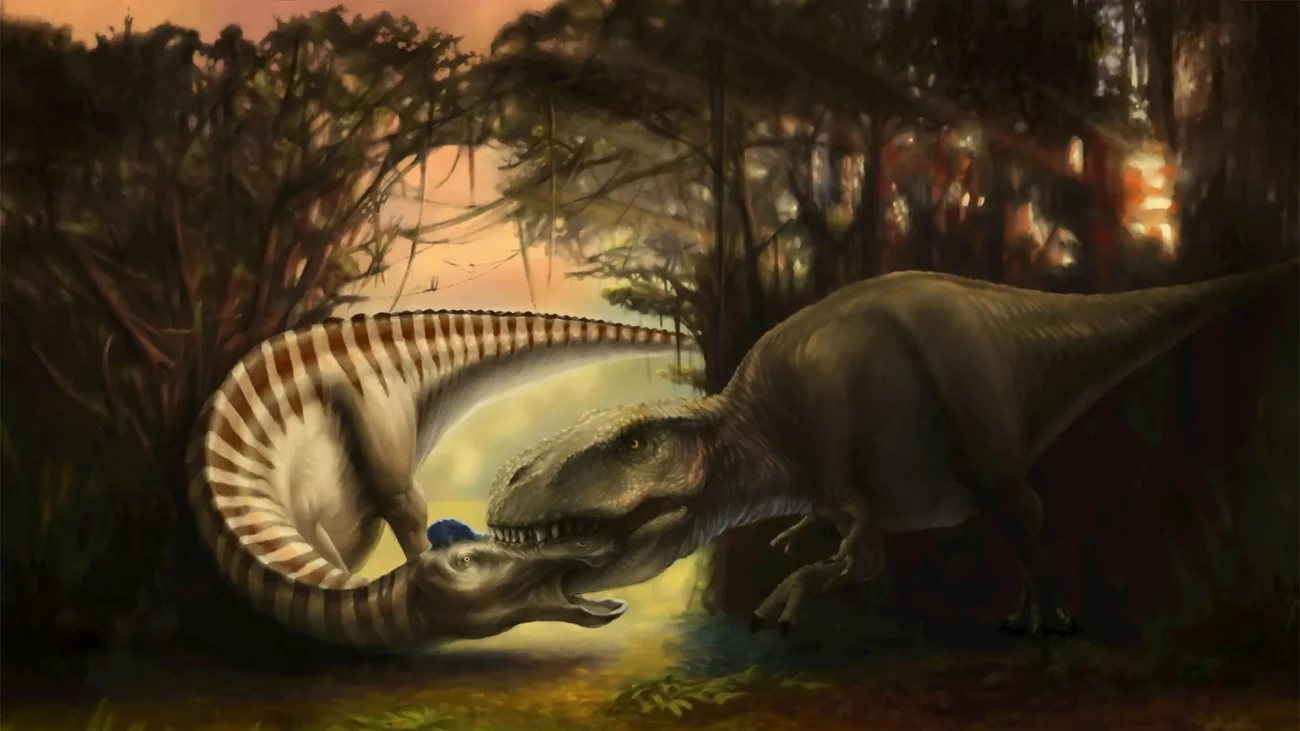
A remarkable fossil unearthed in Montana is providing paleontologists with an exceptionally detailed look at the predatory tactics of Tyrannosaurus rex, the apex predator of the Late Cretaceous period. The specimen, a nearly complete skull of an Edmontosaurus with a tyrannosaur tooth still firmly lodged within its bone, is the subject of a groundbreaking new study by researchers from Montana State University and the University of Alberta. This discovery is illuminating the brutal efficiency of T. rex, shedding new light on how this fearsome dinosaur may have hunted and dispatched its prey.
The Cretaceous Crime Scene: A Fossilized Encounter
Approximately 66 million years ago, during the twilight of the Age of Dinosaurs, the landscape of what is now Montana was a vibrant ecosystem dominated by colossal creatures. Tyrannosaurus rex reigned supreme as the ultimate predator, sharing its territory with other magnificent herbivores, including the formidable, horned Triceratops and the broad-billed Edmontosaurus. It is within this ancient world that the dramatic encounter preserved in this fossil took place.
The extraordinary find was made in 2005 by researchers working in the Hell Creek Formation of eastern Montana, an area renowned for its rich fossil deposits. The fossilized skull, belonging to an Edmontosaurus, was recovered from land managed by the Bureau of Land Management. Upon its accession into the paleontology collection at the Museum of the Rockies, one feature immediately captivated the scientific community: a broken tooth from a tyrannosaur, irrevocably embedded in the Edmontosaurus’s facial bone.
This singular fossil now serves as the centerpiece of an intensive collaborative investigation. The study, published in the esteemed scientific journal PeerJ, was spearheaded by Taia Wyenberg-Henzler, a doctoral student at the University of Alberta, and John Scannella, the Curator of Paleontology at the Museum of the Rockies. Their work aims to reconstruct the final moments of this ancient herbivore and the predatory prowess of its killer.
Unlocking the Secrets: The Power of an Embedded Tooth
Bite marks on dinosaur bones are not uncommon in the fossil record, often providing evidence of scavenging or defensive encounters. However, finding an intact, embedded tooth is an exceedingly rare event. "Although bite marks on bones are relatively common, finding an embedded tooth is extremely rare," explained Wyenberg-Henzler in a statement. "The great thing about an embedded tooth, particularly in a skull, is it gives you the identity of not only who was bitten but also who did the biting."
This unique preservation allows researchers to act as "Cretaceous crime scene investigators," as Wyenberg-Henzler aptly describes it. By identifying both the victim and the attacker, they can begin to piece together the narrative of this ancient predation event.
Technological Forensics: CT Scans Illuminate the Attack
To definitively identify the predator, the research team undertook a meticulous process of comparison. They carefully examined the embedded tooth and compared its morphology with the dentition of every known meat-eating dinosaur species from the Hell Creek Formation. The distinctive characteristics of the tooth unequivocally pointed to Tyrannosaurus rex as the assailant.
Further invaluable details about the nature of the injury and how the tooth became lodged were revealed through advanced imaging techniques. Computed tomography (CT) scans, performed at Advanced Medical Imaging at Bozeman Health Deaconess Hospital, provided a non-invasive, high-resolution view of the fossil. These scans allowed scientists to visualize the tooth’s precise position within the bone, the extent of damage to the Edmontosaurus’s skull, and the forces involved in the attack.
"A fossil like this is extra exciting because it captures a behavior: a tyrannosaur biting into this duckbill’s face," stated Scannella. The CT scans revealed crucial information about the state of the Edmontosaurus’s skull at the time of the bite. Significantly, there were no visible signs of bone healing around the embedded tooth. This absence of regenerative tissue suggests that the Edmontosaurus was either already deceased when the tyrannosaur inflicted the bite, or it succumbed to its injuries shortly after. "The skull shows no signs of healing around the tyrannosaur tooth, so it may have already been dead when it was bitten, or it may be dead because it was bitten," Scannella elaborated.
Reconstructing the Predatory Encounter
The location and angle of the embedded tooth offer compelling clues about the dynamics of the attack. Wyenberg-Henzler highlighted the significance of the tooth’s position, which was found embedded in the nasal region of the Edmontosaurus’s skull. "Looking at the way the tooth is embedded in the nose of the Edmontosaurus suggests that it met its attacker face-to-face, something that usually happens to an animal that was killed by a predator," she noted. This frontal confrontation indicates that the Edmontosaurus may have been facing its attacker, possibly attempting to flee or defend itself, when the fatal bite occurred.
The immense force required to break off a tyrannosaur tooth and embed it so deeply within robust dinosaur bone is another critical piece of evidence. Such an event would necessitate a powerful and decisive bite. "The amount of force necessary for a tooth to have become broken off in bone also points to the use of deadly force," Wyenberg-Henzler emphasized. "For me, this paints a terrifying picture of the last moments of this Edmontosaurus."
A Deeper Understanding of Tyrannosaurus Rex
The feeding habits and hunting strategies of Tyrannosaurus rex have been a subject of intense scientific debate for decades. As one of the largest and most formidable terrestrial carnivores to have ever lived, T. rex has consistently been a focal point of paleontological research. While many fossils provide evidence of its immense power and predatory capabilities, this particular specimen offers a unique, tangible record of a specific predatory event.
The discovery and analysis of this fossilized tooth-in-skull interaction contribute significantly to our understanding of T. rex’s predatory repertoire. It moves beyond inferring behavior from bite marks and provides a direct, albeit frozen-in-time, snapshot of a hunting encounter.
Contextualizing the Hell Creek Formation Ecosystem
The Hell Creek Formation, where this fossil was found, represents one of the most extensively studied fossil sites in North America. Its deposits span the very end of the Cretaceous period, roughly 68 to 66 million years ago, and provide a window into the final ecosystems before the K-Pg extinction event. The fauna of the Hell Creek Formation includes a diverse array of dinosaurs, mammals, birds, and reptiles.
Key inhabitants of this environment included:
- Tyrannosaurus rex: The undisputed apex predator, known for its massive size, powerful jaws, and serrated teeth.
- Triceratops: A large, herbivorous ceratopsian dinosaur with three prominent facial horns and a large frill. They were likely a primary food source for T. rex.
- Edmontosaurus: A large, duck-billed hadrosaur, which were abundant herbivores. Their presence in large numbers would have made them a readily available food source for T. rex.
- Ankylosaurus: A heavily armored herbivore with a distinctive clubbed tail.
- Pachycephalosaurus: A dome-headed dinosaur whose function remains debated, potentially used for intraspecific combat.
- Various smaller dinosaurs, mammals, and reptiles: Contributing to a complex food web.
The presence of both T. rex and its potential prey, like Edmontosaurus, in such close proximity within the same fossil formation underscores the dynamic and often violent interactions that characterized this ancient ecosystem. The Hell Creek Formation also famously preserves evidence of the asteroid impact that ultimately led to the demise of the non-avian dinosaurs, making it a critical site for understanding both the life and the end of the Cretaceous period.
Broader Implications and Future Research
This discovery has several significant implications for paleontological research:
- Direct Evidence of Predation: The embedded tooth provides irrefutable evidence of a T. rex attack, moving beyond inference to direct observation of a predatory event.
- Understanding Bite Force and Mechanics: The embedded tooth and surrounding bone can offer insights into the bite force and the mechanics of T. rex’s jaws. Analyzing the fracture patterns and the way the tooth penetrated the bone can help refine biomechanical models of T. rex feeding.
- Behavioral Insights: The position of the bite and the lack of healing suggest specific predatory behaviors. The frontal assault points towards T. rex potentially ambushing or confronting its prey directly, rather than solely relying on scavenging. The fact that the tooth remained embedded suggests a powerful strike that may have been intended to incapacitate or kill.
- Prey Vulnerability: The vulnerability of Edmontosaurus to a T. rex attack is further confirmed. While large and potentially capable of group defense, individual Edmontosaurus were clearly susceptible to the predatory might of T. rex.
Future research on this specimen may involve more advanced micro-CT scanning to examine the microscopic structure of the bone and tooth interface, potentially revealing details about the exact angle of impact and the sequence of events. Comparative studies with other fossilized bite marks and embedded teeth from different dinosaur species could also shed further light on predator-prey dynamics across the Cretaceous period.
This rare and remarkable fossil from Montana State University’s Museum of the Rockies is more than just an ancient relic; it is a tangible testament to the raw power and predatory efficiency of Tyrannosaurus rex, offering scientists an unparalleled opportunity to reconstruct the thrilling, and often brutal, realities of life in the Late Cretaceous. It serves as a powerful reminder of the constant struggle for survival that shaped the evolution of life on Earth millions of years ago.

