


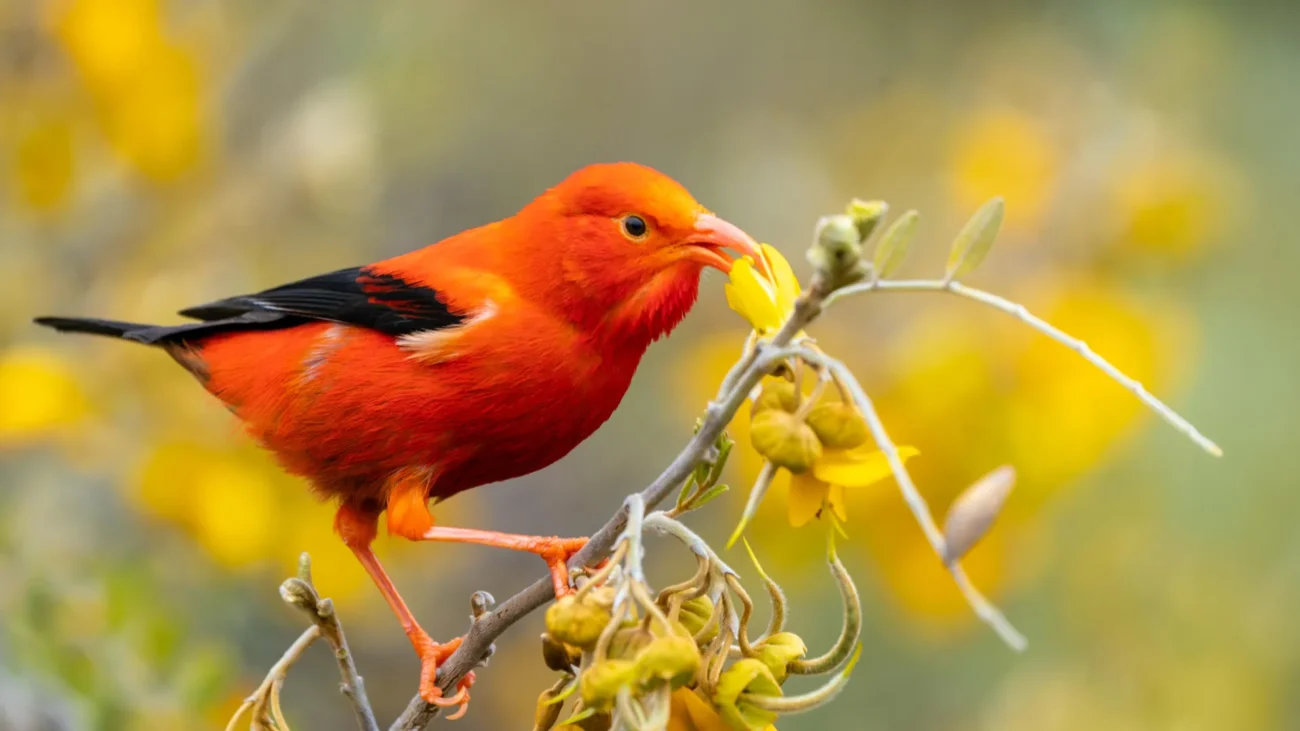
A groundbreaking study spearheaded by a researcher from the University of Hawaiʻi at Mānoa has delivered a stark and sobering revelation: almost every forest bird species in Hawaiʻi possesses the capability to transmit avian malaria. This pervasive ability to spread the deadly disease is a critical factor explaining its widespread presence across the islands, wherever mosquitoes, the disease’s primary vector, can survive. The findings, published on February 10 in the esteemed scientific journal Nature Communications, paint a grim picture for the future of the state’s unique and imperiled avian populations.
The research team meticulously surveyed 64 locations statewide, a comprehensive effort that detected the presence of avian malaria at an astonishing 63 of them. These sites encompassed a diverse array of forest ecosystems, each characterized by distinct bird species compositions, underscoring the ubiquitous nature of the threat. The illness itself is caused by Plasmodium relictum, a generalist parasite that has been identified as a central culprit behind the dramatic population declines and outright extinctions of many native Hawaiian honeycreepers, iconic species found nowhere else on Earth.
Dr. Christa M. Seidl, the mosquito research and control coordinator for the Maui Forest Bird Recovery Project, who led this pivotal research as part of her doctoral work at the University of California, Santa Cruz, articulated the severity of the situation. "Avian malaria has taken a devastating toll on Hawaiʻi’s native forest birds, and this study shows why the disease has been so difficult to contain," Dr. Seidl stated. "When so many bird species can quietly sustain transmission, it narrows the options for protecting native birds and makes mosquito control not just helpful, but essential."
The Devastating Impact of Avian Malaria on Native Birds
Avian malaria is a parasitic disease that directly attacks the red blood cells of birds. This invasion can trigger a cascade of severe health issues, including anemia, organ failure, and a significant reduction in survival rates. For some species, particularly those with limited genetic resilience or those already facing ecological pressures, infection can be swiftly fatal.
The consequences for Hawaiʻi’s endemic avian fauna have been nothing short of catastrophic. Native honeycreepers, renowned for their vibrant plumage and specialized ecological roles, have been disproportionately affected. For instance, the ʻiʻiwi, a striking scarlet honeycreeper, faces an estimated mortality rate of approximately 90 percent if infected with avian malaria. This staggering figure highlights the extreme vulnerability of these birds to the parasite. Even more tragically, the ʻakikiki, a small honeycreeper native to the island of Kauaʻi, is now presumed extinct in the wild, with avian malaria identified as the primary driver of its demise.
Historically, many infectious diseases are sustained by a relatively small number of reservoir species. However, this new research reveals that avian malaria operates under a different paradigm in Hawaiʻi. The study demonstrates that a broad spectrum of forest birds, encompassing both native and introduced species, exhibit a moderate to high capacity for infecting the southern house mosquito (Culex quinquefasciatus), the primary vector responsible for transmitting the parasite. Crucially, even birds carrying minute quantities of the Plasmodium relictum parasite were found to be capable of infecting mosquitoes. This finding is profoundly significant, as it indicates that a vast array of bird communities can collectively perpetuate ongoing transmission cycles of the disease.
"We often understandably think first of the birds when we think of avian malaria, but the parasite needs mosquitoes to reproduce and our work highlights just how good it has gotten at infecting them through many different birds," Dr. Seidl emphasized. This symbiotic relationship, where the parasite thrives by exploiting a wide host range, makes eradication efforts exponentially more challenging.
Chronic Infections: The Silent Engine of Transmission
To arrive at these conclusions, researchers undertook an extensive data collection and laboratory analysis. Blood samples were collected from over 4,000 individual birds spanning the islands of Kauaʻi, Oʻahu, Maui, and Hawaiʻi Island. This extensive field data was then integrated with controlled laboratory experiments designed to quantify the rate at which mosquitoes became infected after feeding on birds from these diverse populations.
The results of these paired analyses were unequivocal: native and introduced bird species exhibited remarkably similar levels of infectiousness to mosquitoes. This implies that both groups play a substantial role in the ongoing spread of avian malaria across the islands, complicating efforts to isolate and protect native species by simply focusing on eliminating introduced bird populations.
Perhaps one of the most concerning discoveries of the study is the prevalence of chronic infections. The research indicates that birds can harbor the avian malaria parasite for extended periods, often lasting for months or even years. During these chronic phases, infected birds may display only mild or even subclinical symptoms, making them appear outwardly healthy. However, despite their apparently good health, these birds remain capable of transmitting the parasite to feeding mosquitoes. The researchers estimate that this prolonged period of low to moderate infectiousness is responsible for the majority of avian malaria transmission occurring statewide, acting as a persistent reservoir for the disease.
Climate Change: Shrinking Safe Havens and Amplifying Threats
The widespread ability of the parasite to infect such a diverse array of bird species provides a compelling explanation for the pervasive distribution of avian malaria throughout Hawaiʻi. The study’s findings strongly suggest that very few mosquito-infested habitats on the islands remain free from the risk of disease transmission.
This already dire situation is being exacerbated by the accelerating impacts of climate change. As global temperatures continue to rise, the geographical range of mosquitoes, the disease vector, is expanding into higher elevation areas. These higher altitudes have historically served as crucial, cooler refuges for native Hawaiian birds, offering a reprieve from both mosquitoes and the diseases they carry. However, with warming trends, these elevated zones are becoming increasingly habitable for mosquitoes, effectively shrinking the safe havens available to vulnerable native avian populations and exposing them to the threat of avian malaria for the first time. This creates a double-edged sword: native birds are being pushed into smaller areas, and those areas are becoming increasingly compromised by the spread of disease.
The implications of this study extend beyond mere scientific observation; they carry significant weight for conservation strategies. The traditional approach of controlling mosquito populations has been a cornerstone of efforts to protect native birds. However, the pervasive nature of avian malaria transmission, now understood to involve nearly all forest bird species, underscores that mosquito control alone, while vital, may not be sufficient to safeguard these imperiled species. A multi-faceted approach, integrating robust mosquito management with other innovative conservation strategies, is urgently required.
Dr. Seidl and her colleagues at the Maui Forest Bird Recovery Project are actively involved in this broader effort. They are key members of "Birds, Not Mosquitoes," a collaborative initiative bringing together a diverse coalition of academic institutions, state and federal government agencies, non-profit organizations, and industry partners. This alliance is dedicated to advancing the science and implementation of mosquito control measures specifically tailored to support the critical conservation of Hawaiian birds.
The Maui Forest Bird Recovery Project operates under the auspices of the Pacific Cooperative Studies Unit within the College of Natural Sciences, underscoring the institutional support for this vital research. It is important to note that all birds involved in the study were captured and handled with the utmost care by highly trained ornithologists, operating strictly under the necessary state and federal permits, ensuring ethical and scientifically sound research practices.
Background and Chronology of the Avian Malaria Crisis in Hawaiʻi
The introduction of the avian malaria parasite and its vector, the southern house mosquito, to the Hawaiian Islands in the late 19th and early 20th centuries marked a turning point for the islands’ unique birdlife. Historically, Hawaiʻi’s native birds evolved in isolation, free from the immune pressures posed by many continental diseases and their associated vectors. The arrival of these novel pathogens and their carriers proved devastating, particularly for species lacking pre-existing immunity.
The earliest documented evidence of avian malaria in Hawaiʻi dates back to the early 1900s. Scientists observed significant declines in native bird populations, with symptoms consistent with malaria. Over the subsequent decades, the disease spread relentlessly, primarily driven by the expansion of mosquito populations, which themselves were aided by human activities and the introduction of non-native plant species that created suitable breeding grounds.
By the mid-20th century, many native forest bird species had experienced dramatic population reductions. Species like the ʻōʻō, the poʻo uli, and various honeycreepers became increasingly rare, confined to higher elevation forests where cooler temperatures historically limited mosquito activity. However, as the current study highlights, even these presumed refugia are now under threat.
The research published in Nature Communications represents the culmination of years of dedicated scientific inquiry and fieldwork. The study’s timeline can be broadly outlined as follows:
- Late 19th – Early 20th Century: Introduction of the southern house mosquito and avian malaria parasite to Hawaiʻi.
- Mid-20th Century: Widespread observation of native bird declines attributed to avian malaria, with populations becoming increasingly restricted to higher elevations.
- Late 20th – Early 21st Century: Continued monitoring and research efforts by various conservation organizations and academic institutions, confirming the persistent impact of avian malaria and identifying specific at-risk species.
- Recent Years (leading up to publication): Intensive fieldwork and laboratory analysis for the current study, involving the collection of thousands of bird samples and controlled mosquito infection experiments.
- February 10, [Year of Publication]: Publication of the pivotal study in Nature Communications, revealing the near-universal capacity of Hawaiian forest birds to transmit avian malaria and highlighting the exacerbating role of climate change.
This chronological progression underscores the long-standing nature of the avian malaria crisis in Hawaiʻi and the evolving understanding of its complex dynamics.
Supporting Data and Implications
The study’s findings are supported by robust quantitative data, including:
- Detection Rate: Avian malaria detected at 63 out of 64 surveyed locations, indicating a prevalence of over 98%.
- Host Diversity: Nearly all tested forest bird species, both native and introduced, demonstrated the ability to infect mosquitoes. This challenges previous assumptions that transmission was primarily driven by a limited number of species.
- Infectiousness Levels: Even birds with low parasite loads were found to be infectious to mosquitoes, suggesting a low threshold for transmission.
- Chronic Infection Duration: Evidence indicates that chronic infections can persist for months to years, providing a continuous source of parasite transmission.
- Climate Change Correlation: Observed expansion of mosquito habitats into higher elevations, directly correlating with rising global temperatures.
The implications of this research are far-reaching:
- Conservation Strategy Re-evaluation: Traditional conservation approaches focused solely on mosquito control may need significant revision. A broader strategy encompassing parasite management, habitat restoration, and potentially the development of bird-specific resistance or immunity is likely necessary.
- Urgency for Intervention: The study amplifies the urgent need for decisive action to curb mosquito populations and prevent further spread of avian malaria, especially into previously unaffected high-elevation areas.
- Economic and Ecological Impact: The potential extinction of more native bird species represents not only an ecological tragedy but also a significant loss for Hawaiʻi’s ecotourism industry and its unique natural heritage.
- Global Relevance: While focused on Hawaiʻi, the study’s findings on the broad host competence for avian malaria and the impact of climate change on disease transmission have relevance for conservation efforts concerning bird populations in other vulnerable tropical regions.
Official Responses and Broader Conservation Efforts
The scientific community and conservation organizations have responded to the study’s findings with a mixture of concern and renewed determination. While the results present a daunting challenge, they also provide critical data that can inform more effective conservation strategies.
Partnerships like "Birds, Not Mosquitoes" are crucial in this context. This collaborative effort aims to accelerate research into innovative mosquito control methods, such as the use of sterile insect technique (SIT) and gene drive technologies, which could offer more targeted and effective solutions than traditional insecticides. The project also emphasizes public awareness and engagement, recognizing that community support is vital for the long-term success of conservation initiatives.
Government agencies, including the Hawaiʻi Department of Land and Natural Resources, have acknowledged the severity of the avian malaria threat and are working in conjunction with research institutions and non-profit groups. Funding allocations and policy decisions are increasingly being shaped by the scientific evidence, recognizing the escalating crisis facing native bird populations.
The long-term survival of Hawaiʻi’s native forest birds hinges on a comprehensive and adaptive approach. This new study serves as a critical call to action, highlighting the pervasive nature of avian malaria and the urgent need for intensified, collaborative, and innovative conservation efforts to protect these irreplaceable natural treasures from the brink of extinction. The fate of these unique species rests on our ability to understand and effectively combat the complex interplay of parasites, vectors, hosts, and a changing climate.

