


For more than three centuries, Sir Isaac Newton’s third law of motion has stood as an unshakeable pillar of classical mechanics. Formulated in 1687 in the foundational Philosophiae Naturalis Principia Mathematica, the axiom that for every action there is an equal and opposite reaction has explained everything from the propulsion of ballistic missiles and the mechanics of pedestrian foot traffic to the orbital trajectories of celestial bodies. Generations of physics students have memorized the principle, using it to solve textbook equations and anchor theoretical models of the physical world. Yet, nature has long harbored glaring exceptions to this absolute rule. Across biology, soft condensed matter, and non-equilibrium physics, countless systems operate on a strictly one-way street, defying the intuitive balance of reciprocal forces.
In recent breakthroughs published in the journal Nature Physics, an international research collaboration based in Dresden and Würzburg has unveiled a mathematical framework that finally reconciles these rebellious systems with traditional physics. By introducing a novel theoretical architecture that utilizes fictitious partners, researchers can now precisely simulate and analyze systems where Newton’s third law breaks down. This development bridges a decades-long chasm in theoretical physics, promising to revolutionize our understanding of everything from bacterial colonies and cellular biology to complex crowd dynamics and collective quantum phenomena.
The Limits of Reciprocity in Nature
To understand the magnitude of the Dresden team’s achievement, one must first examine the pervasive nature of non-reciprocal interactions in the natural world. In classical mechanics, interactions between objects are typically reciprocal. When a runner propels themselves forward, their foot exerts a backward force on the ground, and the earth responds with an equal and opposite forward thrust. When two cars collide or two billiard balls strike one another, the forces exchanged are mutual, balanced, and symmetrical.
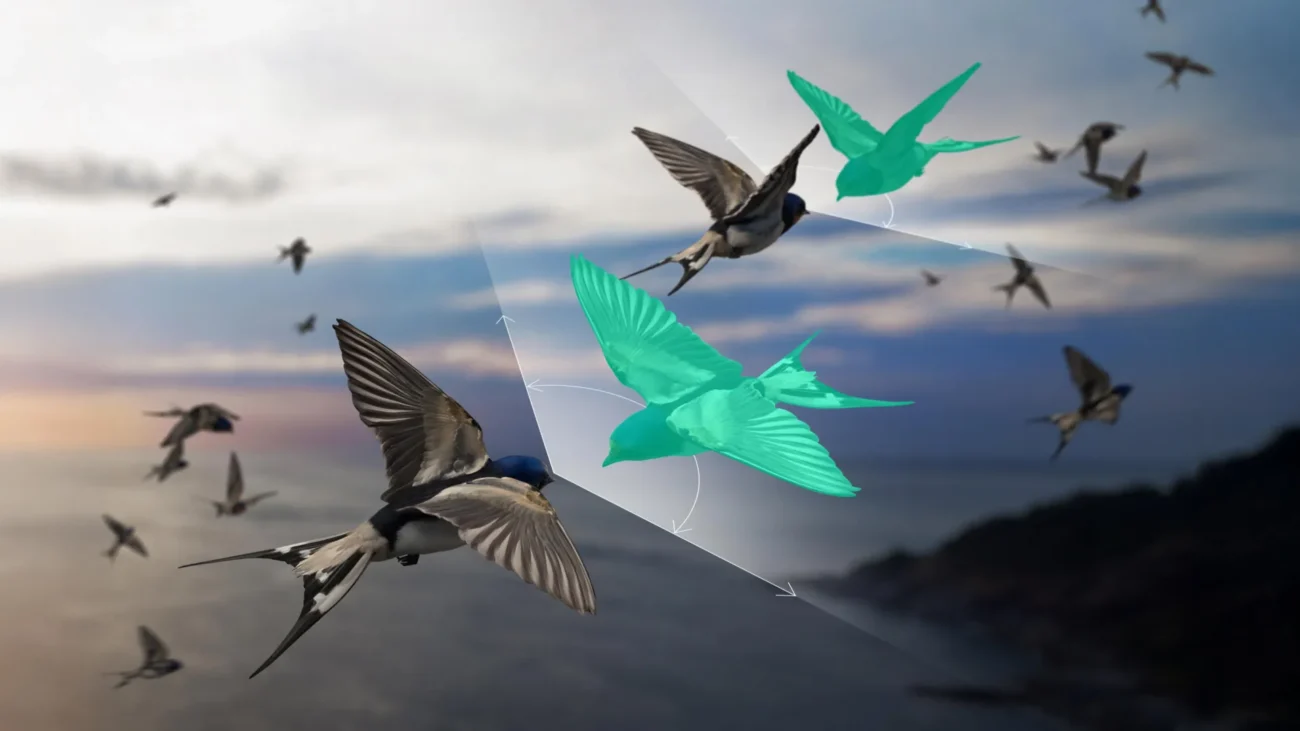
However, many complex systems—particularly those driven far from thermal equilibrium—abandon this symmetry entirely. Consider a flock of starlings executing breathtaking aerial ballets across a twilight sky. Intensive behavioral studies have revealed that individual birds do not survey their entire environment symmetrically. Instead, a bird focuses its attention almost exclusively on its immediate neighbors to the side and ahead. It reacts to their movements, but the birds behind it have no direct mechanical or perceptual influence on its trajectory.
This creates a fundamental asymmetry: bird A influences bird B, but bird B does not exert a reciprocal, balancing influence on bird A. Similar one-way dynamics govern swarms of bacteria navigating chemical gradients, crowds of human commuters navigating a bustling railway station, and collective groups of cells migrating during embryonic development or wound healing.
For decades, these phenomena presented a severe analytical headache for theoretical physicists. Traditional mathematical frameworks and simulation tools were fundamentally engineered to handle reciprocal interactions, where action and reaction neatly cancel or balance each other out. When researchers attempted to apply these classical tools to non-reciprocal systems, the models frequently broke down, yielded inaccurate predictions, or required computationally prohibitive custom workarounds. Consequently, science lacked a unified language to describe how order emerges spontaneously in systems governed by unequal, one-way forces.
A Breakthrough Engineered in Dresden
The quest to solve this longstanding theoretical bottleneck culminated in the collaborative efforts of researchers working alongside physicist Roderich Moessner. Moessner serves as a Principal Investigator of the Würzburg-Dresden Cluster of Excellence ctd.qmat—Complexity, Topology and Dynamics in Quantum Matter—and is the director of the Max Planck Institute for the Physics of Complex Systems (MPI-PKS) in Dresden. Working closely with research group leader Marín Bukov, biophysicist Ricard Alert, and their colleagues, the team set out to construct a bridge between the unruly world of non-reciprocal systems and the tidy, well-tested machinery of classical and statistical mechanics.
The core of their solution lies in a clever mathematical expansion of the traditional action-reaction framework. Rather than abandoning classical mechanics or attempting to invent an entirely new physics from scratch, the research team found a way to adapt established methods so they can seamlessly handle systems where Newton’s third law does not apply.
"The research team has developed and proven a theory that makes much of what we teach our students applicable to non-reciprocal systems as well," explains Marín Bukov. "These systems, where Newton’s third law does not apply, can now finally be described exactly and simulated precisely—even using established methods. This is exactly the kind of tool that has been missing in recent years."
The Mechanics of the Fictitious Partner
The genius of the new theoretical model rests on the introduction of auxiliary degrees of freedom, a concept well-known in advanced physics but never before applied in this specific context. In standard physical modeling, scientists assign mathematical variables to real, observable properties: a bird’s instantaneous velocity, a bacterium’s spatial coordinates, or a pedestrian’s heading in a crowded corridor.
To neutralize the complications caused by one-way, non-reciprocal interactions, the Dresden research team introduced a counter-intuitive trick: they invented imaginary partners for every real component in the system.
"The trick behind the new theory is that it constructs a partner for each component of the system—a fictitious partner that doesn’t exist in nature," explains Ricard Alert. "The original non-reciprocal interactions are replaced by reciprocal interactions with these auxiliary degrees of freedom."
To visualize this in practice, consider the earlier example of the flock of birds. Under the new mathematical framework, researchers simulate the flock by artificially pairing each real bird with a fictitious counterpart placed precisely in front of it, aligned in the opposite direction. These imaginary entities do not correspond to physical animals soaring through the air; rather, they serve as sophisticated mathematical buffers. By translating the asymmetrical, one-way tracking behavior of the real birds into symmetrical, reciprocal interactions with these auxiliary variables, the entire system becomes mathematically tractable.
Suddenly, researchers can deploy powerful, pre-existing computational toolkits designed for many-body physics to analyze systems that previously defied standard modeling techniques. This methodological leap transforms an intractable analytical problem into a solvable set of equations.
Implications for Biological Systems and Soft Matter
The practical implications of this theoretical framework extend far beyond the whimsical physics of bird flocks. In the realm of molecular and cellular biology, non-reciprocal interactions are the rule rather than the exception. Biological tissues are active matter systems, meaning individual cells constantly consume metabolic energy to generate mechanical forces.
During processes such as embryonic morphogenesis, cancer metastasis, and tissue regeneration, cells must crawl, stretch, and coordinate their movements over large distances. These cellular collectives frequently exhibit non-reciprocal signaling and mechanical feedback. By providing a precise method for simulating active matter, the Dresden framework equips bioengineers and biophysicists with the computational muscle needed to model these vital biological processes with unprecedented fidelity.
Furthermore, the study of artificial active matter—such as self-propelled synthetic microswimmers, Janus particles, and robotic swarms—stands to benefit immensely. Engineers designing autonomous microscopic swarms for targeted drug delivery or environmental cleanup rely heavily on accurate simulations to predict how individual units will self-organize. Without accounting for non-reciprocal forces, these simulations often fail to capture real-world emergent behaviors, leading to costly trial-and-error design cycles.
Venturing Into Quantum Frontiers
While the immediate applications of the new theory clearly impact soft matter and biology, the theoretical framework was forged within an institution deeply immersed in the strange behaviors of quantum materials. The Würzburg-Dresden Cluster of Excellence ctd.qmat focuses primarily on topological quantum matter, where particles interact under extreme conditions to produce exotic phenomena such as fractional quantum Hall states, high-temperature superconductivity, and lossless current transport.
Roderich Moessner emphasizes that the boundaries of this new theory stretch well beyond classical macroscopic systems, opening thrilling avenues of inquiry in the quantum realm.
"In Würzburg and Dresden, we study quantum matter whose particles interact under certain conditions in ways that give rise to new phenomena such as magnetism or lossless current transport," Moessner notes. "The exciting question now is whether these exceptions to Newton’s law lead to entirely new forms of collective quantum behavior. We still know very little about this—and that is precisely what makes this so fascinating."
In many quantum systems, microscopic particles experience non-reciprocal effective interactions, particularly when they are coupled to external environments or driven out of thermal equilibrium by laser fields or electrical currents. Until now, theoretical physicists lacked the tools to rigorously explore how these quantum-level violations of Newton’s third law might manifest as macroscopic quantum phases. By extending the auxiliary variable framework down to the quantum scale, researchers hope to uncover entirely uncharted states of matter that defy standard thermodynamic expectations.
A Paradigm Shift in Theoretical Physics
The publication of these findings in Nature Physics marks a watershed moment for theoretical mechanics. For over three centuries, the absolute universality of Newton’s third law was treated as an uncompromised bedrock of physics education. While physicists always recognized that open, non-equilibrium systems could exhibit one-way interactions, they lacked a unified, rigorous mathematical language to tame them.
By demonstrating that non-reciprocal systems can be systematically mapped onto reciprocal ones through the strategic deployment of fictitious partners, the Dresden research team has expanded the toolkit available to scientists across multiple disciplines. This development transforms a nagging theoretical anomaly into a fertile playground for discovery.
As laboratories around the world begin to adopt this auxiliary variable approach, the scientific community anticipates a cascade of new insights into how collective order arises from asymmetrical chaos. Whether charting the migratory paths of cellular sheets, optimizing autonomous drone swarms, or probing the bizarre quantum properties of driven matter, researchers now possess the precise mathematical lens required to view the universe’s most rebellious systems in sharp focus. Newton’s third law remains as valid as ever for the classical machines and everyday objects it was originally designed to describe, but physics has finally found a way to move beyond its limitations—opening a vast, mathematically sound door to the non-reciprocal universe.

