


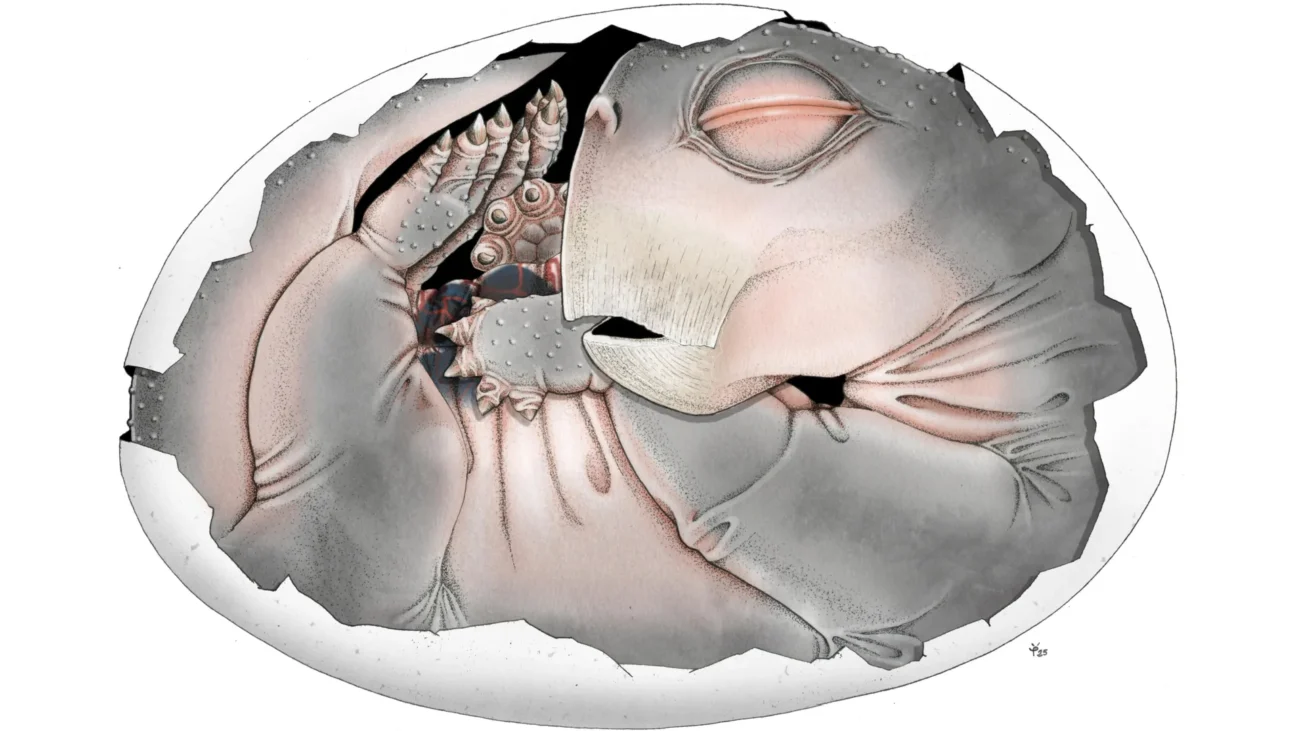
A groundbreaking fossil discovery is illuminating the remarkable survival strategies of an ancient creature, shedding new light on a persistent scientific enigma and fundamentally altering our understanding of early mammalian evolution. The fossil, a remarkably preserved egg containing a 250-million-year-old embryo of Lystrosaurus, a resilient plant-eating ancestor of mammals, provides the first concrete evidence that these crucial precursors to modern mammals laid eggs. This finding directly addresses a question that has puzzled paleontologists for decades and offers profound insights into how Lystrosaurus not only survived but became a dominant species in the aftermath of the devastating End-Permian Mass Extinction.
The Great Dying and the Rise of a Survivor
The End-Permian Mass Extinction, often referred to as the "Great Dying," stands as the most catastrophic biodiversity crisis in Earth’s history. Occurring approximately 252 million years ago, at the boundary between the Permian and Triassic periods, this cataclysmic event annihilated an estimated 96% of all marine species and 70% of terrestrial vertebrate species. The primary drivers are believed to have been massive volcanic eruptions in Siberia, which released colossal amounts of greenhouse gases, leading to rapid and extreme global warming, ocean acidification, and widespread anoxia. The planet’s surface became a hostile, scorched wasteland characterized by scorching temperatures, volatile atmospheric conditions, and prolonged, devastating droughts.
Amidst this global ecological collapse, life on Earth faced an existential threat. Yet, from the ashes of this devastation, a new era of life emerged, and certain species proved exceptionally adept at navigating these radically altered environments. Among the most successful of these survivors was Lystrosaurus, a genus of dicynodonts – a group of non-mammalian synapsids that are considered direct ancestors of mammals. Lystrosaurus was a stocky, pig-sized herbivore characterized by its lack of teeth in the upper jaw, replaced by a sharp, keratinous beak, and two prominent tusks protruding from its upper jaw. Its robust build and presumably efficient digestive system allowed it to exploit a wide range of plant matter, a crucial advantage in a resource-scarce post-extinction world. The fossil record demonstrates a dramatic proliferation of Lystrosaurus fossils in the immediate geological strata following the End-Permian extinction, marking it as one of the most dominant terrestrial vertebrates of the Early Triassic. However, the precise reproductive strategies that underpinned this extraordinary success remained a subject of intense speculation and debate.
A Long-Sought Clue Unearthed
The recent discovery, detailed in the prestigious journal PLOS ONE, represents a monumental leap in our understanding of Lystrosaurus and its evolutionary lineage. An international team of researchers, spearheaded by Professor Julien Benoit of the University of Paris-Saclay, Professor Jennifer Botha from the Evolutionary Studies Institute at the University of the Witwatersrand in South Africa, and Dr. Vincent Fernandez of the European Synchrotron Radiation Facility (ESRF) in France, meticulously analyzed a fossil specimen that has now been definitively identified as a Lystrosaurus egg containing a developing embryo. This specimen, estimated to be approximately 250 million years old, is the first confirmed egg of a mammal ancestor ever discovered.
The implications of this find are far-reaching, finally providing a definitive answer to the age-old question: did the evolutionary precursors to mammals lay eggs? The answer, now unequivocally confirmed, is yes.
The Challenge of Preserving Ancient Eggs
The rarity of fossilized eggs, particularly those belonging to early amniotes like Lystrosaurus, has long been a significant hurdle for paleontologists. Unlike the hard, calcified shells of many dinosaur eggs, which are readily preserved in the fossil record, researchers hypothesize that the eggs of Lystrosaurus and other early mammal ancestors were likely soft-shelled. This characteristic, similar to the eggs laid by modern reptiles and birds, would have made them far more susceptible to decay and decomposition before fossilization could occur. Over millions of years, these delicate structures would have largely disintegrated, leaving little to no trace for future discovery. The successful preservation of this particular Lystrosaurus egg, therefore, is an extraordinary stroke of paleontological fortune.
From Field Discovery to Advanced Imaging: A Multi-Decade Journey
The story of this pivotal discovery began nearly two decades ago, during a field excursion led by Professor Jennifer Botha in South Africa, a region rich in Permian and Triassic fossils. In 2008, John Nyaphuli, an exceptionally skilled preparator and fossil finder, identified a small nodule that initially yielded only faint fragments of bone. With painstaking care and expertise, Nyaphuli began to prepare the specimen, gradually revealing a remarkably complete Lystrosaurus hatchling, perfectly curled within what appeared to be its embryonic shell. Professor Botha harbored a strong suspicion at the time that the creature had died within its egg, but the technology available then was insufficient to confirm this hypothesis with certainty.
The specimen lay dormant for years, a tantalizing puzzle awaiting the advancements in scientific instrumentation. The turning point came with the advent of state-of-the-art synchrotron X-ray computed tomography (CT) scanning technology, particularly the powerful capabilities offered by the ESRF in France. These advanced imaging techniques allowed researchers to peer inside the fossilized nodule with unprecedented detail, non-destructively revealing the internal structure and confirming what had long been suspected.
Dr. Vincent Fernandez, a key member of the research team at the ESRF, described the moment of revelation as exceptionally exciting. "Understanding reproduction in mammal ancestors has been a long-lasting enigma, and this fossil provides a key piece to this puzzle," he stated. "It was essential that we scanned the fossil just right to capture the level of detail needed to resolve such tiny, delicate bones." The high-resolution scans provided a clear view of the embryo’s developmental stage, offering critical clues about its life and the reproductive strategies of its species.
Unveiling Developmental Clues: The Mandibular Symphasis
Professor Julien Benoit, another lead researcher on the project, highlighted a particularly significant detail observed in the scans: the incomplete mandibular symphysis. The mandible, or lower jaw, in many vertebrates, including Lystrosaurus, is initially formed from two distinct halves that eventually fuse together. This fusion is a critical step that allows the animal to properly chew and process food. The observation that this fusion had not yet occurred in the Lystrosaurus embryo provided a crucial insight. "The fact that this fusion had not yet occurred shows that the individual would have been incapable of feeding itself," Professor Benoit explained. This suggests that the embryo was still in a pre-hatching developmental stage and had not yet reached the point of independent feeding.
Large Eggs, Rapid Development, and Parental Care
The analysis of the fossilized egg and its contained embryo has led to further deductions about the reproductive biology of Lystrosaurus. The study indicates that Lystrosaurus produced relatively large eggs in proportion to its body size. In modern biology, larger eggs typically contain a greater amount of yolk, providing ample nutrients to sustain the developing embryo for an extended period. This abundance of yolk can reduce or eliminate the need for parental provisioning of food after hatching.
This finding strongly suggests that Lystrosaurus did not engage in the complex parental care behaviors seen in many modern mammals, such as feeding their young with milk. Instead, the large, yolk-rich eggs likely allowed the hatchlings to develop to a relatively advanced stage within the egg, emerging with the capacity for independent survival.
Furthermore, the large egg size would have offered a significant advantage in the harsh, arid conditions that characterized the post-extinction landscape. Soft-shelled eggs are vulnerable to desiccation, and a larger yolk sac could have provided a more self-contained and resilient environment, better protected against drying out.
Precocial Hatchlings: A Strategy for Survival
Based on these observations, the researchers propose that Lystrosaurus hatchlings were likely precocial. This term describes offspring that are born or hatched at a relatively advanced stage of development, possessing the ability to move, feed, and even evade predators soon after birth or hatching. In the context of the Early Triassic, this precocial strategy would have been highly advantageous. Hatchlings that could quickly become independent would have been better equipped to forage for scarce resources, avoid newly emerging predators, and reach maturity rapidly in an unstable environment.
In essence, the success of Lystrosaurus appears to be rooted in a potent combination of rapid growth and early reproductive maturation. This reproductive strategy, facilitated by large, well-provisioned eggs, allowed the species to capitalize on the limited opportunities available in the post-apocalyptic world.
A Winning Formula for Resilience
The discovery of the Lystrosaurus egg and embryo offers the first direct biological evidence that mammal ancestors laid eggs, thereby resolving a long-standing question in evolutionary paleontology. More importantly, it provides a tangible explanation for the remarkable dominance of Lystrosaurus in the ecosystems that emerged from the shadow of the End-Permian Mass Extinction. Their ability to reproduce effectively in such extreme conditions, coupled with their robust physiology, positioned them as masters of survival.
This finding also contributes to a broader emerging pattern observed in the study of ancient life: the critical role of adaptability, resilience, and flexible reproductive strategies in navigating periods of global crisis. Lystrosaurus appears to have embodied all these traits, showcasing a remarkable capacity to thrive against overwhelming odds.
Broader Implications for Understanding Climate Change and Biodiversity
The significance of this discovery extends far beyond the realm of paleontology. As scientists continue to unravel the complexities of ancient life and the environmental upheavals it endured, a profound understanding of resilience and adaptability in the face of extreme global change is taking shape. The study of how past organisms survived mass extinctions offers invaluable lessons for contemporary biodiversity and climate challenges.
Professor Julien Benoit emphasized the profound relevance of this research: "In a modern context, this work is highly impactful because it offers a deep-time perspective on resilience and adaptability in the face of rapid climate change and ecological crisis. Understanding how past organisms survived global upheaval helps scientists better predict how species today might respond to ongoing environmental stress, making this discovery not just a breakthrough in paleontology, but also highly relevant to current biodiversity and climate challenges."
The opportunity to collaborate at cutting-edge facilities like the ESRF, where advanced imaging techniques enabled researchers to "see" inside the fossil with extraordinary detail, was also a crucial element of the scientific journey. "That moment, when the pieces all came together, was incredibly rewarding," Professor Benoit added.
Professor Jennifer Botha underscored the historical significance of the find: "It is also thrilling because this discovery breaks entirely new ground. For over 150 years of South African paleontology, no fossil had ever been conclusively identified as a therapsid egg. This is the first time we can say, with confidence, that mammal ancestors like Lystrosaurus laid eggs, making it a true milestone in the field." She also noted the satisfaction of revisiting John Nyaphuli’s nearly two-decade-old discovery and finally solving the mystery he had uncovered.
The Lystrosaurus egg fossil stands as a powerful testament to the ingenuity of life in overcoming adversity. It not only rewrites a chapter in the history of mammalian evolution but also offers a crucial deep-time perspective on the challenges of environmental change, providing vital context for understanding and addressing the biodiversity crisis unfolding in our own era. The resilience demonstrated by these ancient ancestors serves as a stark reminder of the power of adaptation in the face of planetary-scale disruption.

