


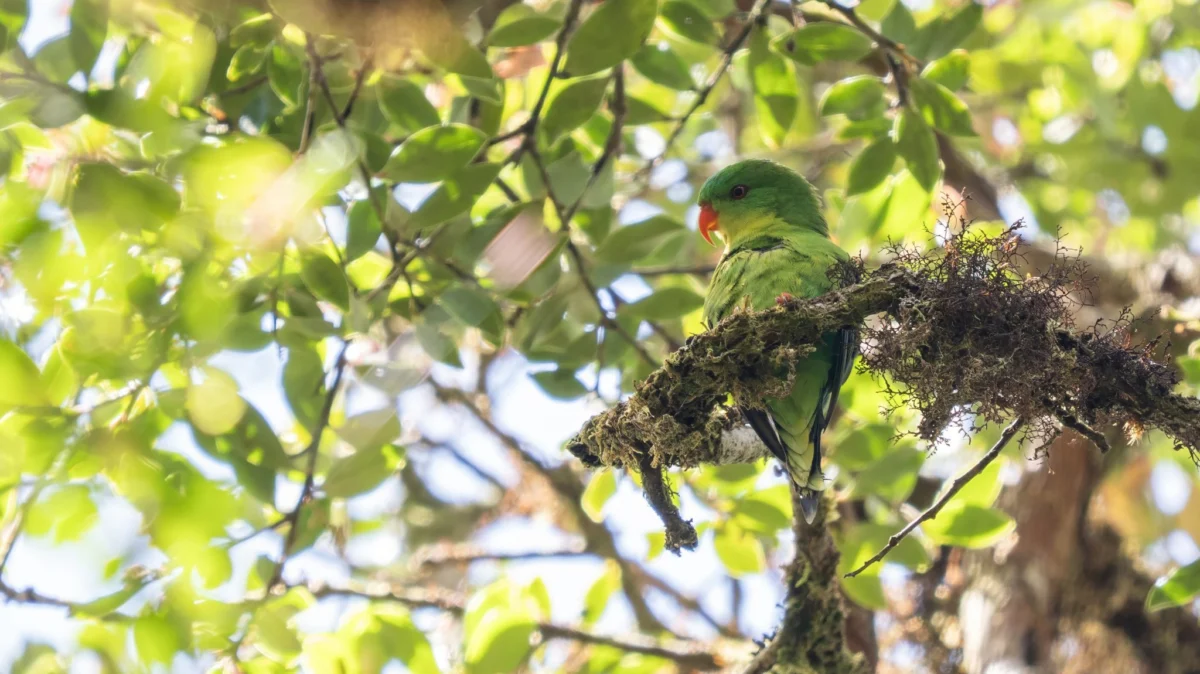
A groundbreaking expedition deep into the remote and challenging highlands of Mount Kapalatmada on Buru Island, Indonesia, has achieved a remarkable feat: the rediscovery of the elusive Blue-fronted Lorikeet (Charmosyna toxopei). This vibrant parrot, believed by many to be lost to the world for nearly a century, has now been officially documented for only the second time since its initial description over a hundred years ago. The sighting, captured in April during a grueling 14-day trek, marks a significant triumph for conservation efforts and provides a glimmer of hope for other critically endangered and "lost" bird species worldwide.
A Ghost of the Forest Returns
The Blue-fronted Lorikeet, a small parrot characterized by its lime-green plumage, striking orange bill, and a distinctive blue hindcrown, was first scientifically described in the 1920s based on a handful of specimens. Despite extensive surveys conducted in the lowland and mid-elevation forests where these initial specimens were found, the species vanished from scientific records, leading to its classification as Data Deficient on the IUCN Red List and its inclusion in the "Search for Lost Birds" initiative. The assumption for many years was that the lorikeet, if it still existed, must inhabit the inaccessible montane forests of Buru’s higher altitudes. This theory, however, remained unproven until a recent surge of exploration in these formidable landscapes.

The expedition, a collaborative effort spearheaded by the Indonesian mountaineering group Kanal Buru and led by expedition leader Handoko, brought together researchers and conservationists from the American Bird Conservancy (ABC), Birdtour Asia, and Yayasan Planet Indonesia. Their arduous journey into the island’s most unexplored territory culminated in the breathtaking confirmation of the Blue-fronted Lorikeet’s continued existence.
Sumaraja, a seasoned Birdtour Asia guide and tour leader on the expedition, described the profound emotional impact of the sighting. "When we saw the Blue-fronted Lorikeet, I couldn’t hold back my tears," he recounted. "Every day, I almost cried with joy at seeing that these birds still exist." This sentiment underscores the immense significance of the discovery for those dedicated to avian conservation.
Charting the Path to Rediscovery: A Chronology of Hope
The journey to reconfirm the presence of the Blue-fronted Lorikeet involved several crucial steps and a confluence of dedicated efforts:

- 1920s: The Blue-fronted Lorikeet is first described based on a series of seven specimens collected on Buru Island.
- Post-1920s: Despite repeated surveys in known habitats, the species fails to be re-sighted, leading to its disappearance from scientific records.
- 2014: A pivotal moment arrives when Craig Robson and a Birdquest birding tour capture the first photographic evidence of the Blue-fronted Lorikeet since its initial description, suggesting its persistence in a potentially different habitat.
- 2024: The Blue-fronted Lorikeet is officially recognized as a "lost species" by the Search for Lost Birds, a global initiative involving ABC, Re:wild, and Birdlife International, highlighting its extreme rarity and the urgent need for its rediscovery. The species is also listed as Data Deficient on the IUCN Red List.
- Autumn 2023: Local climbers from Kanal Buru successfully map a new route to the summit of Mount Kapalatmada, Buru’s highest peak, opening previously inaccessible areas to exploration.
- April 2024: An expedition team comprising members from ABC, Birdtour Asia, Yayasan Planet Indonesia, and guided by Kanal Buru undertakes a challenging 14-day trek into the Mount Kapalatmada highlands.
- During the April 2024 Expedition:
- After six days of ascent, the team reaches a mossy cloud forest.
- A lorikeet is spotted, but departs before photographs can be taken.
- Two days later, a second Blue-fronted Lorikeet is sighted and photographed during breakfast, marking the first confirmed documentation in over a decade.
- On the final morning, two more lorikeets are observed, and the first sound recordings of their calls are captured.
- The expedition also documents other significant species, including a Madanga and a potential new taxon of Island Thrush.
Unveiling the Habitat and Threats
The expedition’s findings strongly support the long-held speculation that the Blue-fronted Lorikeet primarily inhabits the higher elevations of Buru’s montane forests. The challenging ascent through jagged limestone terrain eventually gave way to a "charming mossy cloud forest and park-like clearing full of birdsong," suggesting a distinct ecological niche for the species.
John Mittermeier, Director of the Search for Lost Birds at ABC, vividly described the moment of discovery: "We noticed two small birds fly into a nearby tree so I picked up my binoculars to see what one of them was. I short-circuited with excitement when I realised it was a Blue-fronted Lorikeet." The subsequent photographic and audio documentation provided irrefutable evidence of the lorikeet’s presence in this remote habitat.
However, the rediscovery is tinged with concern regarding the threats facing this vulnerable species. Benny A. Siregar, Maluku Coordinator at Burung Indonesia, a Birdlife partner organization, emphasized the critical situation: "Rare sighting records suggest a highly restricted habitat use. The primary challenge facing the Blue-fronted Lorikeet is that they are facing threats that remain largely unknown. This bird inhabits areas under continuous pressure from deforestation, with a population estimated to be exceedingly small and vulnerable."

Dwi Agustina, Conservation Program Coordinator for Konservasi Kakatua Indonesia (KKI), which conducted surveys from 2023 to early 2025, highlighted specific threats including habitat destruction and hunting for consumption and trade. "Buru is home to many endemic birds, and the logging and mining companies that have acquired much of the island’s forest represent a major threat to their survival and wildlife," she stated, underscoring the urgent need for coordinated conservation action.
Broader Implications: A Symbol of Resilience and a Call to Action
The rediscovery of the Blue-fronted Lorikeet is more than just an ornithological triumph; it serves as a powerful symbol of resilience in the face of extinction and a stark reminder of the vast, unexplored biodiversity that still exists on our planet. Its survival in the inaccessible highlands of Mount Kapalatmada, shielded by its remoteness, offers a beacon of hope for other species that have similarly vanished from sight and are feared to be on the brink of disappearing forever.
The success of this expedition also underscores the vital role of persistent exploration and collaborative partnerships in conservation. The "Search for Lost Birds" initiative, by identifying species that are critically endangered but potentially still extant, guides crucial fieldwork. The involvement of local communities, such as Kanal Buru, is paramount, as they possess invaluable knowledge of the terrain and its ecosystems.

The implications of this rediscovery extend to other critically endangered lorikeets, such as the New Caledonian Lorikeet and the Red-throated Lorikeet, which are thought to be perilously close to extinction. The Blue-fronted Lorikeet’s survival demonstrates that even species presumed lost may persist in overlooked or under-surveyed landscapes.
The expedition leaders and conservationists involved have expressed a strong desire for increased awareness and action. Sumaraja eloquently stated, "In the future, I certainly hope more people will be able to see and learn more about these birds. At the same time, I sincerely hope more people will care about and participate in preserving the remaining forests on Buru Island."
Handoko, the expedition leader, echoed this sentiment, emphasizing the educational and empowering aspect of the expedition: "This expedition helped me and the members of Kanal Buru gain new perspectives and knowledge about Mount Kapalatmada, especially about the birds and the ecosystems there. I hope to share these experiences to empower people in Buru to protect this unique area."

The future of the Blue-fronted Lorikeet and its fragile habitat now hinges on a "collective approach and action from all stakeholders," as advocated by Benny A. Siregar. The newfound accessibility to Mount Kapalatmada’s highlands, while enabling discovery, also presents new challenges. Thoughtful stewardship, robust conservation strategies, and continued collaboration with local communities are essential to ensure that this remarkable rediscovery leads to sustained protection for the Blue-fronted Lorikeet and the rich biodiversity of Buru Island. The story of this "lost" bird’s return is a powerful testament to nature’s enduring capacity for surprise and a compelling call to safeguard our planet’s remaining wild spaces.

