


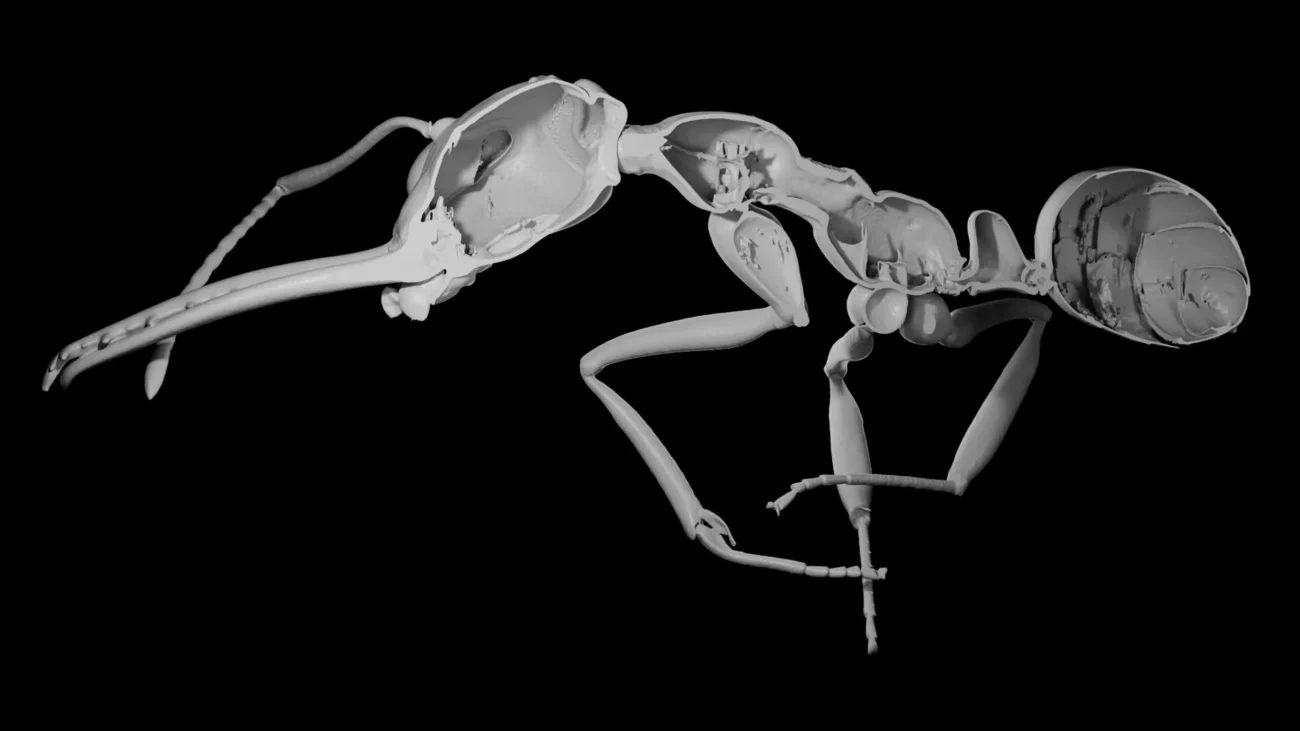
A groundbreaking study published on December 19, 2025, in the esteemed journal Science Advances reveals a fundamental evolutionary strategy that has propelled the diversification and complexity of ant societies: a deliberate trade-off between individual robustness and sheer numbers. This research, led by scientists at the University of Maryland and the University of Cambridge, proposes that certain ant species have strategically invested less in the physical armor of individual workers, opting instead to produce a greater quantity of these less-protected individuals. This resource allocation strategy, the study suggests, has been a key driver in the evolution of large, complex social structures, offering profound insights into the development of collective intelligence and societal evolution, even extending to human civilizations.
The research addresses a long-standing question in biology: how do individuals change as the societies they inhabit become more intricate? The study posits that in highly organized social groups, individual organisms can become "cheaper" to produce, requiring fewer resources for their creation and maintenance. While this might imply a reduction in individual physical prowess, it unlocks the potential for a significantly larger workforce, a concept that has now been rigorously tested through large-scale analyses of social insects.
The Ant’s Dilemma: Quality Versus Quantity in Evolutionary Success
The core of the investigation centers on the cuticle, the hard exoskeleton that protects ants from a myriad of environmental threats, including predators, desiccation, and disease. The cuticle also provides essential structural support for muscular activity. However, its production is metabolically demanding, consuming vital nutrients like nitrogen and minerals. The researchers hypothesized that a heavier, more robust cuticle necessitates a greater expenditure of these finite resources, thereby limiting the total number of individuals a colony can sustain. Conversely, a less substantial cuticle, while offering reduced individual protection, could free up these crucial nutrients, allowing for the production of a larger ant population.
This hypothesis was tested by analyzing an extensive dataset comprising 3D X-ray scans of over 500 ant species. The scientists meticulously measured both the total body volume and the cuticle volume for each species. Their findings revealed a significant variation in cuticle investment, ranging from a mere 6% of an ant’s body mass to a substantial 35%. When these measurements were integrated into sophisticated evolutionary models, a clear and compelling trend emerged: species that allocated a smaller proportion of their body mass to cuticle development were overwhelmingly found to form larger, more populous colonies.
This inverse relationship between cuticle investment and colony size suggests a deliberate evolutionary strategy. By foregoing the costly investment in individual "body armor," ant species have been able to amplify their numbers. This strategy appears to have been remarkably successful, leading to the extraordinary diversification and ecological dominance of ants across the globe.
The Strategic Advantage of "Cheaper" Workers
Dr. Evan Economo, senior author of the study and chair of the Department of Entomology at the University of Maryland, elaborated on the implications of this finding. "There’s this question in biology of what happens to individuals as societies they are in get more complex. For example, the individuals may themselves become simpler because tasks that a solitary organism would need to complete can be handled by a collective," Dr. Economo stated. He further explained that this "cheaper" individual concept means they require fewer resources to build and can be produced in larger numbers, even if each is less physically robust.
Arthur Matte, lead author of the study and a Ph.D. student in zoology at the University of Cambridge, highlighted the ubiquity and evolutionary significance of ants. "Ants are everywhere," Matte noted. "Yet the fundamental biological strategies which enabled their massive colonies and extraordinary diversification remain unclear." He added that their research proposes a direct link between colony size and the investment ants make in their cuticle.
The implications of this reduced individual investment extend beyond mere population size. The authors propose that a less heavily armored worker might be more readily integrated into a highly cooperative social system. Reduced reliance on individual defense could foster the development and enhancement of other crucial social traits, such as cooperative foraging for food, collective nest defense against threats, and a more pronounced division of labor among colony members. These collective strengths, amplified by sheer numbers, can compensate for any perceived individual weakness.
"Ants reduce per-worker investment in one of the most nutritionally expensive tissues for the good of the collective," Matte explained. "They’re shifting from self-investment toward a distributed workforce, resulting in more complex societies. It’s a pattern that echoes the evolution of multicellularity, where cooperative units can be individually simpler than a solitary cell, yet collectively capable of far greater complexity."
Diversification: A Ripple Effect of Reduced Armor
Intriguingly, the study also uncovered a correlation between lower investment in the cuticle and higher rates of diversification. Diversification, a measure of how frequently new species emerge, is often used by biologists as a proxy for evolutionary success. Dr. Economo emphasized the significance of this finding, noting that very few traits have been directly linked to diversification in ants, making this particular discovery especially noteworthy.
The exact mechanisms by which reduced cuticle investment might promote speciation remain an area of ongoing research. One leading theory suggests that ants with lower nutritional demands, stemming from their less robust exoskeletons, may be better equipped to colonize environments with limited resources. "Requiring less nitrogen could make them more versatile and able to conquer new environments," Matte theorized. This reduced metabolic requirement could allow these ant lineages to explore and exploit niches that are inaccessible to species with higher resource needs.
Furthermore, the evolution of increasingly complex ant societies might have created a self-reinforcing cycle. As collective defenses, such as coordinated nest protection and sophisticated disease control mechanisms, became more prevalent, the pressure for each individual ant to possess heavy personal armor diminished. This reduced selective pressure for individual toughness, in turn, facilitated larger colony sizes. This dynamic interplay suggests that the evolution of "squishability," as Dr. Economo playfully termed it, was a critical step in the evolutionary trajectory of many ant species.
Historical Context and Broader Implications
The research team’s findings resonate with broader evolutionary principles and historical human developments. The analogy drawn to human military history, where the era of heavily armored knights eventually gave way to specialized infantry units like archers and crossbowmen, illustrates a similar shift from individual prowess to numerical superiority and tactical specialization. Dr. Economo also referenced Lanchester’s Laws, a set of mathematical models developed during World War I to analyze combat outcomes, which demonstrate how larger numbers of weaker combatants can overcome a smaller force of stronger ones.
"The tradeoff between quantity and quality is all around," Matte observed. "It’s in the food you eat, the books you read, the offspring you want to raise. It was fascinating to retrace how ants handled it through their long evolution. We could see lineages taking different directions, being shaped by different constraints and environments, and ultimately giving rise to the extraordinary diversity we observe today."
The study, titled "The evolution of cheaper workers facilitated larger societies and accelerated diversification in ants," represents a significant leap in our understanding of social evolution. By providing empirical evidence for the quantity-versus-quality trade-off in a complex biological system, the research offers a compelling framework for examining similar evolutionary dynamics in other social organisms, potentially including termites and other eusocial insects.
Supporting Data and Timeline
The research builds upon decades of work in evolutionary biology and entomology. The systematic collection of 3D X-ray scans, a technique that has seen significant advancements in recent years, allowed for unprecedented quantitative analysis of ant morphology across a vast number of species. The integration of this morphological data with evolutionary models, utilizing computational power that was less accessible even a decade ago, enabled the researchers to draw robust conclusions about evolutionary trends.
The study’s publication date, December 19, 2025, places it within a contemporary landscape of scientific inquiry focused on understanding the drivers of biodiversity and complex systems. This research likely builds upon prior studies that have explored the functional morphology of ant exoskeletons and the ecological factors influencing colony size. The meticulous data collection and rigorous analytical methods employed suggest a significant investment of time and resources, likely spanning several years of fieldwork, laboratory analysis, and computational modeling.
Potential Reactions and Future Directions
While the study itself represents a significant scientific contribution, it is reasonable to infer potential reactions from the broader scientific community. Entomologists specializing in social insects are likely to find the findings highly influential, potentially spurring further research into the specific genetic and physiological mechanisms underlying cuticle development and resource allocation in ants. Evolutionary biologists will likely see this work as a powerful validation of theoretical concepts regarding the evolution of sociality and complexity.
The implications for conservation biology are also noteworthy. Understanding the evolutionary pressures that lead to diversification could inform strategies for preserving biodiversity, particularly in the face of environmental change.
Future research stemming from this study could delve deeper into the genetic basis of cuticle thickness variation. Investigations into the precise biochemical pathways involved in nutrient allocation for cuticle production versus reproduction or other life-sustaining activities could provide further clarity. Additionally, comparative studies with other social insect groups, such as termites and bees, could reveal whether similar evolutionary trade-offs have played a role in their diversification and societal complexity. The possibility of applying these principles to understand the evolution of other complex systems, from cellular cooperation to human societies, remains a compelling avenue for exploration.
This research was made possible through the support of several international institutions, including the Okinawa Institute of Science and Technology, the Japan Society for the Promotion of Science KAKENHI (24K01785), the University of Cambridge, and the Research Grant Council of Hong Kong (General Research Fund 2022/2023, grant number 17121922). While these organizations provided crucial funding, the views expressed in the article are solely those of the researchers and do not necessarily reflect the official positions of these institutions.

