


The landscape of animal ownership in the United States is currently undergoing a period of significant transition as legislative bodies at the local, state, and federal levels introduce a record number of bills aimed at regulating the keeping, breeding, and exhibition of non-traditional pets. For the avicultural community—comprising pet bird owners, conservation-minded breeders, and zoological exhibitors—the ability to monitor and interpret these legislative shifts has become a critical component of responsible ownership. The American Federation of Aviculture (AFA) and allied organizations have identified a growing trend in which broad-spectrum animal welfare legislation, often drafted by well-funded lobbying groups, inadvertently or intentionally restricts the rights of bird keepers. Understanding the mechanics of the legislative process, from the initial drafting of a bill to the implementation of administrative regulations, is essential for ensuring the continued presence of birds in private and professional settings.
The Mechanics of Modern Legislation and the Role of Lobbying
In its historical sense, legislation refers to the formal process of proposing and enacting laws. In the contemporary political environment, this process typically begins with the introduction of a "Bill." While a bill serves as the blueprint for intended law, the language contained within these documents is frequently complex and, at times, strategically ambiguous. A bill typically includes an introductory summary outlining its purpose, the designated enforcement agency, and the projected impact on the community. However, legal analysts and the AFA warn that these summaries can be misleading, masking the broader implications of the statutory language.
A significant portion of modern animal-related legislation does not originate within the offices of elected representatives. Instead, these bills are often drafted by external lobbying organizations specializing in animal rights or animal welfare. These organizations present pre-packaged "model legislation" to lawmakers, who then introduce the bills into the local, state, or federal systems. Because the agendas of these lobbying groups may focus on the eventual elimination of all animal use or ownership, the resulting bills often fail to account for the nuances of avian care, the requirements of conservation breeding, or the views of the general public. This discrepancy necessitates constant vigilance by the avicultural community to ensure that the interests of bird keepers are represented during the committee and hearing phases of the legislative cycle.
Distinguishing Between Statutory Laws and Local Ordinances
The impact of legislation varies significantly depending on the jurisdiction in which it is proposed. At the state and federal levels, bills are debated and voted upon by elected officials in the State General Assembly, the U.S. Senate, or the U.S. House of Representatives. Once signed into law, these statutes carry broad authority and often dictate the overarching framework for animal treatment and commerce.
Conversely, local legislation—frequently referred to as "ordinances"—is enacted by city councils or county boards. While ordinances are civil rather than criminal in nature, their impact on the individual bird owner can be immediate and severe. For example, a common legislative trend involves "limit laws," which restrict the number of dogs or cats a household may possess. While these may appear reasonable to the general public, the language in such ordinances often includes broad categories such as "other animals" or "domesticated pets."
If an ordinance limiting a household to six animals is amended to include birds, a canary breeder with six breeding pairs would suddenly find themselves in violation of the law. Because ordinances are enforced through civil penalties, a violator may face escalating fines or court appearances. If the issue is not rectified—such as by reducing the number of birds—a judge may hold the owner in contempt of court, leading to more severe legal consequences. The AFA emphasizes that because ordinances can be amended with relatively little public notice compared to federal laws, bird owners must remain active in local municipal monitoring.
The Power of Regulatory Bodies and the Administrative Process
A critical distinction in the legal landscape is the difference between a law and a regulation. While laws are voted on by elected officials, regulations—the specific rules that dictate how a law is applied—are created by government agencies such as the U.S. Fish and Wildlife Service (USFWS) or the United States Department of Agriculture (USDA). These agencies have the authority to change regulations without a direct vote from Congress, provided they follow a standardized administrative process that includes a public comment period.
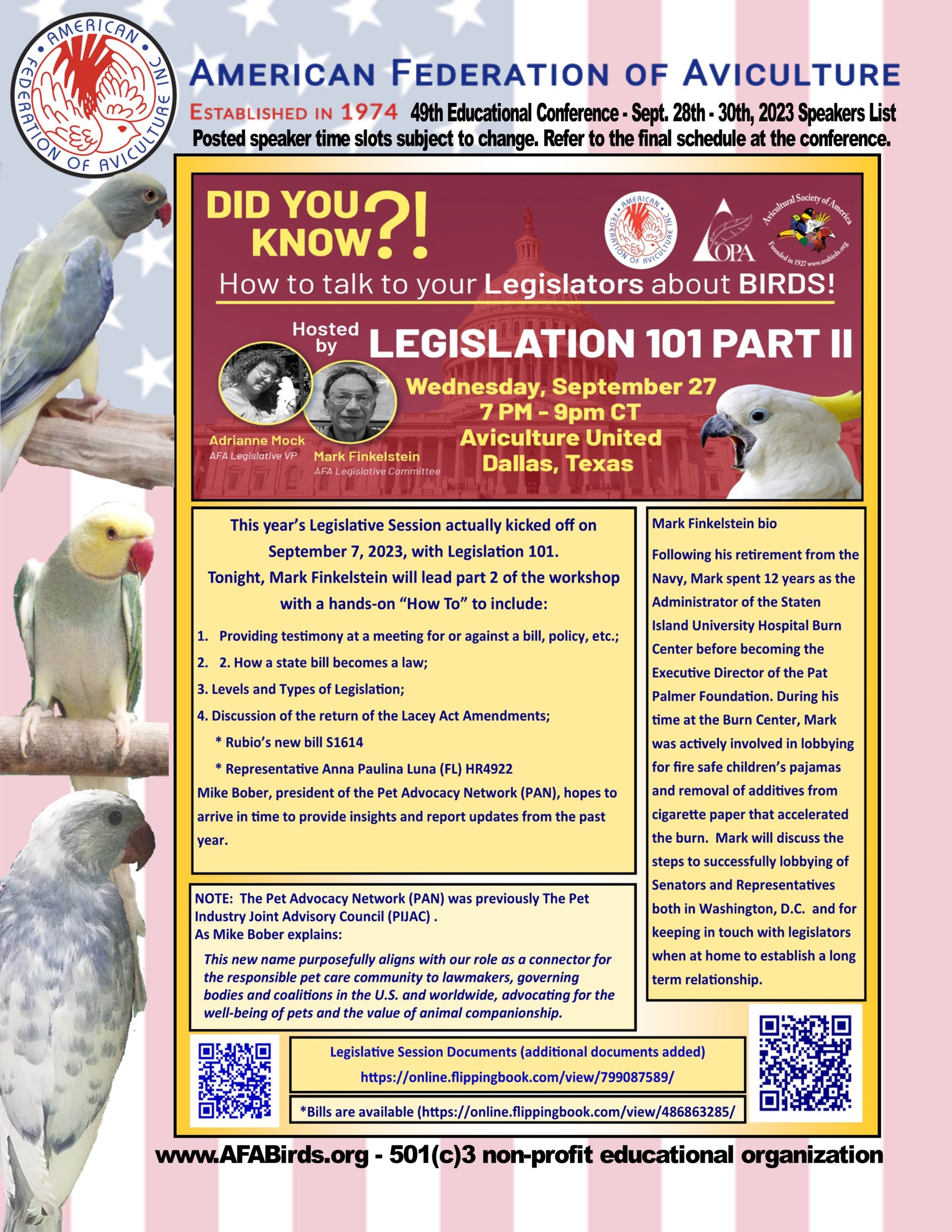
A primary example of this is the Endangered Species Act (ESA). The USFWS has the authority to add avian species to the endangered list, a move that can drastically restrict the interstate movement, sale, and breeding of those birds. Similarly, the USDA’s recent implementation of new standards for birds under the Animal Welfare Act (AWA) represents a massive shift in the regulatory environment. For decades, birds were excluded from specific AWA protections, but recent administrative changes have brought breeders and exhibitors under new federal oversight. Monitoring these regulatory shifts is often more difficult than tracking bills, as they occur within the bureaucratic layers of the executive branch rather than the high-profile environment of a legislative chamber.
Chronology of Major Avian Legislative Milestones
To understand the current urgency of legislative monitoring, one must look at the timeline of avian regulation in the United States, which has moved steadily toward increased restriction:
- 1900: The Lacey Act: Originally designed to prevent the illegal trade of wildlife, this federal law has been expanded multiple times. It now serves as a primary tool for the USFWS to regulate the importation and interstate transport of species deemed "injurious."
- 1973: The Endangered Species Act (ESA): This established the framework for protecting species at risk of extinction. For bird owners, the listing of popular species like the Hyacinth Macaw or the African Grey Parrot has created complex permit requirements for breeders.
- 1992: The Wild Bird Conservation Act (WBCA): This landmark legislation effectively halted the mass importation of wild-caught birds into the U.S. for the pet trade. While it successfully protected wild populations, it placed the entire responsibility for the survival of many species on domestic aviculture.
- 2023: USDA AWA Bird Standards: After years of litigation and public debate, the USDA finalized regulations to include birds under the Animal Welfare Act. This change requires many breeders and exhibitors to obtain federal licenses and adhere to specific facility standards.
This chronology demonstrates a clear trend: as wild populations face threats from habitat loss and climate change, the legal focus on captive populations intensifies. Each new law or regulation sets a precedent that makes subsequent, more restrictive legislation easier to pass.
Supporting Data: The Scope of Bird Ownership and Economic Impact
The necessity for monitoring is underscored by the sheer scale of the avian community. According to data from the American Veterinary Medical Association (AVMA) and the American Pet Products Association (APPA), millions of U.S. households keep birds as companions. The pet industry contributes over $100 billion annually to the U.S. economy, with birds representing a significant sector of that market, including specialized feed, cages, veterinary services, and boarding.
Despite this economic footprint, bird owners are often a "silent minority" in the eyes of legislators. Unlike the well-organized lobbies for the cattle or poultry industries, exotic bird owners are frequently fragmented. This lack of a unified voice makes it easier for restrictive bills—such as those banning "exotic" animals—to pass without adequate consideration for the highly specialized care and conservation efforts provided by private aviculturists.
Broader Impact and the Importance of Proactive Advocacy
The AFA Legislative Committee, working in tandem with other animal interest groups, monitors bills that may appear unrelated to birds at first glance. A notable example is the "circus prohibition act" or bans on the public display of animals. While the public may associate these bills with elephants or tigers, the legal definitions used in the text often include "exotic birds" or "non-domesticated species." If passed, these laws can prevent educational bird shows at schools or local fairs, cutting off a vital link between the public and avian conservation.
The phenomenon of "legislative contagion" is also a major concern. When a restrictive animal law is passed in one state, it is often used as a template for other states. Lobbying groups use successful passage as "proof of concept" to convince other representatives that such laws are popular and necessary. This creates a domino effect that can eventually lead to a nationwide patchwork of conflicting and restrictive regulations.
In conclusion, the monitoring of legislation is not merely a political exercise; it is a defensive necessity for the survival of aviculture. The verbiage used in modern bills—often promising to eliminate "inhumane treatment" or "overpopulation"—can be a Trojan horse for regulations that ultimately prohibit the keeping of pet birds entirely. By staying informed through the AFA’s legislative updates, participating in public comment periods for regulatory changes, and engaging with local representatives, bird owners can protect their rights and ensure that the bond between humans and birds remains a legal and celebrated part of society. The alternative is a slow erosion of freedoms that could see the disappearance of many avian species from the lives of future generations.

