


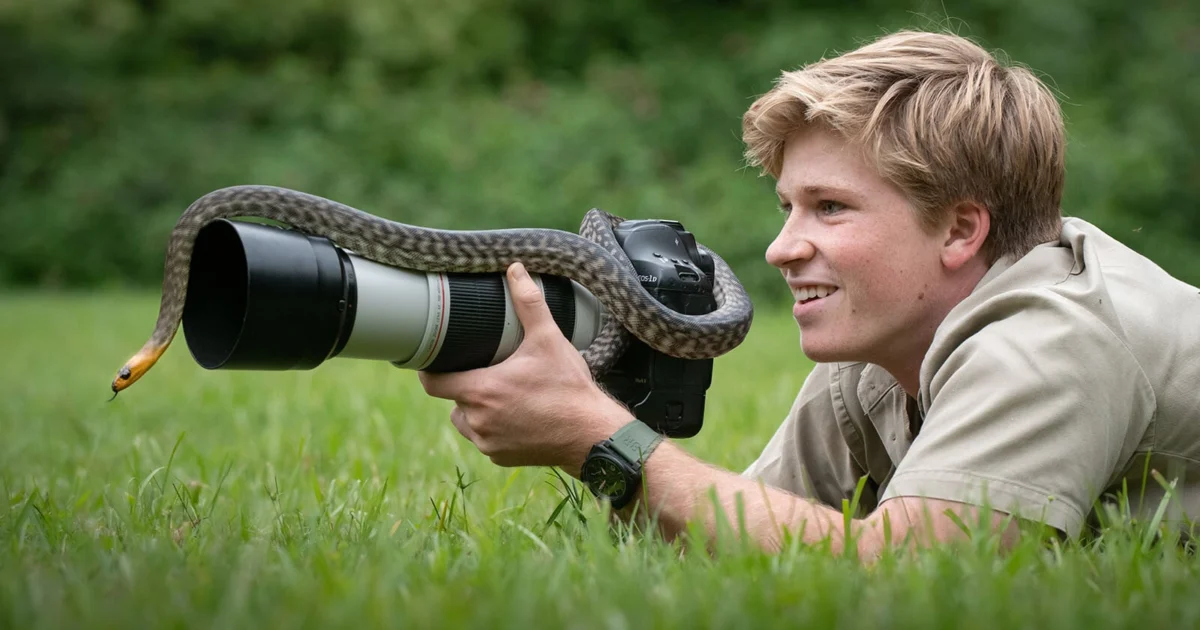
Robert Irwin, the 22-year-old conservationist, television personality, and professional wildlife photographer, has utilized his growing global platform to address the escalating influence of generative artificial intelligence (AI) on the visual arts and environmental conservation. In a comprehensive interview with Parade, Irwin detailed his lifelong commitment to the lens, his concerns regarding the ecological footprint of emerging technologies, and the necessity of maintaining "truth" in wildlife documentation. As the son of the late Steve Irwin, Robert has transitioned from a child legacy into a distinct voice in the photography world, recently adding a victory on Australia’s Dancing with the Stars to his multifaceted career. However, it is his work behind the camera that he identifies as the most formative element of his identity, serving as a primary tool for his global conservation messaging.
The Evolution of a Wildlife Photographer
For Robert Irwin, photography has never been a mere hobby; it has been an essential medium for advocacy since he first picked up a camera at the age of ten. Growing up within the grounds of the Australia Zoo, Irwin was uniquely positioned to document species that many only see in textbooks. Over the last decade, he has refined a style characterized by raw, un-meddled depictions of animal behavior, earning him accolades such as the Wildlife Photographer of the Year People’s Choice Award.
In his recent dialogue with Parade, Irwin emphasized that photography provided him with an individual identity within the vast shadow of his father’s legacy. While his television work follows the high-energy, educational format pioneered by his family, his photography offers a quieter, more contemplative look at the natural world. This "passion project," as he describes it, has become a cornerstone of his efforts to engage younger generations in environmental protection. By sharing the visceral experience of a moment captured in the wild, Irwin aims to foster a sense of stewardship for the planet’s increasingly fragile ecosystems.
The Critique of Generative Artificial Intelligence
As generative AI tools like Midjourney, DALL-E, and Sora become increasingly sophisticated, the photography industry has entered a period of profound disruption. Irwin’s stance on the matter is rooted in two primary concerns: the dilution of human achievement and the hidden environmental costs of the technology.
Irwin argues that the proliferation of AI-generated imagery threatens to desensitize the public to the genuine wonders of nature. When the digital space is flooded with hyper-realistic but entirely fabricated images—such as his example of an "eagle riding an elephant"—the threshold for what the public finds "impressive" is artificially inflated. This phenomenon, often referred to by industry experts as "aesthetic inflation," can lead to a devaluation of real-life wildlife photography, which requires immense patience, physical stamina, and technical skill.
"With AI, I think not only does it take away from the artistry of photography, but it also dilutes what is impressive," Irwin stated. He noted that when viewers can no longer distinguish between a composite generated in seconds and a photograph that took weeks of tracking in the wild, the "visceral feeling" of witnessing a true natural event is lost. For Irwin, the "amazing" quality of an image is inextricably linked to its reality.
Beyond the artistic implications, Irwin highlighted a frequently overlooked aspect of the AI boom: the environmental impact. The computational power required to train and run large-scale AI models is immense. Data centers, which house the hardware necessary for these processes, consume vast quantities of electricity and water for cooling. According to reports from the International Energy Agency (IEA), data centers currently account for approximately 1% to 1.5% of global electricity use, a figure expected to rise sharply as AI integration becomes more ubiquitous. For a conservationist whose life work is dedicated to reducing carbon footprints and preserving habitats, the irony of using high-energy AI to "recreate" nature is a significant point of contention.
The Pursuit of the Authentic Moment
Despite his extensive travels and the thousands of hours spent in the field, Irwin remains humble about his experiences, acknowledging that his "bucket list" of wildlife encounters remains extensive. This drive for authentic discovery stands in stark contrast to the instant gratification offered by AI. Irwin revealed that he has yet to photograph many of the world’s most iconic and elusive species in their natural habitats.
Among the top priorities for his future expeditions are the Galapagos Islands and the rainforests of South America, where he hopes to document sloths in the wild. He also expressed a deep-seated desire to photograph Komodo dragons in their native Indonesia and the legendary snow leopards of the Himalayas—often cited by professional photographers as the "pinnacle" of wildlife challenges due to their camouflage and the treacherous terrain they inhabit.
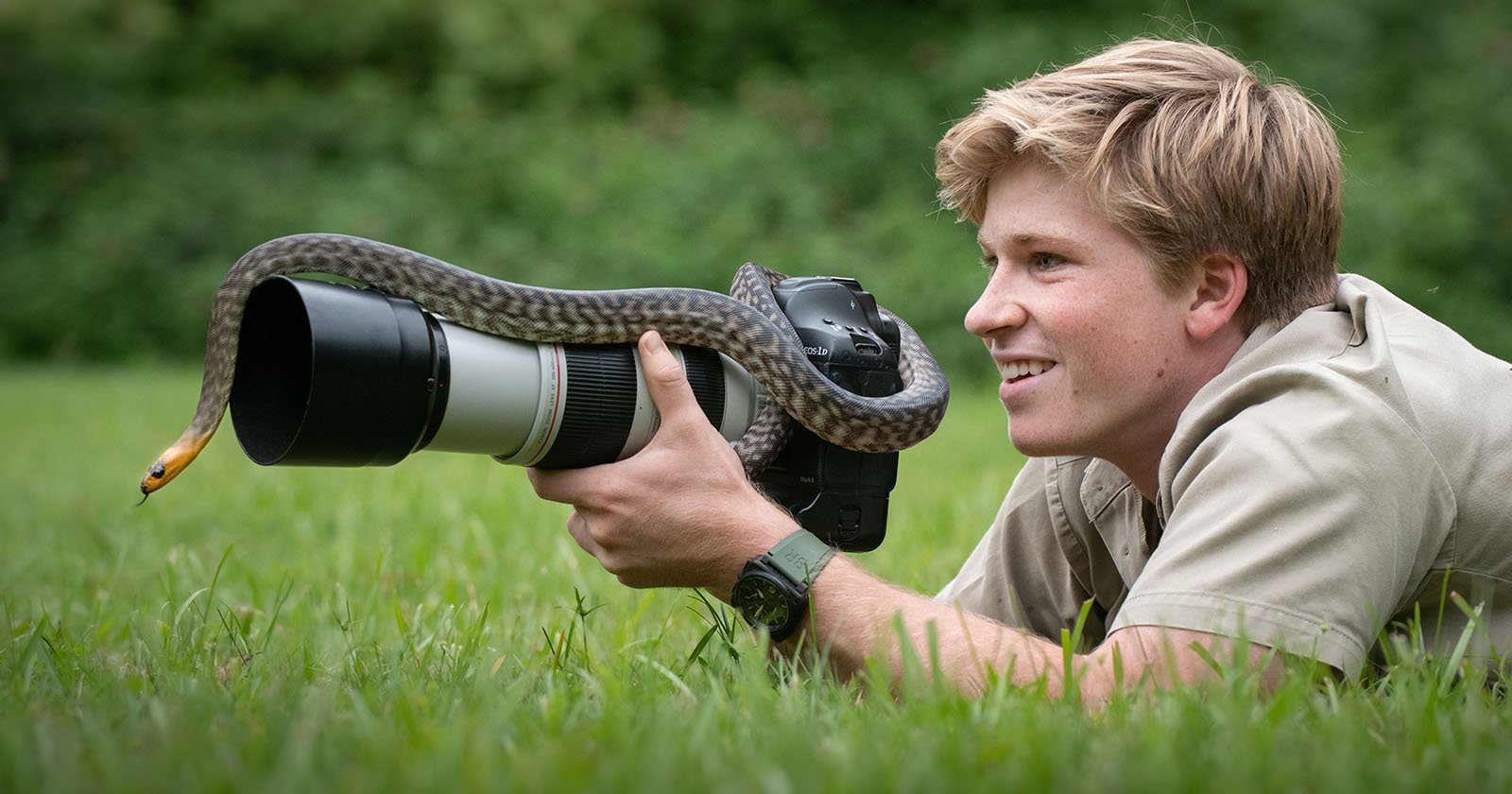
Irwin’s enthusiasm for these future projects underscores his belief that the value of photography lies in the journey and the biological truth of the subject. He recounted that the prospect of seeing a polar bear in the wild would still cause him to "squeal with excitement," a human emotion that cannot be replicated by an algorithm.
The 10th Anniversary of the Crikey! Magazine Photography Competition
To combat the rise of synthetic imagery and celebrate the power of authentic storytelling, Irwin and the Australia Zoo have launched the 10th-anniversary edition of the Crikey! Magazine Photography Competition. This global contest has become a significant platform for both amateur and professional photographers to showcase work that adheres to strict ethical standards.
A central pillar of this year’s competition is a definitive ban on AI-generated content. Irwin was unequivocal in his stance, stating, "In our competition at least, there is no room for AI, that’s for sure. It ain’t happening." The competition seeks "storytelling that shows nature as it’s intended," emphasizing a "true and raw state" where the photographer does not meddle with the environment or the subjects.
The competition is structured to be inclusive, offering categories for various age groups and skill levels. By encouraging children to pick up cameras, Irwin hopes to replicate the formative experience he had a decade ago. The submission window for the 2026 edition is currently open, with a closing date of August 31, 2026. This extended timeframe allows photographers to plan expeditions and wait for those rare, unscripted moments that define the genre.
Analysis of Implications for the Photography Industry
Irwin’s vocal opposition to AI in wildlife photography mirrors a broader debate within the journalism and arts communities. Major organizations, such as World Press Photo, have faced internal and external pressure to define the boundaries of "acceptable" digital manipulation. While some argue that AI can be a tool for creative expression, the consensus among documentary and wildlife purists is that the integrity of the image is paramount for scientific and educational purposes.
If the public loses faith in the authenticity of wildlife imagery, the consequences for conservation could be dire. Photography has historically been one of the most effective tools for raising awareness about endangered species. From the works of Ansel Adams to the modern-day expeditions of Paul Nicklen, "seeing is believing" has been the catalyst for legislative change and public donations. If a photograph of a starving polar bear or a decimated rainforest is met with skepticism regarding its "realness," the urgency of the environmental message is fundamentally undermined.
Irwin’s insistence on authenticity is therefore not merely a matter of artistic preference, but a strategic necessity for the conservation movement. By championing the "visceral feeling" that only a real image can provide, he is attempting to safeguard the emotional bridge between humanity and the natural world.
Chronology of Recent Milestones
The current focus on AI and the 10th-anniversary photo competition follows a period of intense activity for Irwin.
- 2021-2022: Irwin expands his role at Australia Zoo, taking on more significant leadership responsibilities within the "Wildlife Warriors" foundation, an organization established by his parents in 2002.
- Early 2023: Irwin sits for an interview with PetaPixel, where he first begins to publicly articulate his philosophy on the technical aspects of wildlife photography and the importance of high-end gear in capturing authentic moments.
- Late 2023: Robert Irwin competes in and wins the Australian version of Dancing with the Stars, a move that significantly broadens his demographic reach and brings his conservation message to a mainstream entertainment audience.
- Mid-2024: The partnership with Parade and the announcement of the 10th-anniversary Crikey! Magazine competition mark a return to his roots in photography and a direct confrontation with the challenges posed by generative AI.
- 2024-2026: Irwin plans to embark on a series of global expeditions to check off his wildlife "bucket list" while continuing to judge and promote the non-AI photography movement.
Conclusion
Robert Irwin’s advocacy for traditional wildlife photography serves as a reminder of the enduring value of the human perspective in an increasingly automated world. By highlighting the environmental costs of AI and the artistic "dilution" caused by synthetic imagery, he challenges both creators and consumers to reconsider the definition of an "impressive" image. Through the Crikey! Magazine Photography Competition and his ongoing conservation work, Irwin continues to champion a "true and authentic representation of nature," asserting that the most powerful stories are those that are lived and captured, rather than generated. As he looks toward the future, Irwin’s mission remains clear: to ensure that the "raw state" of the natural world is documented with the honesty it deserves, preserving the awe of the wild for generations to come.

