


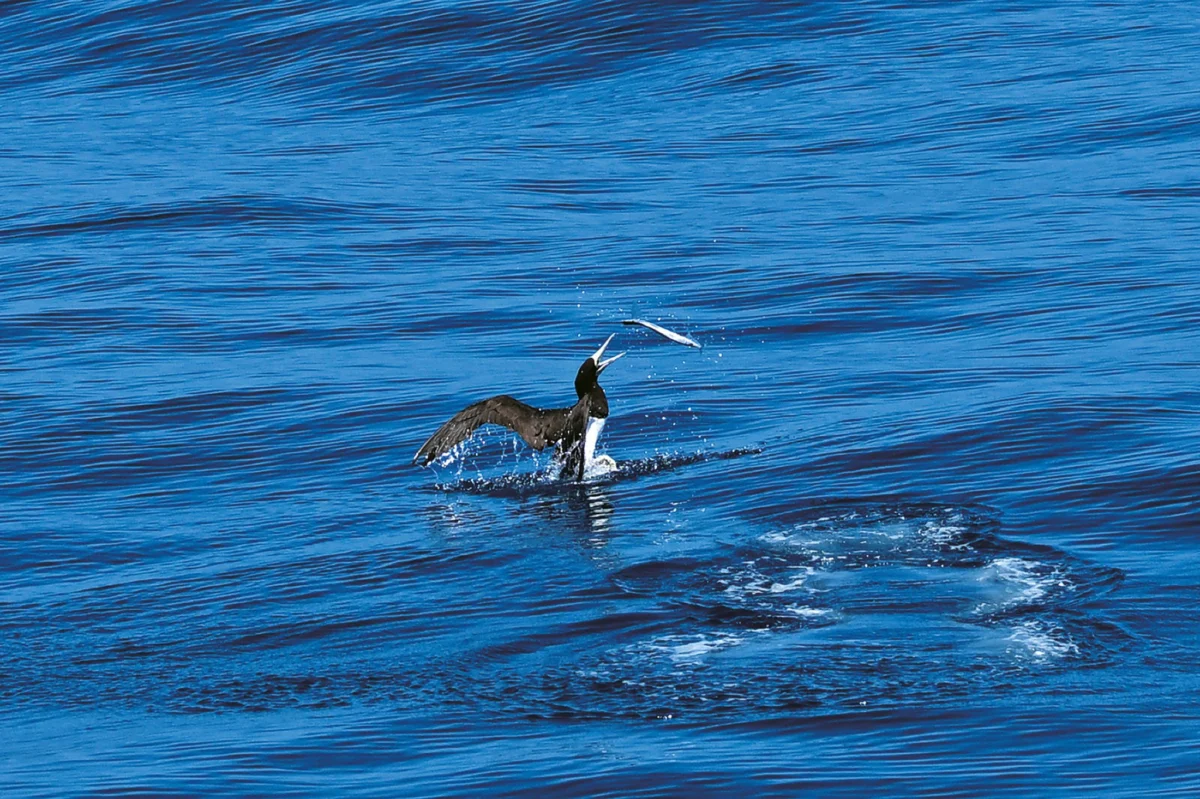
The Ogasawara Islands, a remote archipelago situated approximately 1,000 kilometers south of Tokyo, served as the focal point for an intensive ornithological study conducted in May 2026 by HIH Princess Takamado. Published in the August 2026 edition of Fujingahou Magazine, the expedition’s visual documentation highlights the behavioral ecology of the Sulidae family, specifically focusing on the hunting mechanics and survival strategies of booby species. By utilizing high-speed digital photography to analyze the rapid, often chaotic nature of marine predation, the project offers both a scientific look at avian survival and a cultural reflection on the relationship between Japanese maritime history and local wildlife.
Context and Expedition Objectives
The expedition follows a period of heightened public interest in Japan’s biodiversity, partially fueled by the environmental themes emphasized during the 2025 World Expo in Osaka. While the Expo focused on global technological and ecological advancements, the Princess’s visit to the Ogasawara Islands shifted the perspective back to the raw, unmediated realities of natural ecosystems.
The Ogasawara Islands, often referred to as the "Galapagos of the Orient," are a UNESCO World Heritage site known for their high degree of endemism. The timing of the May 2026 trip was strategic, aligning with the breeding season of several seabird species that utilize the archipelago’s cliffs and surrounding nutrient-rich currents. The project, edited by Koichi Fujiwara of NATURE’S PLANET and Yuki Masuda of Fujingahou, aimed to document the specific hunting adaptations of the Brown Booby (Sula leucogaster) and the Red-footed Booby (Sula sula).
Chronology of the Expedition
The field study was structured around a multi-day observation window in mid-May 2026. The documentation process involved:

- Initial Observation (May 12-14): Establishing baseline activity patterns for the Brown Booby colonies residing near the coastal cliffs.
- Behavioral Data Collection (May 15-18): Utilizing high-speed burst photography to capture the "plunge-diving" technique. The team focused on the interaction between seabirds and sub-surface schooling fish, a behavior historically linked to the presence of larger predatory fish like bonito.
- Synthesis and Editing (June-July 2026): Reviewing over 100 high-speed frames to isolate sequences of competitive feeding and failed versus successful predation events.
- Publication (August 2026): Dissemination of the findings through Fujingahou, with technical support provided by BirdLife International to ensure taxonomic accuracy.
The Biology of the Plunge: Technical Analysis
The research highlights the sophisticated physiological adaptations of the Sulidae family. A booby’s ability to transition from an aerial predator to an underwater hunter is a feat of evolutionary engineering. When a booby spots prey, it enters a near-vertical dive at speeds reaching 100 km/h. To survive this impact, the bird undergoes a rapid anatomical transformation: wings are folded against the fuselage to reduce drag and prevent injury, while the neck and head are positioned to form a hydrodynamic cone.
Crucially, the booby possesses specialized subcutaneous air sacs—effectively a natural airbag system—that dissipate the kinetic energy of hitting the water. Furthermore, the skull is remarkably thick, acting as a structural helmet. Despite these adaptations, the research notes that environmental variables, such as wind speed and the agility of the prey (e.g., needlefish), often result in failed hunts. The documentation provided by the Princess captures these moments of failure, illustrating that even highly specialized predators face high rates of nutritional insecurity.
Socio-Cultural Significance: The "Katsuo-dori" Legacy
In Japanese maritime culture, the Brown Booby is referred to as Katsuo-dori, or the "Bonito Bird." This nomenclature is not merely poetic; it is a reflection of traditional ecological knowledge. For centuries, Japanese fishermen have used the presence of these birds as a biological indicator for the location of skipjack tuna (bonito) schools.
The research underscores that while the birds do not hunt the tuna themselves, they rely on the tuna’s practice of driving smaller baitfish to the surface. This symbiotic relationship—where the birds act as an apex observer for human fishers—is a cornerstone of coastal tradition in the Izu and Ogasawara island chains. The study serves to bridge the gap between historical cultural observations and modern scientific understanding, providing a reminder of how human economic activity has historically been intertwined with avian migration patterns.
Environmental Implications and Biodiversity
The findings emphasize the scarcity of resources in the open ocean. While viral video footage often creates the illusion of constant, abundant feeding frenzies, the reality—as observed during this expedition—is one of prolonged searching and frequent failure. This has significant implications for conservation efforts. As climate change shifts ocean currents and alters the migration patterns of baitfish, the delicate balance required for the survival of the booby becomes increasingly fragile.

BirdLife International, which assisted in the preparation of the English-language reference materials for this study, has noted that sites like the Torishima Island Marine area are critical for the long-term viability of these populations. The loss of stable fishing grounds due to warming sea temperatures or overfishing could lead to a catastrophic decline in local seabird colonies. The report suggests that continued monitoring of these "indicators" (the boobies) is essential for broader marine conservation strategies in the Pacific.
Official Responses and Future Research
While the expedition was presented as a personal photographic reflection, the meticulous nature of the documentation has garnered interest from the marine biology community. Experts in the field of ornithology suggest that the use of high-speed photography to map the "flipbook" mechanics of avian diving could provide new data for biomechanical studies.
"The documentation provided by Princess Takamado is not merely a collection of images; it is a longitudinal snapshot of survival in an environment that is becoming increasingly unpredictable," noted a representative from an environmental monitoring group. The collaboration between the Imperial household, media outlets, and international conservation organizations like BirdLife International marks a collaborative effort to bring scientific awareness to the general public.
Conclusion: The Harsh Reality of the Wild
The final analysis drawn from the expedition is a sobering look at the "harsh life in the wild." By capturing the struggle of a single bird to retain its catch against competitors, the project strips away the romanticism often associated with nature photography. It highlights the individual agency and physical cost of survival. As the Ogasawara Islands continue to face pressures from environmental change, the legacy of this expedition remains a vital record of the current state of Pacific seabird populations. The photographs serve as both a historical archive and a call to action for the preservation of the vast, boundless seas that these birds call home. Through this lens, the public is invited to see the ocean not just as a resource, but as a complex, struggling ecosystem that requires careful stewardship and ongoing scientific inquiry.

