


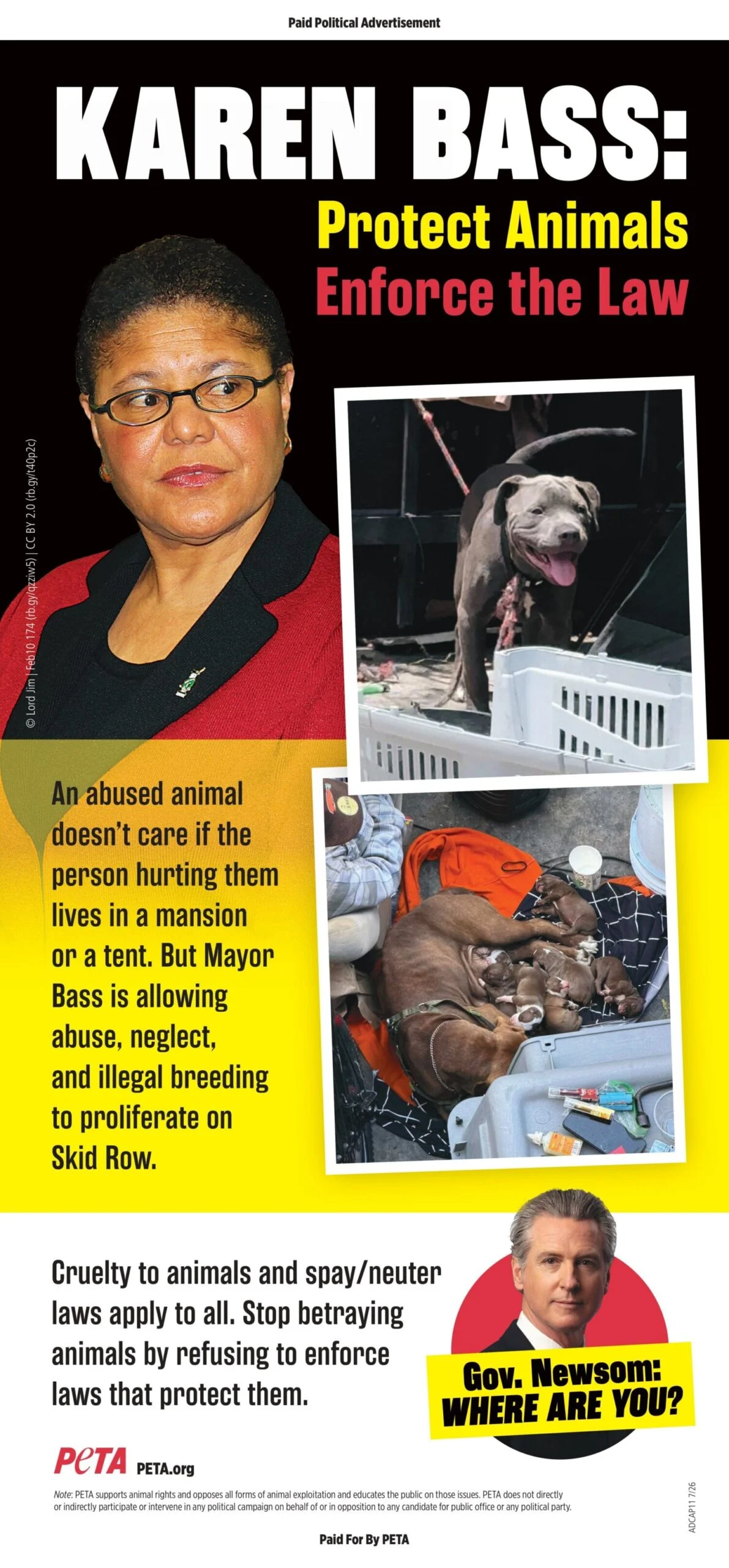
The ongoing animal welfare crisis within Los Angeles’s Skid Row district has intensified following the release of new public records by People for the Ethical Treatment of Animals (PETA). The documents, unveiled during a press conference in September 2026, directly challenge claims made by Los Angeles Mayor Karen Bass regarding municipal crackdowns on illegal breeding, severe neglect, and animal abuse in the 50-block downtown area.
While the Mayor’s administration has publicly maintained that law enforcement and animal services agencies are actively suppressing illegal animal operations in the encampments, Freedom of Information and public records requests tell a starkly different story. According to the obtained documents, police and animal control interventions in Skid Row have been largely restricted to basic supply distributions and food handouts, with virtually no documented enforcement of existing animal protection laws, mandatory spay-neuter mandates, or emergency breeding moratoriums.
The findings have sparked renewed outrage among animal advocacy groups, local rescue organizations, and concerned citizens, who argue that vulnerable animals are enduring unimaginable cruelty in plain sight while city leaders deliberately look the other way.
Background Context of the Skid Row Animal Crisis
Skid Row, historically recognized as the epicenter of homelessness and housing insecurity in downtown Los Angeles, has increasingly become a dumping ground and unregulated marketplace for companion animals. Thousands of unhoused individuals reside in the densely packed tent cities and temporary encampments that span roughly 50 blocks. Within these confines, an invisible sub-crisis of severe animal neglect and commercial exploitation has flourished largely unchecked.
Under current municipal codes in Los Angeles, the legal framework governing companion animals is explicit. The city mandates that all dogs must be spayed or neutered. Furthermore, a citywide breeding moratorium—triggered automatically whenever municipal animal shelters exceed 75% capacity—has remained in continuous effect since its passage in 2024. Los Angeles Animal Services facilities have routinely operated above capacity, meaning that virtually all intentional breeding of dogs within city limits is illegal.
Despite these statutes, activist groups such as Starts With One Today (SWOT) and PETA have documented widespread violations. Investigators and volunteers operating in the district have cataloged numerous instances of backyard breeding operations, including severe inbreeding, animals tethered on excessively short chains for their entire lives, and complete denials of basic veterinary care. In several prominent cases, female dogs suffering from untreated medical conditions—such as ongoing internal hemorrhaging and infections—have continued to be exploited for continuous litter production by owners residing within the encampments.
Chronology of Events and Activism
The public confrontation between animal rights organizations and the administration of Mayor Karen Bass has evolved through several distinct phases over the past several months:
June 2026: The crisis gained prominent public attention when PETA released a high-profile investigative video featuring actors Jesse Kove and David Chokachi alongside internet personality Nathan the Cat Lady. The group ventured directly into Skid Row alongside SWOT founders Jonathan and Victoriah Bech Parker and volunteer Joey Tuccio. The resulting footage documented horrific conditions, including a female Yorkshire Terrier reportedly being bred with her own offspring, caged pugs living in unsanitary conditions, and a mother dog passing blood for months without medical intervention. Activists asserted on the ground that municipal officers claimed they had been instructed by leadership to refrain from applying animal protection laws to unhoused populations.
July 2026: Frustrated by months of administrative silence and a perceived lack of tangible action from city officials, PETA escalated the pressure by purchasing a full-page call-to-action advertisement in the Los Angeles Times. The prominent spread explicitly targeted both Mayor Karen Bass and California Governor Gavin Newsom, demanding immediate enforcement of existing animal protection statutes and an end to administrative exemptions for specific demographics.

September 2026: PETA held a press conference to release the findings of its extensive public records requests targeting the Los Angeles Police Department (LAPD) and Los Angeles Animal Services (LAAS). The documents revealed that despite earlier administrative promises of a dedicated task force and rigorous enforcement, the actual operational footprint in Skid Row consisted almost exclusively of humanitarian supply runs rather than active policing of animal welfare violations.
Supporting Data and Regulatory Frameworks
The disparity between municipal policy enforcement and the reality on the ground highlights deep systemic vulnerabilities within the Los Angeles animal control apparatus. LAAS has faced perennial budgetary constraints, staffing shortages, and operational bottlenecks that severely limit its field response capabilities.
When emergency calls regarding animal abuse or illegal breeding in transient encampments are logged, enforcement officers frequently encounter complex socio-legal hurdles. However, animal rights attorneys and advocacy leaders argue that administrative directives instructing officers to stand down regarding unhoused animal owners effectively create a two-tiered legal system. Under this dynamic, municipal ordinances against animal cruelty and illegal breeding are strictly enforced in residential neighborhoods while remaining entirely suspended in transient zones like Skid Row.
The systemic failure carries profound public health and ethical implications. Unregulated breeding in environments lacking proper sanitation, temperature control, and veterinary oversight contributes directly to the overpopulation crisis plaguing Los Angeles shelters. Puppies born in these conditions frequently suffer from congenital deformities, parvo-virus, malnutrition, and trauma—such as the recent high-profile case of a newly whelped pug that was struck and killed by a vehicle due to unsecured tethering.
Official Responses and Administrative Silence
Thus far, the office of Mayor Karen Bass has faced mounting criticism for its handling of the crisis. While the administration originally announced the formation of specialized task forces aimed at addressing multifaceted issues within Skid Row, municipal representatives have offered limited specific commentary regarding the precise allegations that enforcement personnel were ordered not to cite animal law violators within homeless encampments.
Similarly, pressure has begun to mount on Governor Gavin Newsom’s administration, with advocacy groups questioning whether state intervention will become necessary if municipal leadership continues to exhibit what activists describe as dereliction of statutory duty. Critics argue that humanitarian aid for unhoused human residents and the enforcement of anti-cruelty laws protecting animals are not mutually exclusive goals, but rather complementary necessities for maintaining public safety, public health, and humane standards within dense urban centers.
Broader Impact and Policy Implications
The ongoing standoff in Skid Row serves as a micro-cosmic reflection of broader societal challenges facing major metropolitan areas: balancing compassionate outreach to vulnerable human populations with the strict enforcement of public safety and animal protection laws.
Legal experts point out that exemptions from animal cruelty laws based on the housing status of the perpetrator undermine the foundational intent of the legislation, which is designed to protect sentient creatures from unnecessary pain and suffering regardless of where their owners reside. Furthermore, unchecked breeding operations in transient zones exacerbate the strain on municipal shelter systems, which are already struggling to manage record intake numbers and high euthanasia risk rates across Southern California.
As PETA and local rescue partners continue their public awareness campaigns and legal oversight, the pressure on City Hall shows no signs of abating. The core question facing municipal leaders remains whether the city will bridge the gap between public relations claims and frontline enforcement, ensuring that animal protection laws are applied universally across every neighborhood of Los Angeles, including Skid Row.

