


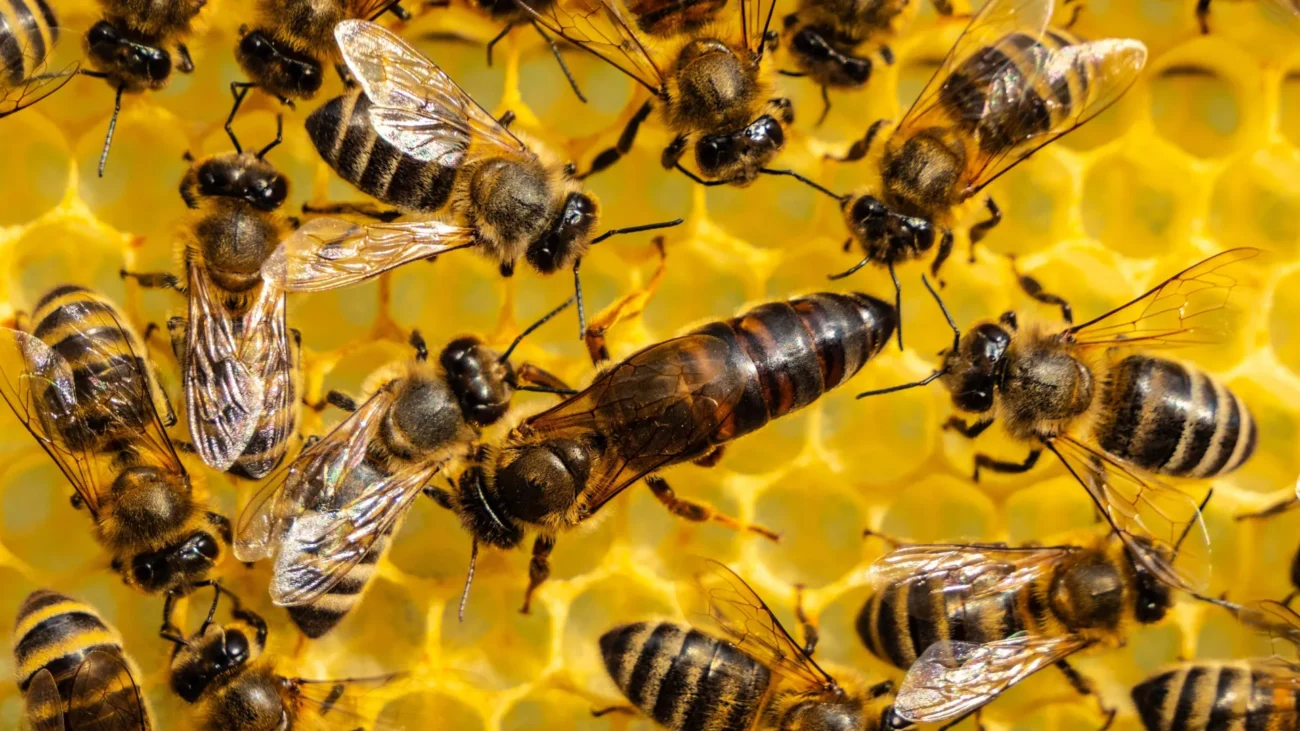
For decades, entomologists and beekeepers have understood that the survival of a honeybee colony relies heavily on a sophisticated division of labor. While foragers travel miles to gather nectar and pollen, worker bees stationed inside the hive act as chemical sentinels, filtering out harmful toxins and preventing environmental pollutants from reaching the heart of the colony. Yet, a groundbreaking study has revealed a previously unknown and alarming biological mechanism operating at the highest level of the hive: when these frontline defenses fail, honeybee queens resort to a drastic internal survival strategy known as maternal offloading, systematically transferring accumulated pesticides directly into their own eggs.
Published in the journal Current Biology, the research was spearheaded by a multidisciplinary team from the University of California, Davis, in collaboration with the Lawrence Livermore National Laboratory (LLNL) and the U.S. Department of Agriculture’s Agricultural Research Service (USDA-ARS). The findings offer the first empirical evidence of how honeybee queens manage severe chemical burdens, illuminating a hidden biological trade-off that may contribute to the enigmatic phenomenon of delayed colony collapse disorder.
The Limits of Worker Bee Protection
In a healthy, functioning honeybee colony, the worker caste assumes the vast majority of environmental risks. When foragers return from agricultural fields laden with nectar and pollen that may carry synthetic pesticide residues, internal worker bees intercept the harvest. Traditionally, scientists believed this biological filtration system was nearly impenetrable, shielding the developing larvae and, most importantly, the egg-laying monarch of the hive from chemical contamination.
However, the UC Davis study demonstrates that this protective barrier has a definitive breaking point. As chronic exposure to agricultural chemicals persists over time, the filtering capacity of the worker bees becomes progressively overwhelmed.
"In our study, pesticides began to accumulate in queens over time, suggesting that worker filtration capacity can be overwhelmed," explained Angela Encerrado-Manriquez, the paper’s lead author and a recent Ph.D. graduate from UC Davis. "When this happens, queens have their own defense. Maternal offloading allows them to shunt the toxic burden to their eggs."
This process of maternal offloading functions as a physiological emergency valve. By sequestering fat-soluble and circulating toxins into the reproductive tissue and subsequently into the yolk of the eggs, the queen effectively cleanses her own vital organs. While this self-preservation mechanism keeps the adult queen alive and capable of maintaining her daily reproductive output, it places the toxic burden directly onto the next generation of the hive, threatening the viability of developing embryos and larvae.
Inside the Laboratory: Replicating the Hive Ecosystem
To investigate the complex dynamics of chemical accumulation within a hive, researchers had to design an experimental environment that accurately mirrored natural conditions without exposing large apiaries to uncontrolled risks. The team constructed specialized "nanocolonies"—contained experimental modules consisting of a small conical plastic container featuring a netted bottom, housing precisely one queen and 60 worker bees.
To trace the movement of toxins through the social structure of the hive, the nanocolonies were fed a controlled diet of pollen, water, and sugar syrup deliberately contaminated with methyl parathion, an organophosphate pesticide widely used in global agriculture. Crucially, the researchers utilized a low-level radioactive marker attached to the pesticide molecules, enabling them to track the exact pathway of the chemicals with unprecedented precision.
The experiment relied on advanced technology housed at the Lawrence Livermore National Laboratory. Scientists utilized accelerator mass spectrometry, specifically biological accelerator spectrometry (BioAMS), which allows for the detection and tracing of radioactive isotopes at minute, environmentally relevant concentrations.
"With BioAMS, we can trace very low levels of a pesticide," noted Bruce Buchholz, an LLNL scientist and co-author of the study. "The pesticide concentrations we used were not lethal and were environmentally relevant to that seen in nature, giving us an accurate picture of how these substances behave in living tissue over extended periods."
A Chronological Shift in Hive Defense
The timeline of the experiment revealed a gradual erosion of the hive’s defensive capabilities. On the very first day of exposure, the worker bees demonstrated remarkable efficiency, successfully filtering out approximately 95% of the methyl parathion introduced into the colony and isolating the chemical within the honeycomb matrix away from the queen.
However, as the days progressed and the chemical load within the experimental nanocolonies increased, the efficacy of the worker bees noticeably declined. By the tenth day of continuous exposure, the filtration rate had dropped to 86%. This incremental failure allowed residual pesticides to bypass the worker barrier, enter the hemolymph of the queen, and begin the insidious process of internal accumulation.
Senior author Sascha Nicklisch, an associate professor in the Department of Environmental Toxicology at UC Davis, emphasized the cumulative nature of this threat. "When pesticides accumulate to the extent that the queen bee has eggs that are so loaded they may no longer develop properly, there could be a tipping point," Nicklisch warned. "There may be a slow creeping effect of chemical accumulation that will contribute to delayed colony collapse."
Broader Implications for Agriculture and Food Security
The implications of these findings extend far beyond academic toxicology, raising urgent questions for commercial beekeepers, agricultural growers, and policymakers involved in integrated pest management (IPM). Honeybees are an indispensable cornerstone of global agriculture, responsible for pollinating roughly one-third of all food crops consumed by humans, including vital fruits, vegetables, and nuts.
A single honeybee queen is the biological engine of the entire enterprise, capable of producing between 1,500 and 2,500 eggs per day to sustain the workforce required for colony survival and foraging operations. If chronic exposure to sub-lethal doses of pesticides forces queens to systematically poison their own progeny via maternal offloading, the reproductive output of colonies could experience a precipitous, hidden decline.
Unlike acute pesticide poisonings, which result in massive, easily observable die-offs at the hive entrance, maternal offloading represents a chronic, sub-lethal stressor. Colonies may appear outwardly healthy while quietly experiencing reproductive failure, reduced worker emergence, and eventual population collapse weeks or months after peak agricultural spraying seasons have concluded.
Future Research and Unanswered Questions
As the scientific community digests these findings, researchers are already turning their attention to the numerous unknowns that remain. Key questions for future study include determining the exact duration over which a queen can continue offloading contaminants before suffering permanent physiological damage, evaluating whether different classes of synthetic pesticides trigger identical offloading responses, and assessing the long-term survivability of larvae hatched from chemically loaded eggs.
The research team also featured contributions from Julia Fine and Eliza Litsey of the USDA-ARS, alongside David Baliu-Rodriguez, Sean Leonard, and Bruce Buchholz from LLNL. Financial support for the project was provided by the USDA’s National Institute of Food and Agriculture, the Non-Assistance Cooperative Agreement program, the PAm-Costco USA Scholarship program, and the University of California National Laboratory Fees Research Program, with work at LLNL performed under the auspices of the U.S. Department of Energy.
Ultimately, the discovery of maternal offloading in honeybee queens reframes our understanding of chemical exposure in social insects. It highlights the desperate physiological measures required to sustain life in an increasingly chemical-laden environment, serving as a stark reminder of the hidden costs paid by the world’s most vital pollinators.

