


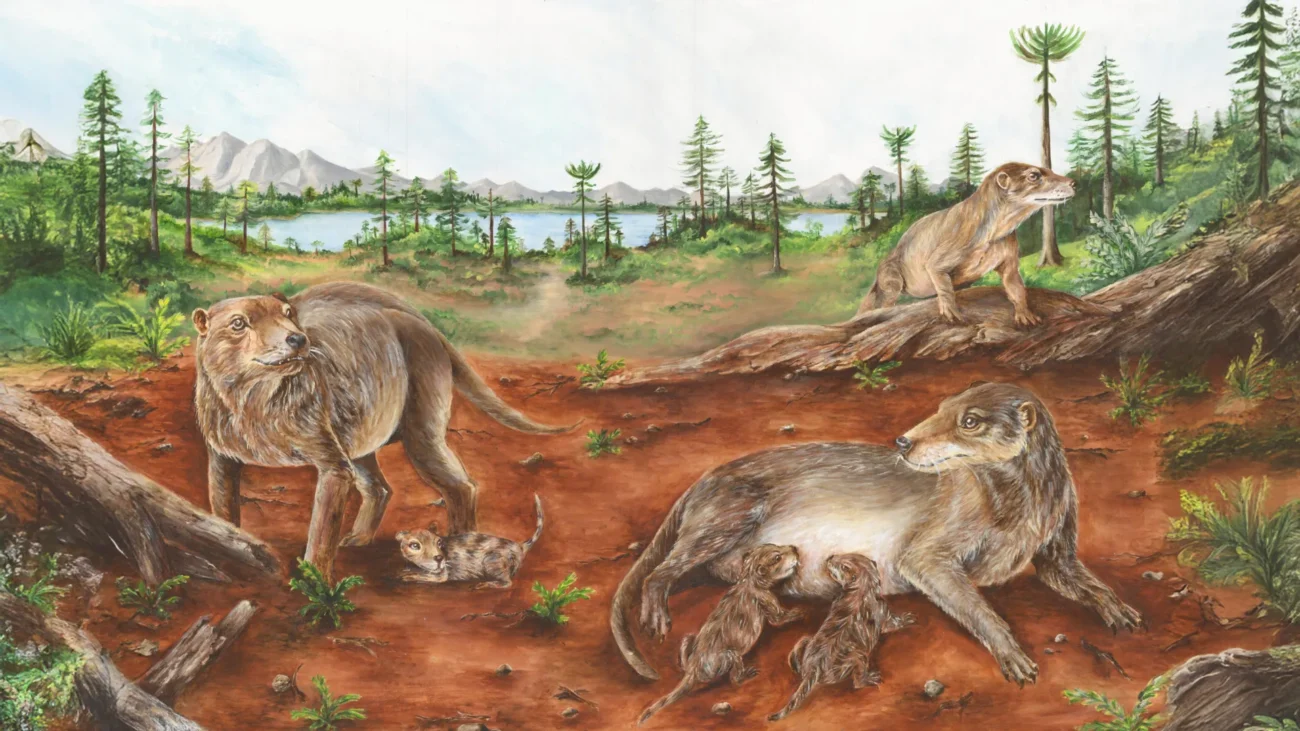
Paleontologists have uncovered compelling new evidence suggesting that certain ancient precursors to mammals may have abandoned egg-laying in favor of live birth far earlier in evolutionary history than previously established. Published in the journal Frontiers in Mammal Science, a recent study details the groundbreaking discovery of a neonatal growth line preserved within the fossilized remains of Chiniquodon theotonicus, a cynodont that roamed the Earth approximately 236 million years ago. This revelation pushes back the timeline for the emergence of viviparity—the trait of giving birth to live young rather than laying eggs—within the mammalian lineage by roughly 90 to 95 million years, prompting scientists to fundamentally reevaluate the physiological evolution of early warm-blooded creatures.
The research team, spearheaded by paleontologists from the National Scientific and Technical Research Council (CONICET) in Argentina, utilized innovative microscopic bone analysis and comparative biometry to reach their conclusions. By measuring the proportions of a fully grown C. theotonicus specimen unearthed in northwestern Argentina, the scientists deduced that these ancient animals exhibited a birth and growth strategy remarkably akin to that of modern placental mammals, challenging long-held assumptions regarding the reproductive biology of pre-mammalian therapsids.
A Longstanding Mystery in Paleontological Research
For decades, the exact reproductive strategies of early mammal ancestors have remained one of paleontology’s most stubborn enigmas. Because soft tissues, embryos, and reproductive organs rarely fossilize, researchers have long relied on indirect anatomical clues to determine whether creatures like cynodonts laid leathery or hard-shelled eggs or nurtured their developing young internally.
Cynodonts—a diverse group of therapsids that includes the direct ancestors of all modern mammals—flourished during the Triassic period. This geological epoch was characterized by intense environmental volatility, following on the heels of the Permian-Triassic extinction event, which wiped out an estimated 96% of marine species and 70% of terrestrial vertebrate species. The surviving ecosystems were defined by fierce competition for scarce resources, relentless predatory pressures, and a global trend toward hyper-aridity and extreme seasonal fluctuations.
According to senior study author Adriana Mancuso, a CONICET researcher specializing in terrestrial ecosystem evolution, these harsh environmental conditions may have served as the primary evolutionary catalyst for the development of live birth. In an ecosystem fraught with danger and climatic unpredictability, retaining embryos internally provided a crucial protective advantage. Unlike vulnerable eggs left exposed in nests to the elements and predators, internal gestation allowed mothers to shield their developing offspring through the most critical phases of embryogenesis, regulating their temperature and ensuring a safer transition into the world.
Unlocking the Fossil Record Through Microscopic Analysis
The breakthrough investigation began serendipitously during a postgraduate academic course. Researchers examining the microscopic internal structure of a fully grown C. theotonicus fossil noticed an unusual, distinct growth mark embedded deep within the bone matrix. Through careful comparison with the histological markers of living vertebrates, the team identified the feature as a definitive neonatal line.
In modern animals, neonatal lines form as distinct histological rings in bones or teeth in direct response to the physiological shock and sharp acceleration of growth that occurs immediately following birth. To test whether this hypothesis held true for an extinct organism, the research team devised a novel comparative framework. They reconstructed the approximate body mass of the C. theotonicus specimen at the exact moment of birth—utilizing the dimensions indicated by the neonatal line—and contrasted it with the animal’s final body mass at the time of its death.
The researchers then cross-referenced these calculated mass values against an expansive dataset encompassing thousands of extant mammals, non-avian reptiles, and birds. Lead author Dr. Leandro Gaetano noted that while determining the reproductive mode of fossilized organisms has historically been viewed as an inscrutable challenge, this ingenious methodological approach allowed the team to bypass the limitations of traditional paleontology and probe the deep-time record of vertebrate ontogeny.
Astonishing Scale: An Unusually Large Newborn
The quantitative results of the study upended conventional expectations regarding pre-mammalian physiology. Calculations derived from the fossilized skeletal measurements revealed that the C. theotonicus individual weighed approximately 1.7 kilograms at birth. By the time the animal reached adulthood and met its end, its body mass had expanded to roughly 12 kilograms.
This translates to a neonate-to-adult body mass ratio of approximately 14%. In practical terms, a newborn C. theotonicus constituted nearly a seventh of its eventual fully grown mass—a massive investment of maternal resources that sharply contrasts with the reproductive strategies observed in modern reptiles and birds.
For comparison, extant reptiles of a similar adult weight scale—such as large snakes, turtles, and crocodilians weighing between 8 and 14.5 kilograms—produce remarkably small hatchlings. Their neonates typically weigh anywhere from 9 to 53 grams, yielding extremely low neonate-adult body mass ratios ranging from 0.1% to 0.6%. Avian species exhibit a similarly conservative reproductive output; large birds such as cranes, pelicans, and vultures with adult masses between 8 and 21.5 kilograms produce hatchlings weighing between 110 and 357 grams, resulting in mass ratios of roughly 1.3% to 4.5%.
In stark contrast, modern mammals within the 8 to 15 kilogram weight bracket routinely give birth to significantly heavier, more developed young. Their neonate-adult ratios can scale as high as 18.77%, with birth weights ranging from 35.5 grams up to 1.87 kilograms. As a prominent biological parallel, the bay duiker antelope produces offspring that closely mirror the estimated birth weight of the ancient C. theotonicus. When the researchers filtered out non-placental mammals—such as monotremes, which lay eggs, and marsupials, which give birth to underdeveloped young that mature in pouches—the statistical clustering became unmistakable.
"We were amazed to find that C. theotonicus grouped with extant placental mammals, being clearly distinct from other amniotes like reptiles or birds," Dr. Gaetano observed.
Implications for the Evolution of Mammalian Physiology
The identification of embryonic growth milestones in a 236-million-year-old cynodont opens a new chapter in evolutionary biology. Historically, live birth has been categorized as a relatively late physiological adaptation within the mammalian lineage, closely tied to the emergence of true mammals during the Mesozoic era. However, the presence of a neonatal line in C. theotonicus demonstrates that complex maternal-fetal adaptations were already developing hundreds of millions of years ago.
Co-author María Miceli Baro, a graduate student at the University of Buenos Aires, emphasized the rarity of the find. "In cynodonts, embryonic tissues were never observed before, let alone a neonatal line," she noted. "Through its analysis, we found that a trait that is generally linked to evolutionary success was present in animals long before true mammals originated."
This paradigm shift raises profound questions about what other physiological traits commonly associated with modern mammals—such as lactation, specialized endothermy, and complex social behaviors—might have roots stretching far deeper into the Triassic period than previously acknowledged.
Broader Scientific Impact and Future Research Directions
While C. theotonicus provides the first robust, data-backed anchor for early cynodont viviparity, scientists emphasize the necessity for caution and continued empirical testing. The research team stresses that while this specific fossil provides undeniable evidence of live birth in one species, further investigation is required to determine whether viviparity was an isolated evolutionary experiment or a widespread physiological standard across the broader cynodont clade.
"It is very well possible that C. theotonicus does not represent an isolated case of viviparity among cynodonts," Dr. Gaetano concluded. "It could be evidence of the general switch from laying eggs to giving birth to live young early on in the mammalian lineage. But we need more evidence to test this hypothesis. Still, it looks like some cynodonts were in fact very similar to present-day mammals."
As paleontologists apply these advanced histological and biometric techniques to other therapsid specimens housed in museum collections worldwide, the hidden reproductive histories of Earth’s ancient ecosystems are slowly coming to light. The discovery not only rewrites the evolutionary timeline of mammalian reproduction but also underscores the remarkable resilience and adaptability of life in the face of ancient planetary upheaval.

