


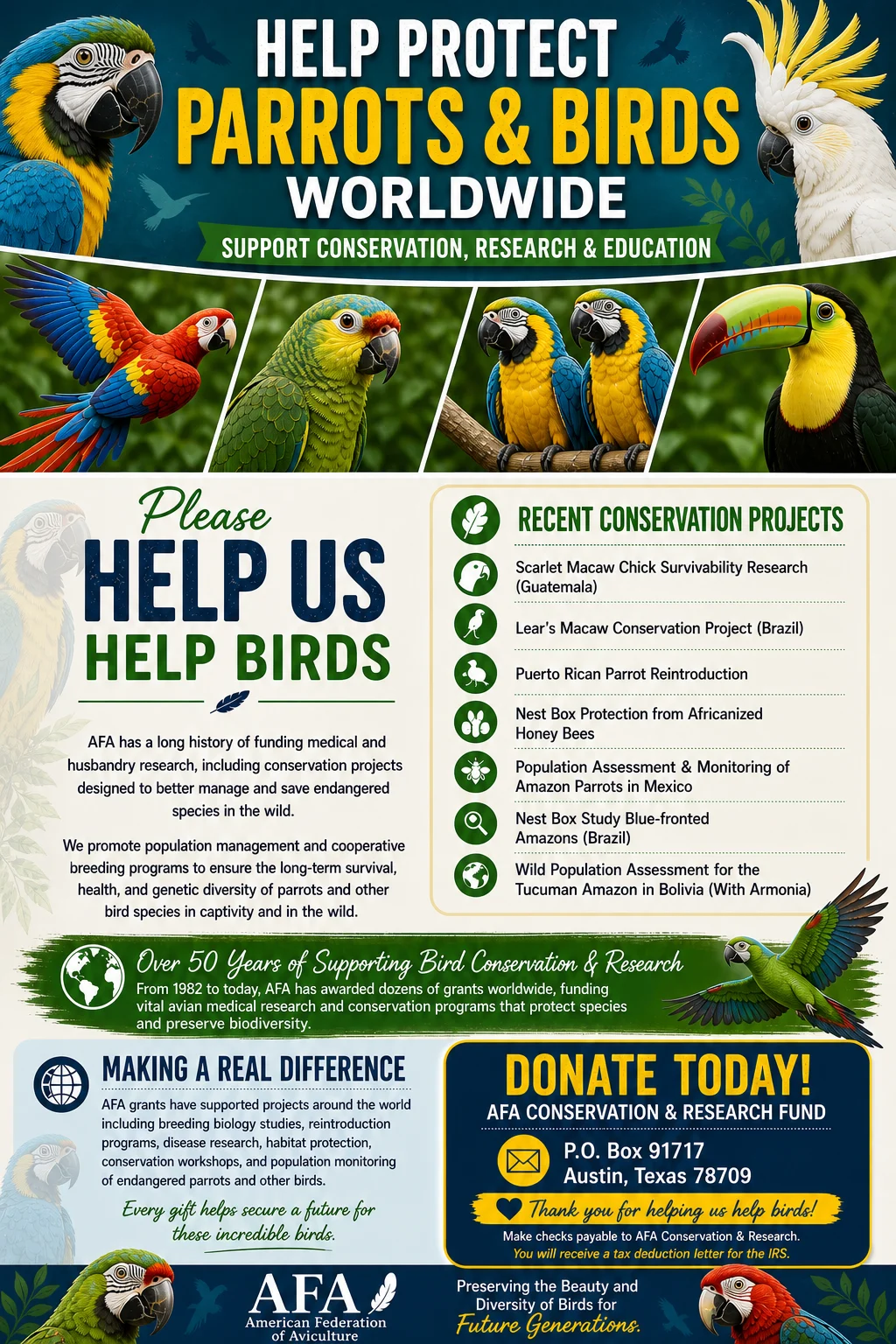
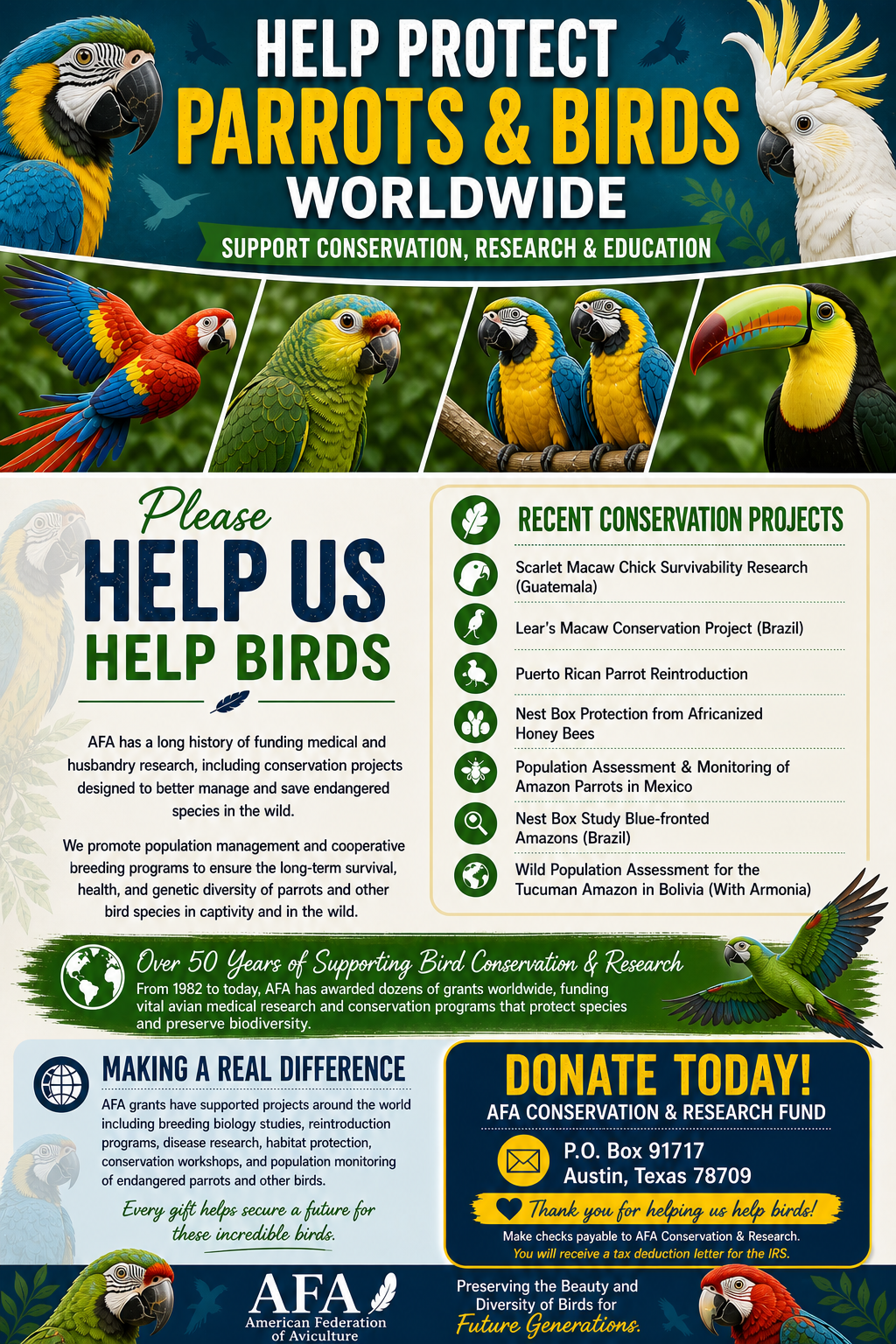
The American Federation of Aviculture (AFA), a premier non-profit educational organization dedicated to the advancement of aviculture and the protection of exotic bird populations, has announced a series of major conservation initiatives, project grants, and regulatory updates for the 2024–2025 operational cycle. Central to these new developments is a substantial $25,000 financial contribution from Harrison’s Bird Foods, bolstering the AFA’s ongoing efforts to fund field research, habitat preservation, and captive breeding management programs globally.
Founded in March 1974 in response to severe regulatory crises during the Exotic Newcastle Disease outbreak in California, the AFA has evolved into an international umbrella organization representing thousands of aviculturists, scientists, and bird clubs. Over the past five decades, the organization has consistently aligned its mission with the preservation of self-sustaining avian populations both in captivity and within their native ecosystems. The latest partnership with Harrison’s Bird Foods reinforces this dual commitment by providing immediate financial lifelines to vital wild parrot conservation projects across Latin America.
Strategic Grants and Field Conservation Initiatives
The AFA Conservation Committee reviews and administers financial grants annually to field biology, research, and conservation endeavors that align directly with the organization’s core mission. For the 2024–2025 funding cycle, the AFA is actively soliciting small grant applications from project leaders and field researchers.
Among the primary beneficiaries of AFA’s ongoing financial and structural support is the Chajul Biology Station, operated by Natura Mexicana in the Lacandon rain forest of southern Mexico. Serving as the designated official AFA conservation focus, the station targets the critical protection of wild scarlet macaws. Due to intense poaching pressures driven by domestic and international wildlife trade, nest production in the region historically hovered near a zero-percent fledgling rate without direct human intervention. Station biologists actively monitor wild nests, identify and track hatchlings, and execute specialized rear-and-release protocols. To date, the program has successfully fledged more than 150 scarlet macaws back into the wild. The current fundraising objective of $5,000 aims to procure vital field equipment, including medical supplies, standard and portable incubators, brooders, and precise gram scales.
In Guatemala, the AFA continues its long-standing association with the Wildlife Conservation Society’s (WCS) Selva Maya Living Landscape Program. Operating within the expansive Maya Biosphere Reserve since 2002, WCS researchers have advanced the understanding of scarlet macaw conservation statuses while implementing direct population enhancements. These include experimental interventions designed to increase chick survivability, cementing the scarlet macaw as a primary landscape species for regional conservation frameworks.
Addressing Emerging Ecological Threats in Avian Habitats
Beyond direct habitat monitoring and population reinforcement, AFA-backed research addresses complex ecological hurdles impacting reproductive success. A prominent initiative spearheaded by Principal Investigator Caroline A. Efstathion focuses on a preventive protocol to protect artificial and natural parrot nest boxes from aggressive colonization by Africanized honey bees.
Africanized honey bees frequently outcompete cavity-nesting psittacines, destroying eggs and chicks. Dr. Efstathion’s research has developed a "push-pull" methodology. This system utilizes a bird-safe insecticide, permethrin, to repel scout bees from avian nest boxes while simultaneously drawing them toward pheromone-baited traps utilizing Nasonov pheromone. By engineering alternative, highly attractive nesting structures designed to appeal specifically to bee biology—featuring small, south-facing, bottom entrances—the protocol successfully redirects invasive colonizers away from endangered parrot habitats.
Simultaneously, the AFA contributes to comprehensive baseline health assessments through the Tambopata Macaw Project in Peru, led by principal investigators J. Jill Heatley, Lizzie Ortiz-cam, and Donald Brightsmith. Utilizing field-side i-STAT analyzers, researchers measure electrolytes, venous blood gases, lactate, and ionized calcium in free-flighted parrots and nestlings. Furthermore, ongoing analysis of more than 100 differential white blood cell counts aims to establish standardized physiological baselines applicable to both wild conservation assessments and domestic avian veterinary medicine. Additionally, these physiological metrics contribute to ongoing investigations into why wild parrots consume mineral-rich clay at regional licks.
Regulatory Compliance and the Wild Bird Conservation Act of 1992

While field conservation remains a cornerstone of AFA operations, the organization maintains an equally rigorous focus on domestic and international wildlife legislation. A significant portion of AFA’s administrative work involves navigating the complex legal landscape governing the ownership, breeding, and international movement of exotic birds.
The legislative foundation for bird importation in the United States shifted fundamentally with the enactment of the Wild Bird Conservation Act (WBCA) of 1992. Signed into law to halt the large-scale commercial importation of wild-caught birds for the U.S. pet trade, the WBCA initially restricted species listed under Appendices I and II of the Convention on International Trade in Endangered Species of Wild Fauna and Flora (CITES). Subsequent legal challenges extended these restrictions to encompass all CITES-listed parrot species (family Psittacidae), creating an effective regulatory moratorium on commercial parrot imports.
Despite these stringent prohibitions, the WBCA incorporates specific legal pathways for aviculturists, notably through Cooperative Breeding Programs (CBPs) and the "Clean List" of captive-bred exempt species (Title 50, Code of Federal Regulations, Part 15). Cooperative Breeding Programs allow approved clubs, organizations, or groups of breeders to import limited numbers of underrepresented species to establish sustainable, genetically diverse U.S. populations. The AFA has a distinguished history of serving as an official overseer for multiple USFWS-approved CBPs, including those for the Red Siskin, Blue-headed Macaw, Javan Hill Mynah, Pyrrhura conures, Red-crested Cardinal, and the current Blue-eyed (Ophthalmica) and Black Cockatoo programs.
International Trade Governance via CITES

Operating on a global scale, the AFA maintains an active presence within international regulatory bodies, holding official Non-Governmental Observer (NGO) status at CITES Animal Committee meetings. Through this platform, AFA representatives provide ground-level avicultural data to the U.S. Fish and Wildlife Service (USFWS) and international delegates, ensuring that administrative policies reflect practical husbandry realities and support in situ conservation.
The CITES framework categorizes species across three distinct appendices depending on their extinction risk status. While international movement of Appendix I species requires rigorous dual-permit verification and must directly serve conservation purposes, Appendices II and III regulate commercial and non-commercial trade to prevent overexploitation. AFA’s committee work ensures that captive-bred populations in aviculture are distinguished from wild-harvested specimens, advocating for policies that promote genetic diversity without inadvertently encouraging illegal wildlife trafficking.
Implications and Future Outlook
The multifaceted approach maintained by the American Federation of Aviculture—spanning direct financial grants for field stations, logistical support for veterinary research, cooperative breeding oversight, and regulatory advocacy—underscores the modern evolution of aviculture. By bridging the gap between domestic bird keepers and international conservation biologists, the AFA continues to foster a unified framework aimed at ensuring the long-term survival of exotic avian species for future generations.
Individuals and organizations interested in submitting conservation grant proposals, becoming official AFA Conservation Partners, or participating in Cooperative Breeding Programs are encouraged to review submission guidelines via the AFA official website or contact the national office in Austin, Texas.

