


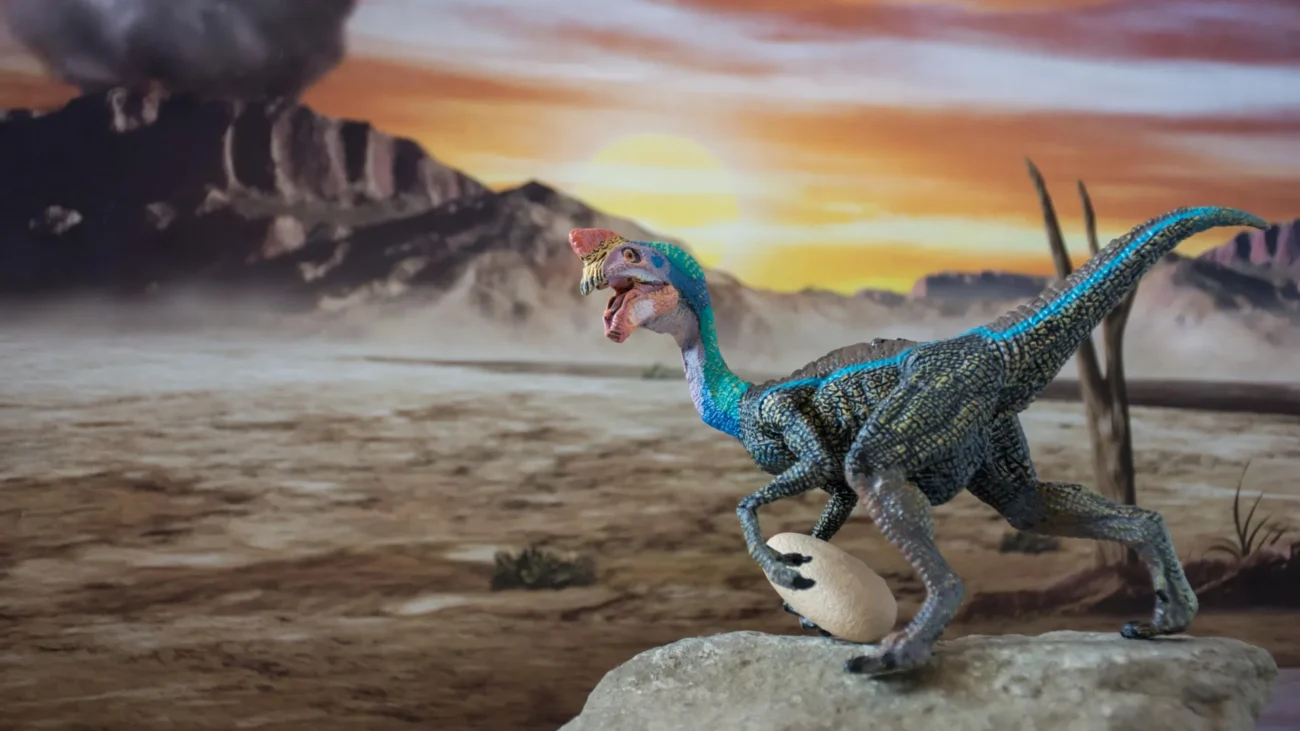
For generations, paleontologists have debated how non-avian, feathered dinosaurs managed the delicate and thermally demanding task of bringing their young into the world. While modern birds sit squarely atop their clutches to transfer body heat directly through a process known as thermoregulatory contact incubation, the reproductive strategies of their prehistoric ancestors have remained shrouded in mystery. Were creatures like the oviraptor acting as warm-blooded avian parents, or were they relying heavily on environmental heat sources much like modern-day reptiles? A groundbreaking new study published in the journal Frontiers in Ecology and Evolution has cast fresh light on this ancient puzzle, offering a compelling look at the intersection of dinosaur biology, environmental physics, and evolutionary history.
By combining meticulous physical experiments with advanced computer simulations, a research team based in Taiwan has mapped out how oviraptor eggs were warmed and how efficiently they hatched. The findings suggest that these feathered, bird-like dinosaurs utilized a cooperative system of parental brooding and solar energy, marking a fascinating transitional phase in the evolutionary journey from buried reptilian nests to the sophisticated incubation behaviors seen in modern birds.
Recreating the Late Cretaceous: The Experimental Methodology
To understand how a 20-kilogram, 1.5-meter-long Heyuannia huangi—an oviraptor species that roamed what is now China between 70 and 66 million years ago—cared for its young, the research team had to literally reconstruct the past. Led by senior author Dr. Tzu-Ruei Yang, an associate curator of vertebrate paleontology at Taiwan’s National Museum of Natural Science, and first author Chun-Yu Su, who was a high school student at Washington High School in Taichung during the research period, the team built a life-sized model of the dinosaur and its nesting environment.
Constructing the model required significant ingenuity. The torso of the adult Heyuannia huangi was fashioned using a wooden framework and lightweight polystyrene foam, with cotton, cloth, and bubble paper meticulously layered to simulate soft tissues. Because oviraptor eggs differ significantly in shape and texture from those of any living animal, the team cast artificial eggs out of resin to mimic the physical properties of the fossilized specimens. These resin eggs were then arranged in the distinctive double-ring, semi-open layout characteristic of fossilized oviraptor nests discovered across Asia, particularly in Mongolia and China.
This physical model was subjected to various simulated environmental conditions to test how heat transferred from the brooding adult and the surrounding atmosphere to the clutch. The results revealed that the position of the adult relative to the eggs was critical for embryonic development, yet the overall dynamics departed sharply from the standards of modern avian biology.
Thermal Dynamics and the Role of Sunlight
Under cooler environmental conditions, the physical experiment showed that eggs located in the outer ring of the nest experienced temperature variations of up to 6 degrees Celsius compared to those closer to the center or directly beneath the adult. In biological terms, such a wide thermal gap would have induced asynchronous hatching, meaning that certain chicks within the same clutch would have developed faster and emerged days before their siblings.
However, when warmer environmental conditions were simulated, the temperature discrepancy between the inner and outer rings dropped precipitously to just 0.6 degrees Celsius. This dramatic shift highlights the profound influence of ambient sunlight. Because oviraptor nests were semi-open and exposed to the air, solar radiation served as a vital co-incubator alongside the physical presence of the adult dinosaur.
Unlike modern birds, which function as the sole and primary heat source for their eggs while maintaining a tightly controlled thermal range, oviraptors and the sun appear to have shared the workload. Dr. Yang noted that large dinosaurs typically avoided sitting directly atop fragile clutches to crush them, instead leaning on external environmental factors like soil or solar heat—much like modern turtles and crocodiles. Yet, because oviraptor nests were open, solar heat played a far more dominant role than geothermal soil heat.
Oviraptors in Evolutionary Context: Who Were They?
To fully appreciate the implications of the new study, it is necessary to examine the broader historical and biological context of oviraptors. Living during the Late Cretaceous Period, roughly 100 to 66 million years ago, these creatures have long suffered from a historical misnomer. Their name, which translates directly to "egg thief," stems from the discovery of the first-ever oviraptor fossil resting near a nest, leading early 20th-century scientists to assume the animal was caught in the act of raiding a meal.
Decades of subsequent fossil discoveries corrected this misconception. Paleontologists eventually found adult oviraptors preserved in brooding postures directly atop clutches of their own eggs, demonstrating advanced parental care behaviors that mirrored those of modern birds. Characterized by toothless, beak-like jaws, long necks, crests, and a heavy covering of feathers, these omnivorous dinosaurs fed on a diverse diet that likely included seeds, vegetation, small animals, and insects.
Oviraptors occupy a crucial branch on the evolutionary tree, serving as a vital bridge between non-avian dinosaurs and modern avian species. Their anatomical features, nesting structures, and dedicated brooding habits prove that many traits once thought exclusive to birds actually evolved millions of years earlier in their dinosaurian ancestors.
Comparative Efficiency: Dinosaurs Versus Modern Birds
When comparing the incubation efficiency of oviraptors to that of modern birds, the researchers found a distinct technological and biological gap. Modern birds rely on thermoregulatory contact incubation (TCI), a method requiring three strict conditions: the parent must physically touch every egg in the clutch, act as the exclusive thermal source, and maintain the entire clutch within a very narrow, optimal temperature window.
Oviraptors were anatomically and behaviorally incapable of meeting these strict criteria. Their nest geometry and body proportions prevented the brooding adult from making simultaneous, direct contact with every egg in a multi-ringed, semi-open clutch. Consequently, their incubation efficiency was calculated to be significantly lower than that of modern birds.
Yet, the study’s authors caution against viewing this difference through a teleological lens of "better" or "worse." Dr. Yang emphasized that modern birds are not inherently superior at hatching eggs; rather, avian species and oviraptors evolved entirely distinct reproductive strategies tailored to their respective ecological niches and physiological designs. The co-incubation model—where the dinosaur and the sun work in tandem—represents an evolutionary stepping stone, likely corresponding to the transition from buried reptilian nests to fully exposed avian broods.
Broader Implications and Future Research Directions
The implications of this study extend well beyond the mechanics of dinosaur hatching. By pioneering a multidisciplinary approach that marries physical reconstructions with computer-based heat transfer modeling, the research team has opened new methodological doors for paleontologists. Traditionally, scientists have been constrained by the static nature of the fossil record, finding it difficult to model dynamic biological processes like thermoregulation and embryonic development using bones alone.
At the same time, the researchers acknowledge certain limitations inherent in their work. The physical experiments were based on a single reconstructed nest model of Heyuannia huangi, and global climatic conditions during the Late Cretaceous featured significantly higher greenhouse gas concentrations and global temperatures than the Earth experiences today. Furthermore, oviraptors are widely believed to have required considerably longer incubation periods than modern birds, adding another layer of complexity to their reproductive biology.
Despite these variables, the study serves as a milestone not only for dinosaur paleontology but also for international scientific collaboration. Dr. Yang highlighted the inspiring nature of the project for students in regions without native dinosaur fossils, noting that cutting-edge discoveries can be made through innovative thinking, physics, and computational modeling regardless of geographic constraints.
Ultimately, this research refines our understanding of prehistoric parenting. It paints a vivid picture of feathered dinosaurs tending to their nests under the ancient Cretaceous sun—not as clumsy reptiles or fully refined modern birds, but as magnificent transitional creatures navigating the evolutionary path toward the avian world we see today.

