


The newly rebuilt Belmont Park, constructed with the backing of a controversial $455 million taxpayer-funded loan from New York State, has plunged into controversy following the deaths of two young horses within its first week of operation. After hosting just nine races on its inner turf track, the facility has recorded consecutive fatal breakdowns, reigniting intense scrutiny over the safety of Thoroughbred racing, the allocation of public funds to private racing associations, and the efficacy of modern equine welfare standards.
The incidents have drawn sharp condemnation from animal rights organizations, most notably People for the Ethical Treatment of Animals (PETA), which has formally called upon the New York State Gaming Commission to immediately suspend racing operations on the inner turf track and conduct a comprehensive safety investigation. With public financing tied directly to the venue’s massive modernization project, the fatalities have transformed a celebratory milestone for the New York Racing Association (NYRA) into a flashpoint for debate regarding accountability, track conditions, and the ethical limits of the sport.
Chronology of the Fatal Incidents
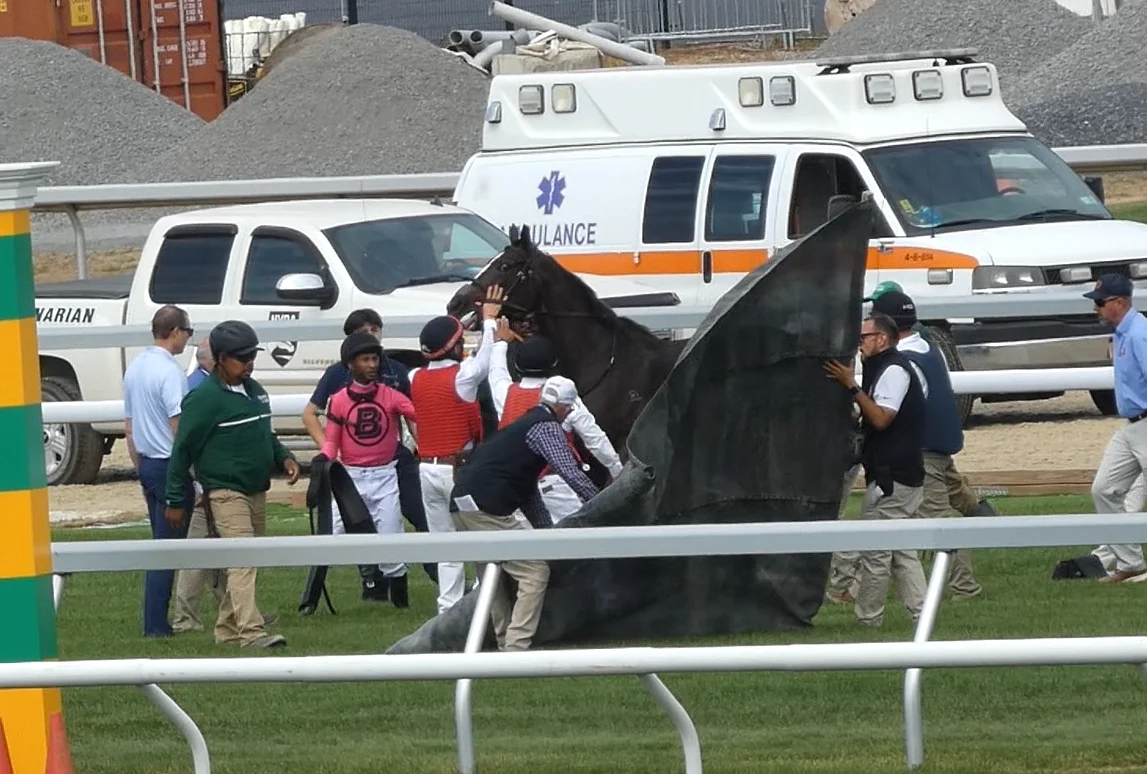
The timeline of tragedy began during the grand opening weekend of the $550 million facility. On Saturday, September 19, 2026, the venue hosted its second day of racing. During a sprint race, a 3-year-old filly named Heat Missile—who entered the race as the betting favorite—suffered a catastrophic breakdown in her left front leg. Veterinary examinations later confirmed that both sesamoid bones were fractured and her fetlock joint was dislocated. Track workers quickly deployed privacy screens to shield spectators in the grandstand from witnessing the euthanasia process, during which the mare was administered a lethal dose of sedatives and anesthetics. Following the removal of her body from the racing surface, operations resumed, including betting, spectator activities, and entertainment.
Just six days later, on Friday, September 25, the newly opened course claimed a second victim. Main Thing, a 3-year-old colt competing in just his third career race, suffered a severe right hind leg injury on the exact same inner turf track. Despite immediate medical intervention, the injuries were deemed unsurvivable, and the young horse was euthanized on the track.
The consecutive deaths brought the early operational death toll to two horses in just nine races, raising immediate red flags among veterinarians, regulators, and equine welfare advocates.
Broader Industry Crisis: Multi-Horse Pileup at Churchill Downs
The fatalities at Belmont Park did not occur in a vacuum. On the same weekend Heat Missile lost her life at Belmont, a separate catastrophic incident unfolded hundreds of miles away at Churchill Downs in Louisville, Kentucky.
During a race involving two-year-old horses, a participant named Lutkenhaus suffered a fatal breakdown of his left front leg, causing him to fall directly on the track. The sudden obstruction triggered a massive, multi-horse pileup involving five other juvenile horses: Ritornello, Midnight Rumble, Shacklebolt, Steve Wood, and Industrious. The ensuing collision left the track resembling a disaster zone, according to eyewitnesses and video footage subsequently circulated on social media platforms like X.
Lutkenhaus was euthanized on-site due to the severity of his injuries, while Industrious and Shacklebolt sustained injuries requiring transport via equine ambulance. The incident also resulted in injuries to three jockeys, who were transported to a local hospital for emergency medical evaluation. The simultaneous occurrence of fatal breakdowns at two of American racing’s most historic and prestigious venues—Belmont Park and Churchill Downs—intensified national scrutiny over the safety of young horses participating in high-speed competition.
Financial Backing and Public Accountability
At the center of the Belmont Park controversy is the massive public investment that facilitated the venue’s reconstruction. NYRA spearheaded the $550 million overhaul of the historic racing facility, relying heavily on a $455 million loan provided by the state of New York through taxpayer funds.
The financial arrangement has become a focal point of public criticism. Advocacy groups and fiscal watchdogs are demanding transparency regarding the specific terms, interest rates, and repayment schedules governing the loan between NYRA and the state government. Critics argue that public funds should not underwrite infrastructure that fails to guarantee baseline safety standards for competing animals. PETA and other oversight organizations have questioned the wisdom of allocating nearly half a billion dollars in public capital to an industry facing declining public trust and persistent questions regarding animal mortality rates.
Official Responses and Demands for Reform
In the wake of the fatalities, pressure has mounted significantly on regulatory bodies and racing executives. PETA has issued formal demands to the New York State Gaming Commission, urging regulators to halt all events on Belmont’s inner turf track pending a rigorous, independent engineering and veterinary review of the track’s composition, maintenance protocols, and grading.
Furthermore, animal welfare advocates are pressing the broader racing industry to adopt enforceable, standardized safety protocols. Proposed reforms include mandatory pre-race veterinary vetting using advanced diagnostic imaging, stricter regulations regarding training workloads for two-year-old horses, limitations on the use of whips and artificial stimulants, and increased transparency regarding equine injury and fatality data across all major American tracks.
The Ethical Debate Surrounding Equine Sports
The recent deaths have once again thrust the foundational ethics of horse racing into the public consciousness. Animal behaviorists and ethicists emphasize that horses possess complex emotional capacities, social needs, and a high degree of sentience. While domestic horses exhibit a natural inclination to run and move swiftly in herd environments, researchers point out that they do not possess the cognitive capacity to comprehend or consent to the inherent risks of competitive racing.
Industry critics note that forcing young horses—whose skeletal systems are often still developing—to run at maximum speeds under the pressure of whips and heavy betting stakes frequently results in catastrophic physical breakdowns, internal pulmonary hemorrhaging (bleeding lungs), and fatal injuries. The deployment of privacy screens during fatal incidents, designed primarily to shield spectators from the graphic realities of equine euthanasia, has been criticized as an attempt to sanitize an inherently hazardous sport and conceal the true cost of entertainment and wagering.
Implications for the Future of Belmont Park
As the New York State Gaming Commission weighs its next steps, the future of the newly redesigned Belmont Park hangs in a precarious balance. The facility, intended to symbolize a modern golden era for New York racing, is instead facing an unprecedented public relations and regulatory crisis.
For the racing industry, the challenge extends far beyond public relations. With public financing coming under intense legislative scrutiny and consumer confidence shaken by back-to-back fatalities during opening week, track executives and regulators face a stark choice: implement radical, verifiable safety reforms that prioritize equine well-being above revenue and spectacle, or risk accelerated alienation from a public increasingly unwilling to tolerate the loss of young animal lives on the racetrack.

