


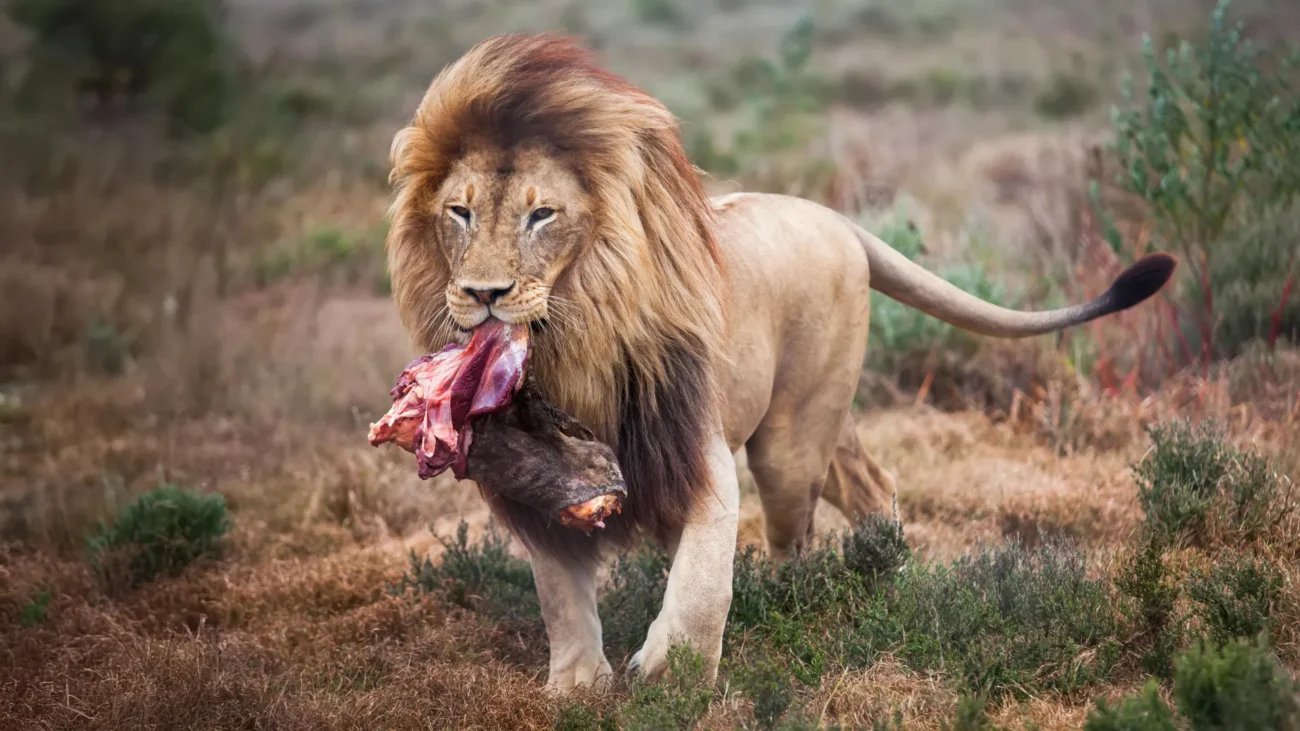
Recent findings published in the academic journal Applied Animal Behaviour Science have shed new light on the psychological and physical well-being of apex predators in human care, offering a compelling look into how simple modifications to diet delivery can fundamentally alter daily routines. Conducted through a collaborative partnership between the University of Adelaide and Monarto Safari Park in South Australia, a groundbreaking study has demonstrated that adult male African lions housed in a zoo environment exhibit behavioral patterns remarkably similar to their wild counterparts when subjected to a naturalistic feast and fast feeding schedule incorporating whole animal carcasses.
The research team, which included international academic collaboration from the University of Liège in Belgium, set out to challenge traditional zoo management practices. For decades, standard husbandry protocols for large carnivores in zoological facilities have relied on predictable, daily portions of pre-cut meat. While nutritionally adequate, this routine strips away the complex physical mechanics of hunting, tearing, and processing prey that occupy a substantial portion of a wild lion’s existence. By reintroducing the biological rhythm of sporadic hunting success—characterized by massive, labor-intensive consumption followed by extended periods of fasting and digestion—the researchers observed a dramatic shift in how the animals interacted with their environment, utilized their physical capabilities, and managed their time.
The Biological Blueprint of the Wild Lion
To understand the significance of the Adelaide University and Monarto Safari Park study, one must first examine the ecological reality of Panthera leo in its natural habitat. Unlike domestic pets or livestock, wild lions do not operate on a regulated circadian schedule of morning and evening meals. Their survival is dictated by the availability of prey, terrain, stealth, and pack dynamics. A successful hunt may result in a pride gorging on hundreds of kilograms of meat in a single sitting, tearing through hide, muscle, and bone. Following this feast, the animals typically enter a prolonged state of physical inactivity, conserving energy while their digestive systems process the massive caloric intake. This cycle can involve days of fasting before the next successful kill.
In contrast, traditional zoological feeding regimes have historically emphasized consistency. Feeding animals at the exact same hour every day reduces unpredictability for human handlers, but it inadvertently creates a cognitive dissonance for creatures hardwired for intermittency. Previous ethological research has suggested that when carnivores are denied the opportunity to exert physical effort in obtaining and processing their food, they experience a behavioral deficit. This can manifest as stereotypies, chronic boredom, or apathy.
The research team at Monarto Safari Park sought to bridge this gap by simulating the natural feast-and-fast rhythm. By introducing whole animal carcasses into the enclosures every nine days alongside an adjusted feeding routine, the scientists aimed to measure whether modern zoo environments could successfully accommodate a more authentic behavioral repertoire without compromising animal welfare or staff safety.
Chronology of the Study: Tracking the Pride Around the Clock
The empirical phase of the research focused on a coalition of three adult male African lions residing at Monarto Safari Park, one of the largest open-range zoos in the world. Before the experimental protocol was implemented, the research team established a comprehensive baseline of the lions’ normal daily activities, monitoring their movement, resting habits, and social interactions under their standard feeding regime.
The experimental phase marked a radical departure from the norm. Over the course of the three-month trial, the three male lions received approximately 200 kilograms of whole animal carcasses. Rather than consuming a partitioned meal within minutes—as is customary with pre-cut meat rations—the lions were given access to the carcasses for up to three consecutive days. This extended availability was a critical variable, allowing the animals to approach, abandon, and return to the food source organically, mimicking the carcass defense and multi-phase consumption patterns observed on the African savanna.
To capture the minutiae of this behavioral transformation, the research team deployed an advanced surveillance network consisting of eight high-definition infrared cameras. These devices recorded the lions continuously across the 24-hour cycle, generating one of the most granular and extensive datasets ever compiled regarding the behavior of large captive felids under a carcass-feeding regime.
The quantitative results were striking. On days when whole carcasses were introduced, the lions spent nearly three times as long engaged in feeding activities compared to their standard baseline. Rather than quickly swallowing bite-sized chunks, the animals were forced to deploy their anatomical machinery—using their powerful jaw muscles, sharp carnassial teeth, and robust claws to rip, pull, tear, and manipulate the substantial mass of the carcasses. This prolonged physical engagement transformed feeding from a brief, mundane task into a prolonged, highly stimulating behavioral event.
The Ripple Effect: Post-Prandial Rest and Recovery
The impact of the feast-and-fast schedule extended far beyond the initial hours of consumption. Once the lions had completed their extended feeding sessions, a distinct post-prandial phase emerged. The surveillance data revealed that the animals spent considerably more time lying down and resting, a direct physiological response to processing the massive volume of food consumed.
As the days progressed and the fasting period continued, a predictable behavioral trajectory unfolded. The lions gradually increased their locomotion and general activity levels, moving more frequently around their habitat as the time for the next feeding cycle approached. This cyclical pattern—intense, protracted consumption followed by prolonged torpor, which gradually gave way to rising activity and movement—mirrored the exact behavioral oscillations documented in wild lion populations tracked by field biologists.
Lead author Lesia Hryhorenko, a researcher from the University of Adelaide’s School of Animal and Veterinary Sciences, emphasized that the introduction of whole carcasses alters the paradigm of captive animal care far beyond mere nutritional intake.
"Wild lions don’t eat at the same time every day. They experience natural periods of feasting and fasting depending on hunting success," Hryhorenko noted. "We wanted to understand how African lions in human care respond when feeding routines more closely resemble those natural patterns. Providing whole carcasses changes much more than the nutritional content of the diet. It gives lions the opportunity to engage in behaviors such as tearing, pulling, and manipulating food over extended periods, which are important components of their natural feeding ecology."
Debunking Assumptions: Pacing, Anticipation, and Social Stability
A critical component of the study involved monitoring undesirable behaviors often associated with carnivores in zoological settings. Chief among these is pacing—a repetitive, stereotyped locomotion pattern that animal welfare scientists frequently interpret as a sign of frustration, chronic stress, or anticipatory anxiety related to impending feeding times.
As the study progressed, the researchers tracked the frequency and duration of pacing episodes among the male lions. Interestingly, while pacing showed a minor overall increase during certain phases of the trial, it did not consistently escalate as the duration of the fasting period lengthened. In other words, going longer without food did not make the lions progressively more agitated or desperate for a meal.
Instead, a closer micro-analysis of the data revealed that the sharpest spikes in pacing behavior were strictly correlated with predictable environmental triggers rather than internal hunger states. The highest frequencies of pacing occurred immediately prior to routine keeper arrivals and during times when the animals were shifted between different holding areas or sectors of their habitat. This finding suggests that stereotypic pacing in these animals was more strongly tethered to human-controlled temporal routines and the learned expectation of daily events than to the physiological sensation of hunger brought on by the multi-day fasting schedule.
Furthermore, the introduction of large, high-value food resources—which in the wild frequently trigger aggressive territorial disputes and intense competition within a pride—caused no disruption to the social stability of the male coalition. The three lions shared the carcasses without any recorded increase in injurious aggression or social fracturing, demonstrating that such enrichment protocols can be safely managed in group-housed settings under professional supervision.
Implications for Modern Zoo Management and Animal Welfare
The implications of the Adelaide University and Monarto Safari Park study extend far beyond the enclosures of South Australia, offering a potential blueprint for progressive zoological management worldwide. Co-author Associate Professor Alexandra Whittaker underscored the methodological importance of the research, pointing out that behavioral assessments in zoo environments have historically suffered from short-sighted observation windows.
"Many zoo studies focus only on what happens immediately after food is provided," Associate Professor Whittaker explained. "Our results show that feeding schedules can influence behavior for days afterwards, making it essential to look at behavioral patterns across the entire feeding cycle rather than a single feeding event."
By proving that whole-carcass feeding and intermittent fasting schedules can safely induce wild-type behavioral repertoires without inducing chronic stress or social conflict, the study provides empirical backing for animal welfare advocates who argue that psychological enrichment is just as vital as physical health in modern conservation breeding centers. Zoos are increasingly shifting their focus from mere survival and exhibition to holistic welfare, ensuring that captive animals are given opportunities to express their evolutionary adaptations.
Looking ahead, the research team suggests that future investigations should build upon these behavioral findings by integrating physiological measurements—such as fecal cortisol assays or metabolic markers—to construct a comprehensive, multi-dimensional assessment of how varying feeding strategies impact the internal well-being of large carnivores. As zoological institutions continuously refine their husbandry standards, insights from empirical studies like this ensure that the management of captive wildlife is increasingly guided by rigorous science rather than historical convenience, ultimately improving the quality of life for apex predators living under human care.

