


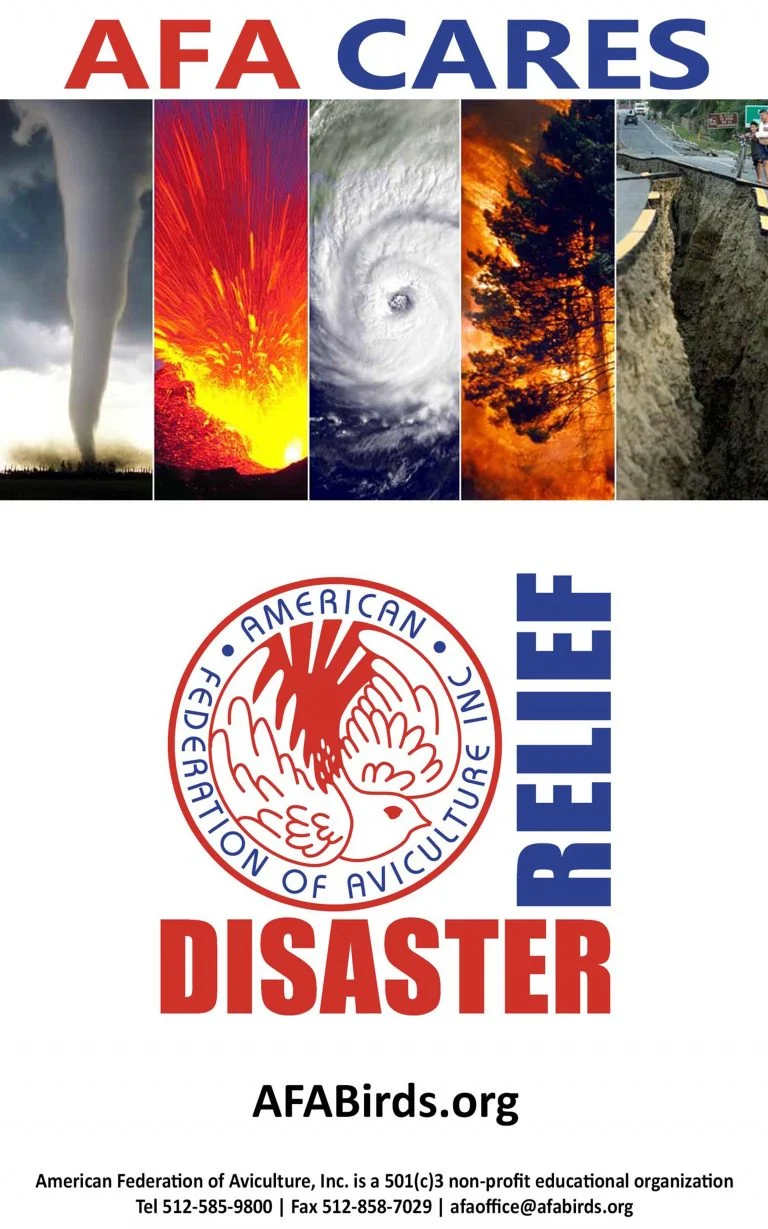
Natural disasters—ranging from catastrophic wildfires and violent tornadoes to devastating hurricanes, floods, and severe winter ice storms—pose an immediate and severe threat not only to human populations, but also to domestic pets and captive exotic birds. Unlike traditional household pets such as dogs and cats, avians require specialized handling, environmental controls, and specific nutritional requirements that complicate emergency response efforts. Recognizing the critical vulnerability of bird populations during large-scale emergencies, the American Federation of Aviculture (AFA) Disaster Relief Team has established a nationwide network designed to coordinate rapid responses, assist local volunteers, and provide life-saving interventions for displaced birds.
The AFA Disaster Relief Team operates through a decentralized framework comprising regional directors and dedicated volunteers stationed strategically across the United States. This structural design significantly accelerates response times, allowing local monitors to assess localized weather threats and coordinate immediate assistance. Bird owners facing imminent danger or individuals aware of vulnerable avians in disaster zones are urged to contact the AFA response network directly through their official communication channels.
Comprehensive Emergency Planning for Aviculturists
According to Mary Ellen LePage, a former Fire Chief for CalFire, preparation remains the single most effective tool for mitigating loss during catastrophic events. Every distinct disaster—whether it is a fast-moving wildfire generating toxic smoke plumes or a slow-rising riverine flood—presents unique challenges that demand tailored contingency plans. Aviculturists must anticipate these scenarios well in advance, establishing rigorous protocols for catching, transporting, and temporarily housing birds.
The cornerstone of effective avian disaster management is pre-planning equipment accessibility. Transporting birds safely necessitates pre-assembled or collapsible carriers outfitted with secure perches and dedicated water dishes. Because emergency situations often unfold with terrifying speed, scrambling to find supplies is rarely viable. Experts recommend storing carriers, heavy-duty towels, capture nets, and protective gloves in designated, easily accessible locations, such as suspended overhead racks in garages or directly adjacent to permanent aviaries and bird rooms. To reduce critical delays during a frantic evacuation, owners should standardize locks across cages and flights, ensuring a single key can open all enclosures.
Furthermore, permanent identification is vital for post-disaster reunification. Leg bands and microchips provide definitive proof of ownership, which is especially critical when animals must be evacuated to temporary municipal shelters or third-party facilities. Owners should also maintain duplicate, off-site physical or digital records containing vital statistics, dietary needs, medical histories, and photographs of their birds.
Evacuation Protocols versus Shelter-in-Place Strategies
Deciding whether to evacuate or shelter in place is often one of the most agonizing choices an aviculturist faces. Timing is frequently the determining factor between a successful evacuation and a catastrophic entrapment.

When a mandatory evacuation order is issued, or when natural indicators strongly suggest imminent danger, bird owners must act immediately. Waiting too long risks severe traffic gridlock, closed evacuation routes, and a complete breakdown of municipal services, leaving evacuees stranded without access to fuel, potable water, or food. Furthermore, larger bird collections require substantial transit vehicles with verified ventilation systems in the cargo areas to prevent heat stress and asphyxiation during transport.
Conversely, if a storm is deemed survivable and transportation logistics are overly hazardous, sheltering in place may be preferable to minimize the severe psychological and physical stress associated with capture and relocation. However, remaining on-site requires extensive self-sufficiency. Property owners must secure independent power sources, such as portable generators, alongside robust reserves of feed, filtration systems, and potable water. Because municipal infrastructure often fails during major disasters, storing non-perishable feed with a rotated expiration schedule prevents spoilage. Additionally, recording precise GPS coordinates of the property ensures that emergency search-and-rescue teams can locate isolated facilities if traditional street signs and landmarks are destroyed.
For both scenarios, a written emergency plan must be posted in a highly visible location. This document should detail feeding instructions, dietary requirements, veterinary contact information, and a comprehensive map outlining the exact locations of feed, water, carriers, and rescue tools such as wire cutters, hardware, and chainsaws.
Guidelines and Regulatory Protocols for Avian Rescuers
When formal rescue operations commence, safety remains paramount. The AFA explicitly mandates that rescue volunteers prioritize personal safety above all else, intervening only when a bird’s life is immediately threatened and when conditions permit safe passage.
Entering disaster zones presents complex logistical hurdles, primarily governed by strict emergency perimeters enforced by local law enforcement and federal oversight agencies. In the United States, large-scale disaster zones are frequently overseen by the Incident Command System (ICS), managed under the auspices of the Occupational Safety and Health Administration (OSHA) or corresponding state emergency management structures. The Incident Commander maintains absolute authority over all rescue and recovery operations within the designated zone.
To gain authorized access to restricted areas, AFA disaster relief volunteers utilize standardized identification, including magnetic vehicle signage bearing the AFA logo, official t-shirts, and specialized credential cards. Rescuers encountering police blockades are instructed to request contact with the designated Incident Commander or their authorized representative to secure legal entry permits. If official access is denied, volunteers rely on local guides familiar with alternative routes, provided such measures do not jeopardize human life.
Field Operations, Transport, and Animal Welfare
Once inside a disaster zone, rescue teams must execute rapid, organized extractions. Rescuers should carry the maximum number of transport containers their vehicles can accommodate. In the absence of standard pet carriers, improvisational solutions such as commercial crates, ventilated plastic storage bins, sturdy cardboard boxes, or even secure paper bags for smaller passerines can serve as temporary holding units.
Field personnel must meticulously record pairings, utilizing non-toxic markers to annotate crates with origin locations and lineage data to facilitate eventual reunification. Crucially, established leg bands must never be removed during the rescue process, as they serve as primary legal and biological identifiers.
Captured birds frequently exhibit heightened stress behaviors, requiring experienced handlers equipped with specialized nets and towels to prevent injury during capture. Avicultural clubs affiliated with the AFA frequently conduct pre-disaster training workshops to educate volunteers on the safe handling of untamed or exotic species under high-stress conditions.
Broader Implications and Long-Term Recovery Analysis
The establishment of organized avian disaster relief networks highlights a vital evolution in animal welfare and emergency management. Historically, disaster response frameworks focused almost exclusively on human evacuees and traditional livestock or companion animals, frequently overlooking the complex ecological and economic value of captive aviculture, rare breeding pairs, and zoological collections.
The socio-economic implications of unmanaged avian disasters are profound. Beyond the emotional devastation experienced by pet owners, the loss of rare and endangered captive-bred species represents an irreversible blow to conservation breeding programs worldwide. Many aviculturalists house species that are extinct or critically endangered in the wild, making the preservation of these genetic lines a matter of global biodiversity significance.
Furthermore, public health and biosecurity considerations underscore the necessity of coordinated professional intervention during animal evacuations. Uncoordinated rescue attempts by untrained citizens can compromise human safety, strain emergency medical resources, and spread zoonotic pathogens or stress-induced illnesses among vulnerable animal populations. By integrating avicultural expertise into official emergency frameworks through organizations like the AFA, the emergency management sector bridges a critical gap in disaster response.
Ultimately, the success of avian disaster mitigation relies on a continuous cycle of preparation, education, and community resilience. As extreme weather events increase in frequency and severity due to shifting global climatic patterns, the implementation of rigorous disaster plans, proactive supply staging, and robust communication channels will remain the definitive safeguard for aviculturists and the birds under their care.

