


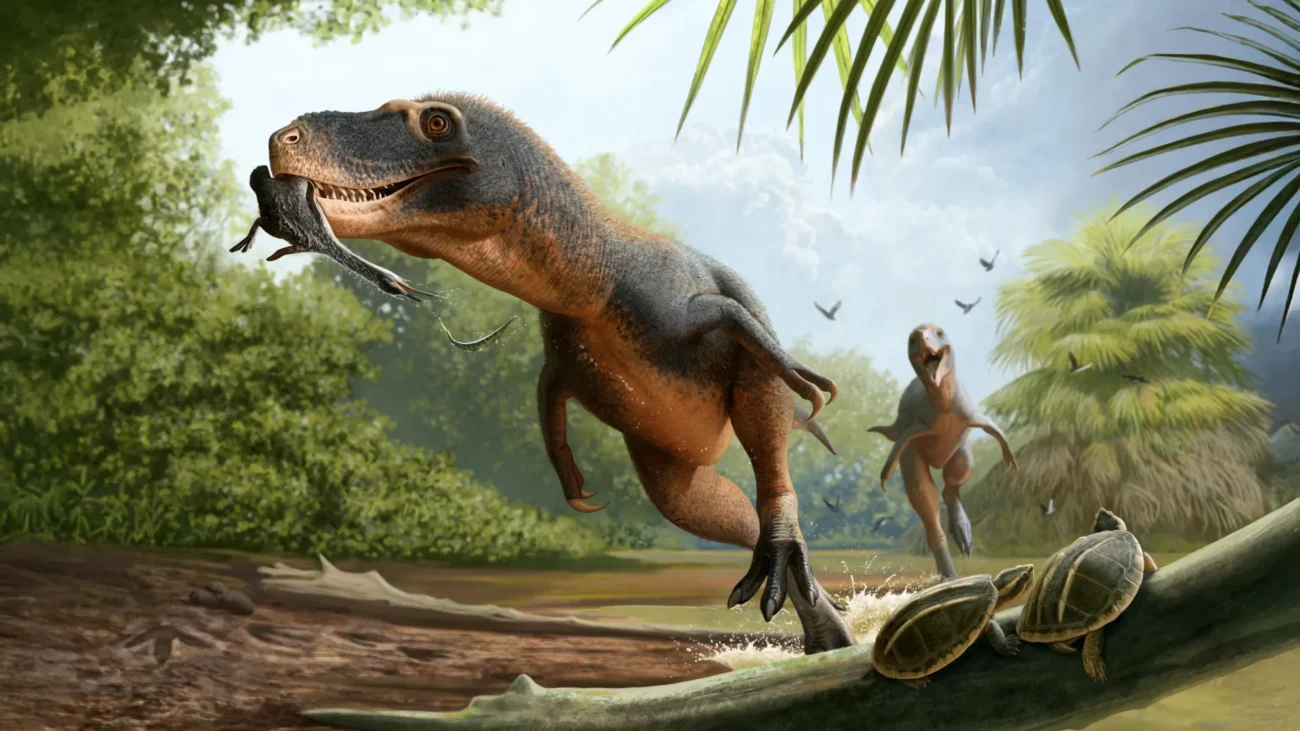
Paleontologists have uncovered what is being hailed as the finest feather specimen ever recovered from the age of dinosaurs, preserved in an exceptionally unusual medium: fossilized dinosaur feces. Discovered in the rugged badlands of northeastern Montana, the golf-ball-sized coprolite offers an unprecedented window into a Cretaceous predator-prey interaction that occurred just prior to the cataclysmic asteroid impact that wiped out non-avian dinosaurs 66 million years ago. Reported in the journal Current Biology, the discovery not only captures the anatomical details of an ancient diving bird but also provides critical clues regarding why only a single lineage of birds managed to survive the mass extinction event at the end of the Mesozoic Era.
Main Facts and the Montana Discovery
The remarkable specimen was unearthed in 2016 during routine fieldwork in the Hell Creek Formation, a geological treasure trove known for yielding Late Cretaceous fossils. David DeMar, Jr., a research scientist and Hell Creek Project collections manager at the University of Washington Burke Museum, was scaling a rocky outcrop in search of microscopic fish fossils when a nondescript, dark reddish-brown nodule caught his eye.
Upon closer inspection with a hand lens, DeMar observed a minute structure protruding from the surface: a tiny, impeccably preserved fossil feather. Given that feathers had remained conspicuously absent from the Hell Creek Formation despite more than a century and a half of intensive fossil prospecting, the discovery was as unexpected as it was groundbreaking.
To analyze the internal contents without destroying the delicate organic material, the research team employed advanced micro-CT scanning technology at the University of Southern California’s medical campus. The digital imaging process, which synthesizes thousands of high-resolution X-rays into a three-dimensional rendering, revealed a microscopic inventory of the predator’s final meal. Hidden inside the coprolite were not only multiple intact feathers but also microscopic scales from a gar fish and distinct leg bones belonging to a hesperornithiform—a toothy, aquatic diving bird ecologically analogous to modern loons.
Because the bird bones and feathers were co-mingled within the same coprolite, researchers concluded they belonged to the same unfortunate individual. The predator responsible for the meal was likely a large carnivorous dinosaur inhabiting the floodplain ecosystem of ancient Montana, potentially a juvenile Tyrannosaurus rex or a closely related Nanotyrannus.
Chronology and the Evolutionary Context of Avian Survival
To understand the magnitude of the find, scientists place the specimen within the broader timeline of avian evolution. Birds diverged from theropod dinosaurs during the Mesozoic Era, with the oldest known avian species, Archaeopteryx, appearing approximately 150 million years ago. For the next 100 million years, birds flourished alongside their non-avian dinosaur counterparts in a diverse array of forms, ranging from primitive arboreal species to specialized aquatic divers.
This long-standing ecological balance was shattered abruptly approximately 66 million years ago when a massive asteroid struck the Yucatán Peninsula, triggering global wildfires, acid rain, and an extended period of atmospheric darkness and severe cooling known as an "impact winter." While the vast majority of dinosaur lineages—including nearly all prehistoric birds—perished during this Cretaceous-Paleogene (K-Pg) extinction event, a single lineage of modern birds, known as Neornithes, survived and diversified into the roughly 10,000 species inhabiting the Earth today.
For decades, evolutionary biologists have debated why the Neornithes branch endured while other avian groups, such as the toothy enantiornithines and the aquatic hesperornithiforms, went extinct. One prevailing hypothesis suggested that aquatic habitats provided a protective buffer against the immediate devastation of the asteroid impact, allowing shoreline and diving birds to subsist on detritus-based food webs.
However, the discovery of the hesperornithiform feathers inside the Montana coprolite complicates this environmental hypothesis. Hesperornithiforms were highly specialized aquatic creatures adapted for diving and hunting fish, yet their entire lineage vanished alongside terrestrial dinosaurs. This survival disparity indicates that habitat alone cannot account for why Neornithes outlived their contemporaries.
Anatomical Analysis and Insights Into Plumage Evolution
The newly analyzed feathers provide a crucial anatomical piece of the extinction puzzle. Morphologically, the feathers found within the coprolite occupy an evolutionary middle ground between the primitive plumage of enantiornithine dinosaurs and the highly specialized feathers of modern Neornithes birds.
According to Dr. Jingmai O’Connor, associate curator of fossil reptiles at the Field Museum in Chicago and lead author of the study, the diving bird possessed a combination of modern-looking, waterproof contour feathers and smaller, primitive, fuzzy body feathers traditionally associated with non-avian dinosaurs. While the outer plumage was adapted for an aquatic lifestyle, the undercoat may have lacked the thermal efficiency required to withstand the drastic temperature drops of the impact winter.
Body feathers are vital for thermoregulation. If hesperornithiforms and enantiornithines possessed plumage that trapped heat less effectively than the advanced feathers of Neornithes, those anatomical shortcomings would have proved fatal as sunlight diminished and global temperatures plummeted. The retention of primitive, less efficient insulation likely doomed these specialized lineages, whereas the more advanced molting and feather structures of ancestral Neornithes provided the metabolic edge needed to survive the harsh post-impact climate.
Official Responses and Scientific Significance
The interdisciplinary research team, which includes experts from the Field Museum, the Burke Museum, the Carter County Museum, the University of Colorado Boulder, and several other academic and scientific institutions, emphasizes the rarity and value of the find.
Dr. Greg Wilson Mantilla, professor at the University of Washington and curator of vertebrate paleontology at the Burke Museum, highlighted the dual significance of the fossil. Beyond illuminating the evolution of avian integumentary structures, the specimen provides a rare, direct record of an ancient food web and predator-prey dynamics operating in the waning days of the Cretaceous Period.
"We rarely find fossils of birds and even more rarely their feathers, giving us such important insight into the evolution of this key aspect of their biology," Wilson Mantilla noted. "On top of that, these bird feathers found within a large fossilized dinosaur dung give us an incredible window into predator-prey interactions 66 million years ago."
The research also underscores a methodological shift in paleontology. Traditionally, paleobiologists rely on exceptionally rare Lagerstätten deposits—such as fine-grained shales or Burmese amber—to study soft tissues like feathers. The successful extraction of pristine 3D feather data from an ordinary-looking coprolite demonstrates that fossilized feces can act as unexpected micro-archives for organic preservation.
Broader Impact and Implications for Future Research
The discovery is expected to spark a broader re-evaluation of museum collections worldwide. Thousands of cataloged coprolites, long overlooked as mere geological curiosities or evaluated solely for dietary content, may now be subjected to non-destructive micro-CT scanning to search for microfossils, feathers, skin impressions, and other delicate soft tissues.
O’Connor expressed optimism that this "lucky break" will inspire fellow researchers to adopt a more forensic approach to coprolite analysis. By treating fossilized feces as complex paleontological crime scenes, scientists can reconstruct ancient ecosystems with unprecedented fidelity.
As paleontology continues to merge high-resolution imaging technology with field excavation, discoveries like the Hell Creek coprolite bridge the gap between macro-level extinction events and micro-level biological traits. Ultimately, this tiny, ancient feather—preserved through the digestive tract of a Cretaceous predator—has provided modern science with a clearer view of the fragile evolutionary thresholds that separated extinction from survival at the dawn of the modern world.

