


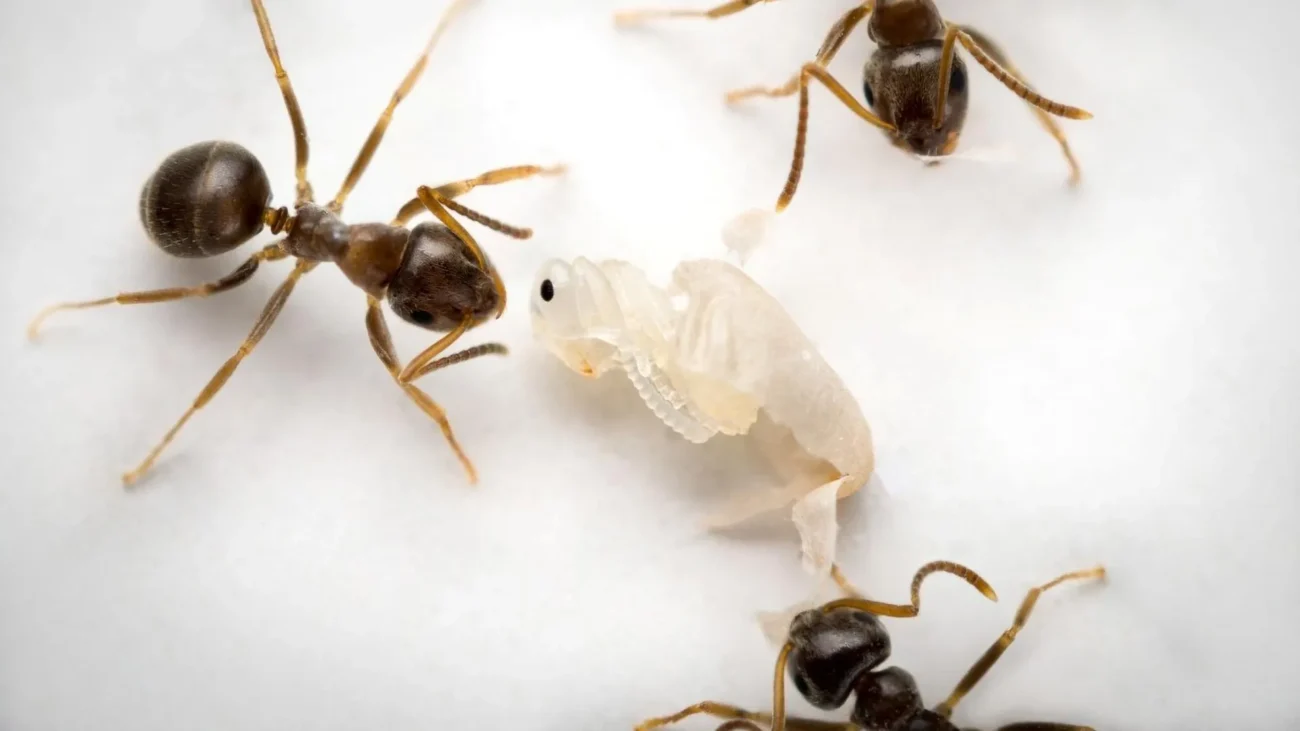
Ant societies, long admired for their complex social structures, operate as highly integrated "superorganisms," a biological marvel where individual ants function akin to cells within a larger body. This intricate coordination extends to a remarkable disease-response mechanism, recently illuminated by researchers at the Institute of Science and Technology Austria (ISTA). Their groundbreaking study, published in the esteemed journal Nature Communications, reveals that terminally ill ant brood emit a distinctive olfactory alarm, a sophisticated chemical signal that alerts their nestmates to impending danger. This "distress scent" is analogous to the way infected cells in a multicellular organism signal for help, enabling the colony to swiftly detect and neutralize threats before they can devastate the entire population.
The Silent Sacrifice: A Unique Approach to Illness
Unlike many social animals, where individuals often conceal signs of sickness to maintain their standing within the group, ant pupae exhibit a profoundly different behavior. When faced with an infection that proves insurmountable, they proactively release a chemical warning. This is not an act of passive demise but an active, albeit fatal, contribution to the colony’s survival. This discovery marks the first documented instance of such altruistic disease signaling in social insects, shedding new light on the evolutionary pressures that shape communal living.
The research, spearheaded by Erika Dawson, a former postdoc in the "Social Immunity" research group at ISTA, under the direction of Professor Sylvia Cremer, in collaboration with chemical ecologist Thomas Schmitt from the University of Würzburg, Germany, details a process of profound biological significance. It underscores the extreme cooperation that underpins ant colony success, demonstrating that individual sacrifice can be a powerful tool for collective preservation.
The Worker Ant Response: A Swift and Decisive Intervention
Upon detecting this subtle but potent olfactory cue, worker ants mobilize with remarkable speed and precision. Their immediate response involves carefully opening the cocoon of the infected pupa. Following this, they make minute incisions in its outer surface, a crucial preparatory step before applying formic acid, a potent antimicrobial compound naturally produced by the workers themselves. This targeted treatment effectively eradicates the pathogens proliferating within the pupa. However, the intervention is so thorough that it ultimately leads to the pupa’s demise.
"What appears to be self-sacrifice at first glance is, in fact, also beneficial to the signaler," explains Dawson. "It safeguards its nestmates, with whom it shares many genes. By warning the colony of their deadly infection, terminally ill ants help the colony remain healthy and produce daughter colonies, which indirectly pass on the signaler’s genes to the next generation." This explanation highlights a sophisticated form of kin selection, where the ultimate genetic legacy of an individual is preserved through the success of its close relatives within the colony.
The Superorganism Analogy: Ants as a Unified Entity
The concept of ants functioning as a "superorganism" is central to understanding this behavior. At the colony level, ants exhibit a division of labor analogous to that found in a multicellular organism. Queens are dedicated to reproduction, the colony’s sole purpose for perpetuation, while worker ants shoulder all other essential tasks: foraging, nest construction and maintenance, and crucially, the colony’s health and defense. This mirrors the biological differentiation within a body, where germline cells are responsible for reproduction, and somatic cells perform the daily biological functions necessary for survival.
Both biological organisms and superorganisms rely on the seamless cooperation between their reproductive and non-reproductive components. In the case of ants, this cooperation is so profound that it encompasses behaviors that actively benefit the collective, even at the direct cost of an individual life. The sacrifice of fatally infected brood exemplifies this ultimate form of altruism.
The Necessity of an Early-Warning System
A pertinent question arises: why would such an elaborate alarm system be necessary if sick individuals could simply isolate themselves? Professor Cremer addresses this by drawing a distinction between adult ants and their developing brood. "Adult ants that approach death leave the nest to die outside the colony," she notes. "Similarly, workers that have been exposed to fungal spores practice social distancing." This inherent capability for self-removal or isolation prevents the spread of contagion among the adult population.
However, this option is not available to ant brood, particularly pupae, which are immobile and entirely dependent on the care of worker ants. Like infected cells within a body, they cannot independently seek isolation or removal. They require external intervention, and the alarm scent serves as the trigger for this essential assistance.
A Chemical SOS: Mimicking Cellular Distress Signals
The strategy employed by developing pupae and infected body cells bears striking similarities. Both release specific chemical cues designed to attract the attention of their respective "helpers." For infected body cells, these cues summon immune cells to engulf and eliminate the threat. For ant pupae, the scent signals worker ants, prompting them to remove the potential source of infection. Immunologists refer to these signals in multicellular organisms as "find-me and eat-me" signals, a descriptor that aptly captures their function.
Professor Cremer emphasizes the critical requirements for such a signal: "The signal must be both sensitive and specific." It needs to be potent enough to reliably identify all terminally ill ant pupae while simultaneously being precise enough to avoid triggering unnecessary interventions. The colony cannot afford to waste resources on healthy pupae or those capable of mounting their own immune defense. This precision raises a fascinating question: how do ants achieve such a finely tuned olfactory alarm system?
Deciphering the Scent of Sickness: Alterations in the Pupal Olfactory Profile
Thomas Schmitt, whose extensive research focuses on chemical communication within social insect communities, points out that worker ants can distinguish a single diseased pupa amidst a multitude of healthy ones. This implies that the alarm scent cannot be a general diffusion through the nest but must be directly linked to the afflicted pupa. Therefore, the signal is not composed of volatile compounds that readily dissipate but rather non-volatile compounds residing on the pupal body surface.
The ISTA research team identified that when a pupa becomes fatally infected, two specific components of its natural scent profile are significantly amplified. To rigorously test whether this olfactory alteration alone was sufficient to trigger the colony’s disinfection response, the researchers conducted a pivotal experiment. They meticulously extracted the altered scent from signaling pupae and then applied it to healthy, uninfected pupae.
The results were compelling. Professor Cremer elaborates, "We extracted the smell from the signaling pupae and applied it to healthy brood." The treated, healthy pupae were subsequently unpacked by the worker ants, demonstrating conclusively that the altered odor of terminally infected brood functions identically to the "find-me and eat-me" signals observed in infected body cells. This experiment provides irrefutable evidence of the scent’s efficacy as an alarm.
Selective Signaling: The Logic Behind Who Calls for Help
The study also revealed a critical nuance: not all ant brood emit this alarm signal. "Queen pupae, which have stronger immune defenses than worker pupae and can limit the infection on their own, were not observed to emit this warning signal to the colony," Dawson explains. In contrast, worker pupae, lacking this robust immune capacity, consistently signaled for assistance when faced with an unmanageable infection.
This selective signaling is a testament to the colony’s efficiency and resource management. By only broadcasting an alarm when an infection is beyond the individual’s ability to control, the brood ensures that the colony’s formidable response mechanisms are deployed only for genuine threats. This prevents the unnecessary expenditure of energy and resources on pupae that are still capable of recovery, thereby maximizing the overall health and reproductive potential of the colony. Professor Cremer summarizes, "This precise coordination between the individual and colony level is what makes this altruistic disease signaling so effective."
Broader Implications for Understanding Social Immunity
The findings from ISTA offer profound insights into the evolution of social immunity and cooperative behavior. They demonstrate that even at the most fundamental biological level – the cellular and developmental stages of an organism – social insects have evolved sophisticated mechanisms to protect the collective. This research has implications extending beyond entomology, offering a potential model for understanding cellular communication and immune responses in other complex biological systems.
The study’s meticulous methodology, which involved chemical analysis, behavioral observation, and experimental manipulation, provides a robust framework for future investigations into the chemical ecology of social insects. Further research may explore the specific chemical compounds responsible for the altered scent, the genetic underpinnings of this signaling behavior, and the potential for similar, albeit perhaps more complex, mechanisms in other social organisms.
The successful identification and characterization of this alarm scent not only deepen our understanding of ant colony dynamics but also highlight the remarkable evolutionary solutions that life has devised for survival in cooperative environments. The "terminally ill ant brood" story is a compelling narrative of sacrifice, communication, and the enduring power of collective defense.
Animal Research: A Foundation for Biological Understanding
It is important to acknowledge the role of animal research in advancing our understanding of fundamental biological processes. As highlighted by the researchers, studies involving animals remain indispensable for exploring complex areas such as behavioral biology, immunology, and genetics. While computational and in vitro methods are valuable tools, they cannot yet fully replicate the intricate interactions and emergent properties observed in living organisms. All animal studies conducted by ISTA and its collaborators adhere to stringent legal regulations, ensuring the ethical collection, rearing, and handling of all animals involved in their experimental protocols. This commitment to ethical practice underpins the scientific integrity of such vital research.

