


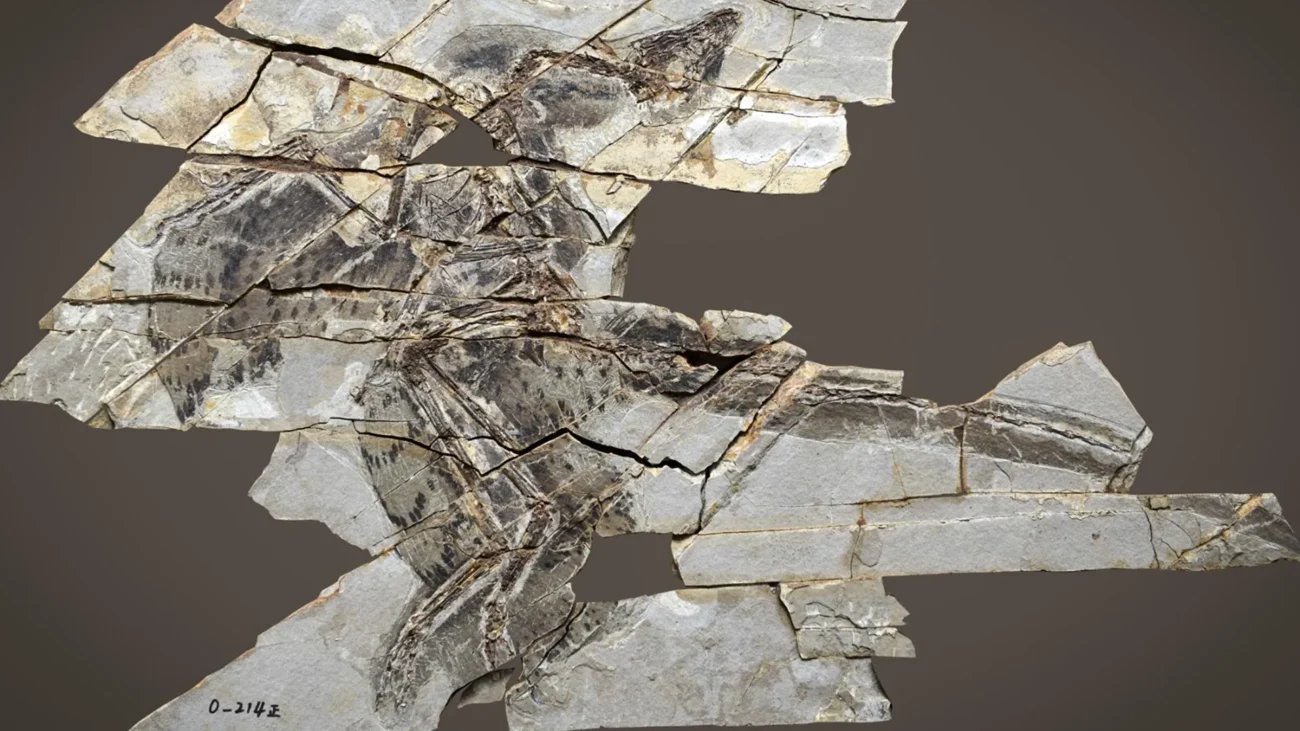
A groundbreaking study examining exceptionally preserved dinosaur fossils from eastern China has revealed compelling evidence that some feathered dinosaurs, long considered potential ancestors of modern birds, were in fact incapable of flight. The research, led by Dr. Yosef Kiat of Tel Aviv University’s School of Zoology and the Steinhardt Museum of Natural History, analyzed the intricate details of fossilized feathers, including their coloration and growth patterns, to reconstruct the flight capabilities of these ancient creatures. This discovery challenges long-held assumptions about the evolutionary trajectory of flight and underscores the remarkable complexity and diversity of wing development in the Mesozoic era. The findings were published in the prestigious journal Communications Biology by Nature Portfolio, a collaboration with researchers from China and the United States.
Unveiling the Secrets of Feather Molting in Ancient Avialans
The study’s central revelation hinges on the analysis of feather molting patterns. Dr. Kiat, an ornithologist specializing in feather biology, explains that feathers, being lightweight protein structures, evolved for a dual purpose: flight and thermoregulation. The research focused on nine fossil specimens of Anchiornis, a genus of feathered dinosaurs belonging to the Pennaraptora group, which lived approximately 160 million years ago during the Jurassic period. Pennaraptora, appearing around 175 million years ago, represents a lineage of feathered dinosaurs considered distant relatives of modern birds, and notably, the sole dinosaurian group to survive the cataclysmic mass extinction event at the end of the Mesozoic era, 66 million years ago.
Scientists have long posited that Pennaraptora evolved feathers primarily for flight. However, the prevailing understanding has been that this ability was either consistently present or gradually refined. This new research proposes a more nuanced evolutionary narrative, suggesting that environmental pressures or shifts in lifestyle may have led certain species to develop rudimentary flight capabilities, only to subsequently lose them over evolutionary time. This phenomenon is mirrored in modern avifauna by flightless birds such as ostriches, emus, and penguins, which have evolved from flying ancestors.
The exceptional preservation of the Anchiornis fossils, a rarity attributed to the unique geological conditions in eastern China, proved crucial. These specimens not only retained the delicate feather structures but also their original coloration. Each of the analyzed Anchiornis fossils displayed wing feathers that were predominantly white, marked by a distinct black spot at their tips. This preserved pigmentation provided an unprecedented window into the feather’s micro-structure and growth cycle, enabling researchers to infer functional traits that are typically lost to time.
The Molting Clue: A Window into Flight Capability
Dr. Kiat elucidated the critical role of molting in understanding avian locomotion. He explained, "Feathers grow over a period of two to three weeks. Upon reaching their final size, they detach from the blood supply that nourished them during their development, transitioning into non-living material. Over time, these feathers become worn and are shed, being replaced by new ones in a process known as molting." This cyclical process, he elaborated, carries significant implications for inferring flight ability.
"Birds that rely on flight, and therefore on the integrity of their flight feathers, exhibit an orderly and gradual molting process," Dr. Kiat stated. "This systematic shedding maintains symmetry between the wings, allowing the bird to continue flying, albeit perhaps with some temporary compromise, during the molt. In contrast, flightless birds tend to molt in a more random and irregular fashion. Consequently, the pattern of feather replacement provides a reliable indicator of whether a winged creature was capable of sustained flight."
By meticulously examining the fossilized wing feathers of Anchiornis, the research team identified a continuous pattern of black spots along the edges of the wings. More importantly, they observed developing feathers that showed a misalignment of these characteristic black spots, indicating that they were in various stages of growth. This irregularity in the growth pattern, when analyzed in conjunction with the overall arrangement of feathers, pointed towards an unsystematic, or irregular, molting sequence.
Anchiornis: A Flightless Feathered Enigma
The inference drawn from these irregular molting patterns is that Anchiornis was likely flightless. Dr. Kiat’s expertise in modern bird behavior and feather dynamics allowed him to interpret these ancient fossilized clues. "Based on my familiarity with modern birds," he concluded, "I identified a molting pattern indicating that these dinosaurs were probably flightless. This is a rare and especially exciting finding: the preserved coloration of the feathers gave us a unique opportunity to identify a functional trait of these ancient creatures – not only the body structure preserved in fossils of skeletons and bones."
This finding places Anchiornis among a growing list of non-avian dinosaurs that possessed feathers but lacked the capacity for powered flight. These discoveries collectively highlight that the evolution of feathers and the evolution of flight were not a singular, linear progression. Instead, they represent a complex and multifaceted evolutionary journey marked by experimentation, adaptation, and even regression. The study emphasizes that the development of wings and the ability to fly were not a monolithic evolutionary event, but rather a dynamic process with diverse outcomes.
Broader Implications for Understanding Avian Origins
The implications of this research extend far beyond the specific case of Anchiornis. It fundamentally reshapes our understanding of the evolutionary pathways leading to modern birds. The discovery suggests that the acquisition of flight was not a straightforward, unidirectional process. Instead, it appears that some lineages may have explored aerial locomotion, developed the necessary anatomical structures, and then, for reasons yet to be fully understood, abandoned or lost this capability.
This challenges the long-held "ladder of progress" model of evolution, where traits are seen as progressively improving over time. Instead, it supports a more "bushy" or branching model, where evolutionary paths diverge, with some branches leading to new innovations and others to specialized adaptations, including the loss of previously acquired traits.
The Pennaraptora group, of which Anchiornis is a member, is particularly significant because it is the direct lineage from which modern birds are believed to have evolved. Therefore, understanding the diversity of flight capabilities within this group is paramount to deciphering the origins of avian flight. The existence of flightless feathered dinosaurs within this lineage suggests that the pathway to sustained flight for birds may have been more circuitous and involved significant evolutionary experimentation.
The Evolutionary Timeline of Feathers and Flight
To fully appreciate the significance of this discovery, it is important to contextualize the evolutionary timeline. Reptiles and the ancestors of dinosaurs diverged approximately 240 million years ago. Following this divergence, over millions of years, various reptilian lineages began to develop feathers. This evolutionary innovation occurred well before the appearance of the first true birds.
Around 175 million years ago, the Pennaraptora emerged. This group is characterized by the presence of well-developed feathers, particularly on their forelimbs, which strongly suggested a role in flight. Fossils from this period, such as those of Archaeopteryx, often cited as the earliest known bird, exhibit a mosaic of reptilian and avian features, including flight-capable wings.
However, the Anchiornis fossils, dating to roughly 160 million years ago, represent a later stage in the evolution of feathered dinosaurs. The finding that a member of this advanced, feathered lineage was flightless indicates that the selective pressures favoring flight were not universally applied, or that other factors influenced the evolutionary trajectory of these animals.
The mass extinction event at the end of the Cretaceous period, approximately 66 million years ago, wiped out all non-avian dinosaurs. The survival of the avian lineage, which had diversified significantly by this point, is a testament to their adaptability. Understanding the evolutionary pathways within the non-avian dinosaur ancestors of birds, such as the flightless Anchiornis, provides crucial data points for reconstructing this complex evolutionary history.
Future Research and Unanswered Questions
The study by Dr. Kiat and his collaborators opens up new avenues for research. Future studies will likely focus on:
- Broader Fossil Analysis: Examining a wider range of feathered dinosaur fossils from different geological periods and geographical locations to determine the prevalence of flightless feathered species.
- Biomechanical Modeling: Developing sophisticated biomechanical models to further investigate the aerodynamic capabilities, or lack thereof, of dinosaurs like Anchiornis, incorporating data on feather structure, musculature, and skeletal proportions.
- Paleoenvironmental Reconstruction: Investigating the paleoenvironments in which these flightless feathered dinosaurs lived to understand what ecological factors might have driven the loss of flight. Was it a shift to a more terrestrial lifestyle, changes in prey availability, or increased predation pressure?
- Genetic Clues (Indirect): While direct genetic material from these ancient creatures is unlikely to be recovered, comparative genomics of modern birds can provide insights into the genetic mechanisms underlying feather development and flight capability, which can then be indirectly applied to understanding evolutionary pathways.
The identification of irregular molting patterns as a reliable indicator of flightlessness in fossilized feathered dinosaurs is a significant methodological advancement. This technique could be applied to other fossil specimens, potentially leading to a re-evaluation of the flight capabilities of numerous extinct species.
In conclusion, the study of Anchiornis fossils, with their remarkably preserved feathers and coloration, has provided a revolutionary perspective on the evolution of flight. It underscores that the journey from feathered dinosaur to modern bird was not a simple, direct ascent but a complex tapestry of evolutionary experimentation, adaptation, and even apparent regression. The seemingly "small technical detail" of feather molting, when meticulously analyzed in the fossil record, has indeed "changed everything we thought about the origins of flight," revealing a more intricate, diverse, and fascinating evolutionary history than previously imagined. This research solidifies the understanding that wing evolution was a multifaceted process, with some lineages developing feathers for display or thermoregulation, while others explored and subsequently abandoned the skies, ultimately contributing to the rich biodiversity of life on Earth.

