


Thousands of years ago, on the Caribbean island of Hispaniola, a dramatic scene likely unfolded within the cool, dark confines of a cave. A giant barn owl, a rodent known as a hutia, and a burrowing bee found themselves in this subterranean environment. The grim reality of nature’s cycle meant that only two would emerge. The riddle, as posed by the discovery, is simple: which one stayed behind? The answer lies with the creature that could not take to the skies. This ancient event, once a fleeting moment in prehistoric life, has been meticulously reconstructed by paleontologists, revealing an extraordinary chapter in the evolutionary adaptations of insects.
The narrative, pieced together from fossilized evidence, begins with the owl. This formidable predator, a common hunter in the region, likely carried its prey, a hutia, back to its cave. Such caves often served as ideal nesting and feeding sites for these birds, providing a safe haven to consume their meals and rear their young. The hutia’s unfortunate fate was to become sustenance for the owl’s offspring. Once the meal concluded, the owl would have departed, leaving behind the scattered remnants of its prey. It is within this undisturbed tableau of bone and sinew that the story takes an unexpected turn, with the arrival of a solitary burrowing bee.
The Unlikely Architects: How Bees Found a Home in Ancient Bones
This bee, driven by the primal instinct to propagate its species, was seeking a suitable location to construct its nest. The dark, sheltered environment of the cave, coupled with the accumulated sediment that had built up over time, presented an attractive prospect. As the bee began its diligent work, excavating into the fine, clay-rich silt that characterized the cave floor, it encountered the fossilized remains of the hutia. What might have been an obstacle instead became an unexpected boon.
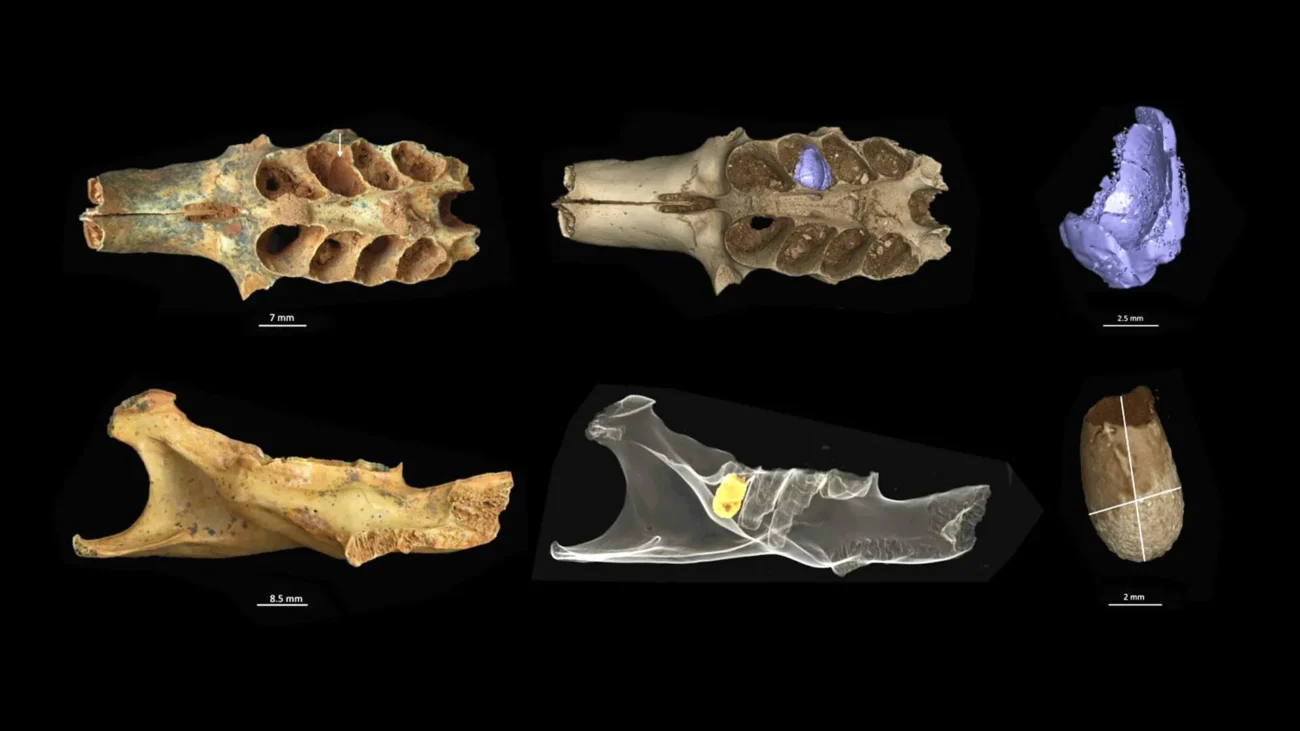
The hutia’s jawbone, a crucial part of its skull, held a unique feature that proved invaluable to the bee. While the rodent’s teeth had long since disintegrated, the small sockets within the jaw, known as alveoli, remained remarkably intact. These hollow spaces, once designed to securely hold the hutia’s teeth, offered an almost perfect dimension for the bee’s nascent nest. The smooth, pre-formed cavities provided an ideal starting point, requiring minimal excavation from the bee before reaching the necessary depth for its brood.
This discovery was not an isolated incident. Over vast stretches of time, subsequent generations of bees continued this remarkable behavior, discovering and utilizing these natural cavities within fossilized bones as ready-made nesting sites. This process, occurring over millennia, effectively entombed the bees and their nesting activities within the very bones they inhabited, leaving behind a unique geological record for future generations to decipher.
A Glimmer of Discovery: The Careful Eye of a Paleontologist
The revelation of this ancient bee behavior might have been lost to time and the relentless geological processes of the Earth, had it not been for the keen observation and meticulous work of paleontologists. Lazaro Viñola Lopez, then a doctoral student at the Florida Museum of Natural History, was conducting excavations in the Cueva de Mono, located in the southern Dominican Republic. His research focused on a particular species of hutia, one that was rarely found elsewhere on the island, making the abundance of its fossils in this cave particularly significant. The cave’s extensive collection of hutia remains strongly suggested it had been a long-term feeding ground for giant barn owls, a pattern repeated over countless generations.
Unlike many paleontological digs where the primary objective is to extract fossils with the sediment meticulously cleared from every crevice, Viñola Lopez took a different approach. He was particularly interested in the fine details, the nuances that could reveal more about the ancient ecosystem. He meticulously inspected the hutia jaws, a departure from the standard practice of removing all sediment from the alveoli during specimen cleaning. This deliberate attention to detail paid off when he noticed a peculiar cavity within one of the hutia mandibles. Its inner surface was remarkably smooth, a stark contrast to the typically rough, porous texture of bone.
From Wasp Nests to Bee Hotels: A Case of Mistaken Identity
This smooth surface immediately triggered a memory for Viñola Lopez. He recalled a similar observation made in Montana in 2014 while excavating dinosaur fossils. At that time, he and his colleagues had discovered what appeared to be wasp cocoons embedded within fossilized material. His initial hypothesis was that he was again encountering evidence of wasp nesting activity. He even contemplated the possibility of a short scientific paper detailing the presence of wasp nests within the mandibles of these ancient hutia.
He shared his preliminary findings with Mitchell Riegler, another doctoral student at the museum. Riegler, initially occupied with other research, was not immediately convinced, viewing the idea as a somewhat niche project. However, the discovery remained in the back of their minds. The opportunity to revisit the hypothesis arose when Riegler accepted a challenge from a former advisor to write a scientific paper within a week. This friendly competition, a collaborative effort to produce a paper within a tight deadline, led them to re-examine the smooth-walled cavities.
Their initial investigation leaned towards identifying the structures as wasp nests. However, as they delved deeper into the scientific literature, particularly research on ichnofossils – traces of past biological activity such as footprints, droppings, or nests – they encountered discrepancies. Wasp nests are typically characterized by rough, uneven walls constructed from chewed plant material mixed with saliva. The smooth, polished interior of the cavities they had discovered did not align with this typical wasp construction. Further research on bee nesting habits provided a crucial clue. Many species of burrowing bees line their nests with a waxy secretion, which, upon hardening, creates a smooth, waterproof, and often lustrous interior. This key characteristic suggested a radical shift in their interpretation: they were not observing wasp nests, but rather the meticulously crafted homes of bees.
A Rare and Unprecedented Behavior: The Significance of the Discovery
The correction from wasps to bees dramatically amplified the significance of their findings. This discovery represented an unprecedented behavioral adaptation. While there is at least one other known instance of burrowing bees nesting within a cave environment, there are virtually no documented cases of bees utilizing pre-existing fossil structures for nesting without significant modification. A prior report mentioned bees drilling into human bones, a more intrusive form of nest construction. However, the bees in the Cueva de Mono were not altering the bone; they were ingeniously repurposing existing natural cavities.
Recognizing the profound importance of their discovery, the researchers adjusted their pace and scope. They embarked on a more comprehensive study, consulting with experts in contemporary bee behavior and meticulously reviewing existing scientific literature. Viñola Lopez even returned to the Cueva de Mono to conduct further geological surveys, examining the various layers of sediment and fossil deposition to better understand the environmental context of the bee’s activity.
Adding a layer of urgency to their work, the cave faced an imminent threat. Plans were once in motion to develop the land and potentially convert the cave into a septic tank. Fortunately, these plans were ultimately halted. However, the potential destruction of this invaluable paleontological site spurred the research team into action. They organized a rapid "rescue mission" to recover as many fossils as possible before any irreversible damage could occur. This effort proved highly successful, yielding a substantial collection of fossils, many of which contained the remarkable bee nests.
Beyond the Jawbone: Nests Found in Diverse Fossil Types
The culmination of their research, detailed in a comprehensive study, paints a vivid picture of the cave’s long history and the extraordinary nesting habits of these ancient bees. The discovery was not limited to the hutia jaws. The researchers found further evidence of bee nesting in other fossilized remains. In one instance, a nest was meticulously constructed within the pulp cavity of a sloth tooth. These large, tree-dwelling mammals once roamed the Caribbean but became extinct shortly after the arrival of humans. Another nest was identified within a hutia vertebra, occupying the space that once housed the animal’s spinal cord.
Advanced imaging techniques, such as CT scans, provided even deeper insights into the bees’ nesting strategies. These scans revealed that some cavities had been reused multiple times, with several layers of nests stacked one inside another. Instead of excavating new tunnels in the challenging karst terrain, these adaptable bees had opted for efficiency, re-occupying existing alveoli if they were empty. In one particularly striking example, six distinct nests were found nested within a single hutia alveolus, arranged in a manner reminiscent of Russian nesting dolls. This layered arrangement suggests a long-term and consistent use of these fossilized cavities by successive generations of bees.
Environmental Pressures: Why the Cave Became a Bee Haven
The study also proposes a compelling explanation for why these burrowing bees would have gravitated towards such an unusual nesting habitat. The surrounding landscape of Hispaniola is characterized by karst topography, a terrain composed of sharp, jagged limestone formations that offers little in the way of stable soil for burrowing insects.
"The area we were collecting in is karst, so it’s made of sharp, edgy limestone, and it’s lost all of its natural soils," Riegler explained, recalling the challenging terrain firsthand. "I actually fell on it at one point, so I can tell you all about it." In such an environment, any soil that does accumulate on the surface is prone to erosion and is often washed into caves, where it can settle and form pockets of suitable material. These sheltered, sediment-rich deposits within caves may have represented some of the only viable nesting conditions for burrowing bees in the region, driving them to seek out alternative, albeit unconventional, nesting sites like fossilized bone cavities.
A Cave of Untold Stories: Future Discoveries Await
The work conducted in the Cueva de Mono is far from over. The researchers continue to analyze the wealth of other fossils recovered from the cave, with further significant findings anticipated in future publications. This ongoing research promises to shed more light on the rich biodiversity and complex ecological interactions that characterized Hispaniola in prehistoric times.
The study, published in the prestigious journal Proceedings of the Royal Society B, offers a compelling testament to the remarkable adaptability of life. It illustrates how organisms can evolve ingenious solutions to environmental challenges, often in ways that are utterly unexpected. In this particular instance, a cave, serving as a silent repository of past meals and the inevitable detritus of life, transformed into a bustling nursery for a species far removed from the original inhabitants. The story of the owl, the hutia, and the burrowing bee, etched in stone and revealed through scientific inquiry, serves as a powerful reminder of the intricate and often surprising connections that weave through the tapestry of life on Earth. The Cueva de Mono, it seems, still holds many secrets, waiting for the careful eye of science to uncover them.

