


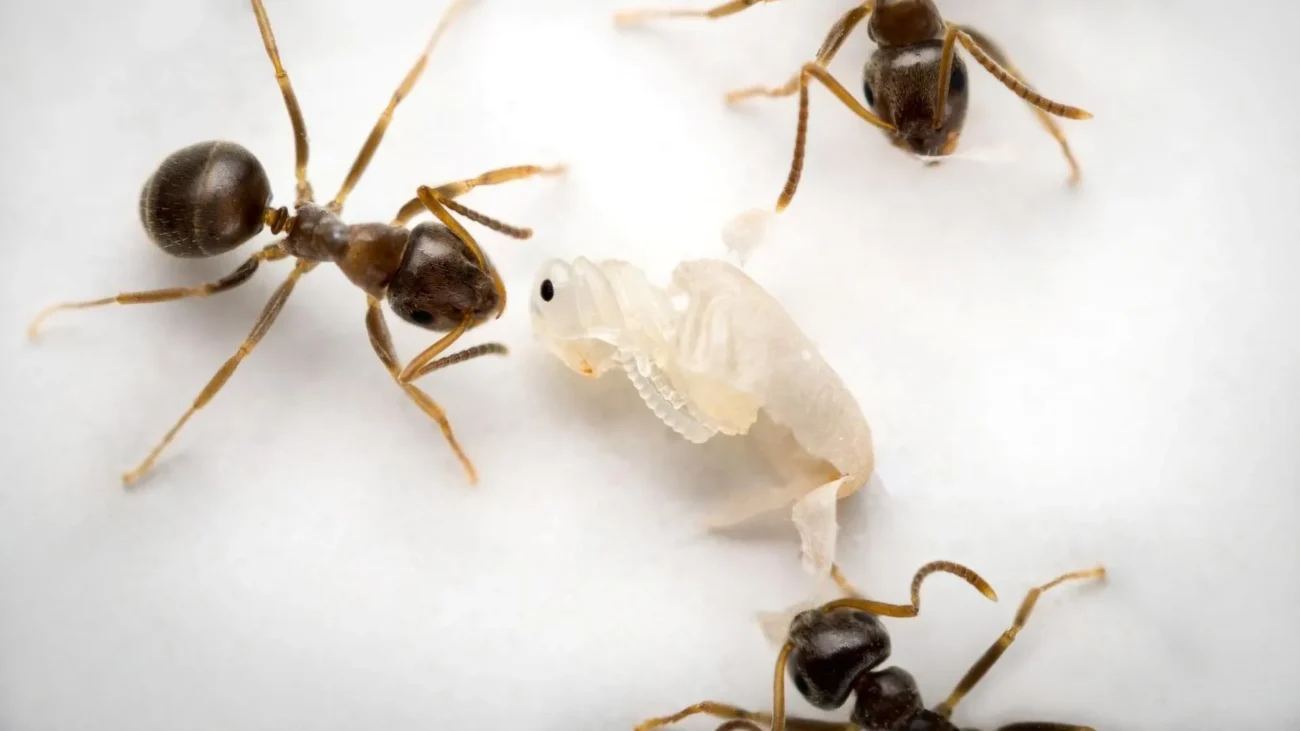
In a remarkable display of biological coordination, researchers at the Institute of Science and Technology Austria (ISTA) have unveiled a sophisticated defense mechanism within ant colonies that mirrors the intricate communication systems of multicellular organisms. Terminally ill ant pupae, facing an insurmountable infection, emit a distinct olfactory alarm, akin to the distress signals released by compromised cells within a living body. This chemical warning enables the colony to swiftly identify and neutralize infectious threats before they can devastate the entire population. The groundbreaking findings, published in the esteemed journal Nature Communications, illuminate a previously unrecognized facet of social immunity in insects.
The Superorganismal Advantage: Altruism in the Face of Death
Unlike many social animals, where individuals may conceal their infirmities to avoid ostracization, ant pupae exhibit a strikingly different behavior. When afflicted with a fatal infection, these developing ants do not remain silent. Instead, they proactively release a potent chemical alarm that alerts their nestmates to the impending danger they represent. This altruistic act, while seemingly a sacrifice, ultimately serves the broader genetic interests of the individual signaler, as it safeguards the survival of its kin and the future reproductive success of the colony.
Dr. Erika Dawson, the study’s lead author and a former postdoctoral researcher in ISTA’s "Social Immunity" research group, headed by Professor Sylvia Cremer, elaborates on this phenomenon. "What appears to be self-sacrifice at first glance is, in fact, also beneficial to the signaler," she explains. "It safeguards its nestmates, with whom it shares many genes. By warning the colony of their deadly infection, terminally ill ants help the colony remain healthy and produce daughter colonies, which indirectly pass on the signaler’s genes to the next generation." This form of kin selection underscores the profound interconnectedness within ant societies.
The research, a collaborative effort with chemical ecologist Professor Thomas Schmitt from the University of Würzburg in Germany, marks the first documented instance of such altruistic disease signaling in social insects. Without this evolved warning system, a dying ant could become a potent source of contagion, jeopardizing the entire colony’s existence. By signaling their perilous condition early, incurably ill brood empower the colony to preemptively manage the threat before it escalates into an epidemic.
The Architecture of Ant Colony Defense: A Superorganismal Analogy
At the colony level, ants operate as a cohesive "superorganism," a concept where the collective behaves as a single, unified entity. Each member plays a specialized role crucial for the survival and propagation of the group. Queens are dedicated to reproduction, while workers tirelessly manage all aspects of colony life, from foraging and nest construction to meticulous healthcare. This functional division of labor bears a striking resemblance to the organization within a human body, where reproductive cells are responsible for offspring, and somatic cells perform the myriad daily biological tasks.
Both biological organisms and superorganisms rely on the seamless cooperation between reproductive and non-reproductive components. In ant colonies, this cooperation is so deeply ingrained that it encompasses behaviors that prioritize the group’s well-being, even at the individual’s expense. The sacrifice of fatally infected brood is a prime example of this extreme altruism, demonstrating the colony’s paramount importance over individual survival.
The Necessity of an Early-Warning System
A pertinent question arises: why would ants evolve such an elaborate alarm system if sick individuals could simply isolate themselves? Professor Cremer addresses this by drawing a parallel to adult ants. "Adult ants that approach death leave the nest to die outside the colony," she notes. "Similarly, workers that have been exposed to fungal spores practice social distancing." However, this recourse is unavailable to brood, which lack the mobility to self-exile. Like compromised cells within a body, they are dependent on external intervention.
Developing pupae and body cells share a common challenge: they cannot independently remove themselves when infected. Consequently, they employ analogous strategies. Both release chemical cues that attract specialized responders – immune cells in the body and worker ants in the colony. These helpers are then tasked with removing the potential source of infection. Immunologists refer to these signals as "find-me and eat-me" signals, a description that aptly captures their function.
"The signal must be both sensitive and specific," Professor Cremer emphasizes. "It should help to identify all terminally-sick ant pupae but be precise enough to avoid triggering the unpacking of healthy pupae or those capable of overcoming the infection with their own immune system." This raises a critical question regarding the precision of such a system and the mechanisms that ensure its accuracy.
Deciphering the Scent of Sickness: How Infection Alters the Pupal Profile
Professor Schmitt, whose research expertise lies in chemical communication within social insects, highlights the remarkable ability of worker ants to pinpoint a single infected pupa amidst a multitude. "This means the scent cannot simply diffuse through the nest chamber but must be directly associated with the diseased pupa," he states. "Accordingly, the signal does not consist of volatile compounds but instead is made up of non-volatile compounds on the pupal body surface."
The research revealed that two specific components of the ants’ natural scent profile become significantly more pronounced when a pupa is fatally infected. To ascertain whether this olfactory shift alone was sufficient to trigger the disinfection response, the researchers conducted a series of controlled experiments. They meticulously transferred the altered scent from infected pupae onto healthy brood.
"We extracted the smell from the signaling pupae and applied it to healthy brood," Professor Cremer recounts. The subsequent observations confirmed the potency of the olfactory cue. The workers responded by promptly unpacking the scent-treated pupae, demonstrating that the altered odor of terminally infected brood effectively functions as a "find-me and eat-me" signal, mirroring the process observed in infected body cells. This suggests a deep evolutionary convergence in distress signaling across vastly different biological scales.
The Selective Nature of the Warning Signal: Queen vs. Worker Pupae
A crucial aspect of this signaling system is its selectivity. Not all brood emit this alarm. Dr. Dawson explains, "Queen pupae, which have stronger immune defenses than worker pupae and can limit the infection on their own, were not observed to emit this warning signal to the colony." In contrast, worker pupae, lacking this robust internal defense, consistently signaled for assistance.
This discerning behavior ensures that the colony directs its resources and attention only towards genuine threats. By signaling exclusively when an infection surpasses the individual’s capacity to manage it, the brood prevent the unnecessary expenditure of energy and the loss of individuals who are still capable of recovery. "This precise coordination between the individual and colony level is what makes this altruistic disease signaling so effective," Professor Cremer concludes, underscoring the evolutionary advantage of such refined communication.
Broader Implications and the Future of Social Immunity Research
The discovery of this sophisticated olfactory alarm system in ants offers significant insights into the evolution of social behavior and disease resistance. It provides a tangible model for understanding how complex societies can maintain health and resilience through collective action and intricate communication networks. The parallels drawn with cellular distress signals in multicellular organisms suggest that fundamental principles of communication and defense may be conserved across diverse biological systems.
The implications of this research extend beyond entomology. It could inform strategies for disease control in other social animals, including livestock and even human populations, by highlighting the importance of early detection and collective response. Furthermore, the precise chemical cues identified could potentially lead to novel methods for detecting and managing infections in both agricultural and biomedical settings.
Future research directions may involve a deeper investigation into the specific chemical compounds responsible for the alarm signal and the molecular mechanisms by which worker ants perceive and respond to them. Understanding the genetic basis for the differential signaling between queen and worker pupae could also shed light on the evolutionary pressures that have shaped these complex social behaviors.
Animal Research: A Necessary Component of Scientific Advancement
It is important to acknowledge the role of animal studies in advancing our understanding of fundamental biological processes. Research involving animals, including behavioral biology, immunology, and genetics, remains indispensable for unraveling complex biological phenomena. Despite the advancements in computational and in vitro methods, animal models continue to provide unique insights that cannot be fully replicated by other approaches. All animals involved in these experiments are ethically sourced, meticulously reared, and handled in strict accordance with prevailing legal regulations, ensuring the highest standards of animal welfare. This commitment to ethical research is paramount as scientists continue to explore the intricate mechanisms of life.

