


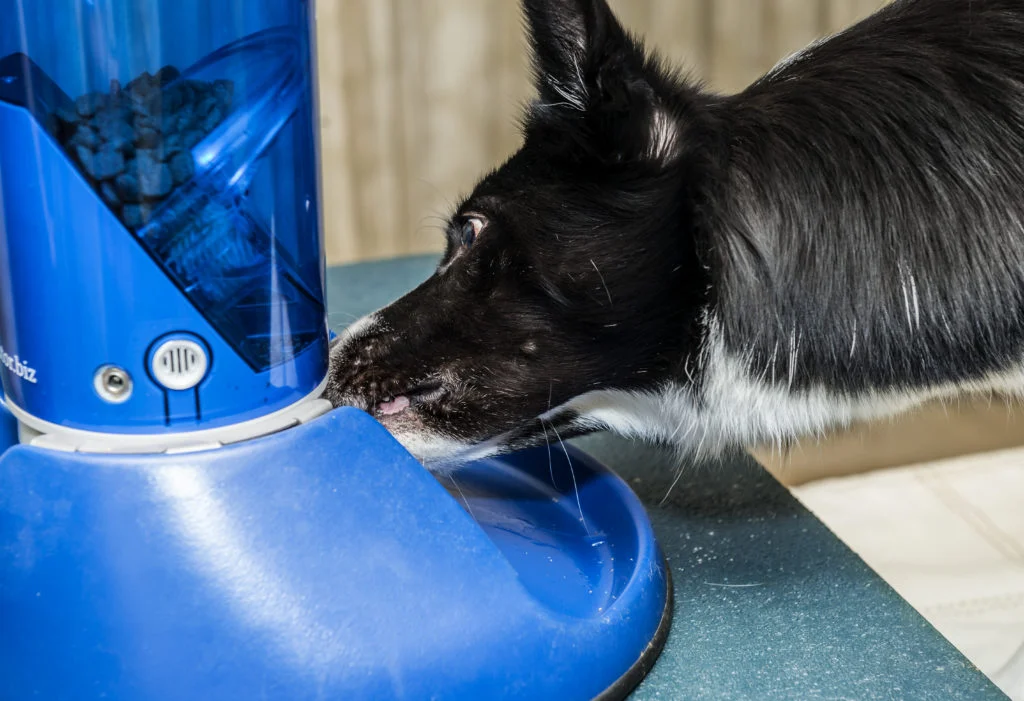
The strategic introduction of automated treat dispensers like the Pet Tutor is crucial for effective canine training, particularly in establishing a healthy distance between the dog and the device. This approach, though seemingly counterintuitive, is foundational to preventing common behavioral issues and ensuring that the dog understands that reinforcement stems from their actions, not from direct interaction with the feeder itself. The objective is to position the feeder as a neutral delivery system, a conduit for rewards, rather than an object of obsession or a puzzle to be physically manipulated.
The Paradox of Proximity: Why Distance Matters in Canine Training
Many dog owners might naturally assume that encouraging proximity to a food dispenser is beneficial, equating closeness with positive association. However, this assumption often leads to unintended consequences. Dogs are inherently driven by food, and when presented with a device that dispenses treats, their natural inclination is to investigate and interact with it directly. This can quickly lead to an undesirable fixation where the dog attempts to "solve" the feeder, nudging it, pawing at it, or even attempting to stick their nose into the mechanism, much like they would with a traditional puzzle toy.
This fixation can become problematic. Instead of focusing on the desired behavior that triggers the treat release, the dog’s attention becomes solely concentrated on the feeder. This misdirection undermines the core principle of operant conditioning, where a specific behavior (the antecedent) leads to a consequence (the reinforcement). If the dog believes that physical interaction with the feeder is the path to reward, they fail to associate the actual trained behavior—be it a sit, a stay, or a recall—with the subsequent treat. Studies in animal cognition suggest that when the reinforcing stimulus (the treat) is too closely associated with the delivery mechanism rather than the performed action, the learning process can be muddled, leading to slower acquisition of skills and a less reliable behavioral response.
Scientific Underpinnings: Operant Conditioning and Stimulus Control
At its core, this training philosophy is deeply rooted in the principles of operant conditioning, pioneered by B.F. Skinner. The goal is to establish clear stimulus control: the dog performs a specific behavior in response to a cue, and that behavior is then reinforced. The Pet Tutor, in this context, functions as a precision instrument for delivering positive reinforcement. Its remote activation capability allows for impeccable timing, ensuring the treat arrives precisely at the moment the desired behavior is completed.
However, if the feeder itself becomes a primary stimulus—a target for interaction—it can inadvertently become a "confounding variable." The dog might learn that any interaction with the feeder, even unwanted ones, sometimes yields a reward, creating a "gambling" effect. Data from various animal behavior studies indicate that inconsistent reinforcement for unwanted behaviors can strengthen them, making them harder to extinguish. By establishing distance, trainers aim to neutralize the feeder as an active participant in the dog’s behavioral repertoire and instead make it a passive, reliable source of reinforcement for other behaviors. This promotes a clearer understanding of the contingency: "My action (e.g., sitting calmly) makes the treat appear," rather than "Pushing this box makes the treat appear."
The Pet Tutor: A Tool for Precision Training
The Pet Tutor represents a significant advancement in positive reinforcement training, offering unparalleled control over the timing and delivery of rewards. Unlike manual treat delivery, which can be influenced by handler movement, scent, or even emotional state, an automated feeder provides consistent, unbiased reinforcement. This consistency is vital for rapid learning and for building strong, reliable behaviors. For example, in complex training scenarios such as agility courses or distance work in obedience, the Pet Tutor allows the trainer to reinforce a dog at a significant distance without breaking focus or interrupting the flow of the exercise.
The device’s capacity for precise, remote delivery is its greatest asset. However, this asset can be undermined if the dog’s attention is diverted from the training task to the feeder itself. Data from professional trainers utilizing remote feeders often highlight that early training to establish a "hands-off" policy with the feeder leads to significantly faster progress in subsequent, more complex behaviors. This initial investment in teaching feeder neutrality pays dividends by allowing the dog to fully engage with the actual training cues and tasks.
Phase 1: Establishing the Foundation – Redefining the Reinforcement Zone
The initial phase of training with the Pet Tutor, as advocated by experts like Dr. Deborah Jones, Ph.D., focuses on meticulously shaping the dog’s perception of the feeder. Dr. Jones, a retired psychology professor with over 25 years of experience in positive reinforcement animal training, emphasizes a structured, step-by-step introduction.
The process begins by elevating the feeder to a height that prevents the dog from easily interacting with it physically. This immediately removes the temptation for nose-poking or pawing. Concurrently, the feeder is positioned so that treats fall directly onto the ground rather than into an integrated bowl. This subtle modification is profoundly impactful. Dogs are naturally inclined to gravitate towards the source of food. If the ground becomes the primary collection point for treats, the dog’s focus shifts from the feeder mechanism to the area beneath it. This naturally encourages a slight physical separation from the device.
During initial sessions, the trainer should release treats onto the floor and, if necessary, gently guide the dog to where they land. This helps the dog quickly understand the new pattern of food delivery. The critical next step involves observing and reinforcing even the slightest movement away from the feeder. This is where the counterintuitive aspect of the training truly manifests. Instead of rewarding proximity, the trainer actively seeks and rewards disengagement. For instance, if the dog takes a single step back, shifts its gaze away from the feeder, or merely relaxes its posture after a treat delivery, a subsequent treat is immediately dispensed, reinforcing that subtle distance.
The case of "Star," a dog with a history of extreme feeder fixation—even attempting to "climb inside" the device during grooming sessions—underscores the importance of this foundational training. For dogs like Star, who have deeply ingrained habits of direct interaction, this initial phase requires patience and consistent reinforcement of even minimal backward movement. Dr. Jones notes that teaching a dog to move away from the source of food is a challenging yet invaluable lesson, especially for those accustomed to actively engaging with food-dispensing puzzles. The goal is to reshape the dog’s expectation: the feeder delivers treats, it is not a target for interaction. The success observed with Star, particularly her ability to catch treats in mid-air (as demonstrated in the provided video), highlights the dog’s adaptability when presented with clear, consistent contingencies. This mid-air catching, while impressive, also serves to further disassociate the treat acquisition from ground-level interaction with the feeder, reinforcing a broader spatial understanding of reinforcement.
Phase 2: Introducing a Designated Reinforcement Station
Once the dog consistently demonstrates an understanding that backing away from the feeder results in reinforcement, the training progresses to the next critical phase: introducing a designated "station." This often takes the form of a bed or a mat placed a short distance from the Pet Tutor.
The introduction of a mat serves multiple purposes. Firstly, it provides a clear, defined target behavior that is spatially separate from the feeder. Instead of merely "backing away," the dog now has a specific location to go to. This helps to further solidify the concept that their behavior at a distance triggers the reward. Secondly, a mat or bed often carries existing positive associations for dogs, making it a comfortable and familiar place to receive reinforcement.
The training sequence for this phase typically involves:
- Positioning the mat: Place the mat a short, manageable distance (e.g., 2-3 feet) from the elevated feeder.
- Luring or capturing movement: Encourage the dog to move towards the mat. Initially, this might involve placing a treat on the mat or using a hand lure to guide them.
- Reinforcing interaction with the mat: As soon as the dog steps onto the mat, or even just approaches it, immediately dispense a treat from the Pet Tutor. The goal is to reinforce any engagement with the mat.
- Shaping duration and position: Gradually increase the criteria for reinforcement. Reward the dog for all four paws on the mat, then for lying down on the mat, and finally for remaining on the mat for increasing durations.
- Increasing distance: As the dog becomes proficient, the mat can be progressively moved further away from the feeder, reinforcing the behavior at greater distances. This systematic increase in distance helps generalize the understanding that their actions away from the feeder, specifically at their station, lead to rewards.
This phased approach, moving from general disengagement to specific stationing, provides a clear and progressive learning pathway. It reinforces the central lesson that the dog’s actions, performed independently of the feeder’s physical presence, are what yield desirable outcomes.
Preventing Obsession: Long-Term Implications of Early Training
The proactive strategy of teaching distance from the feeder carries significant long-term implications for a dog’s overall behavior and training success. By establishing this foundational understanding early on, several common behavioral pitfalls can be effectively avoided:
- Reduced Feeder Obsession: A dog that is taught not to fixate on the feeder is less likely to develop obsessive behaviors around food-dispensing devices in general. This prevents situations where the dog becomes overly agitated, frustrated, or demanding when the feeder is present but not actively dispensing.
- Enhanced Focus on Cues: When the feeder is a neutral delivery system, the dog’s attention remains squarely on the trainer’s cues and the task at hand. This leads to faster learning, stronger associations between cues and behaviors, and ultimately, a more responsive and well-trained dog.
- Prevention of Resource Guarding: While not directly resource guarding the food, a dog that aggressively interacts with the feeder can display similar guarding tendencies towards the device itself. By teaching neutrality, the potential for such possessive behaviors is significantly reduced.
- Fostering Independence and Self-Control: The training encourages the dog to control its impulses and understand that patience and performing the correct behavior, rather than active solicitation, are rewarded. This builds self-control, a critical skill for all aspects of a dog’s life.
- Improved Generalization: When a dog learns that reinforcement for its behavior comes from a specific location (the mat) rather than directly from the feeder, it helps them generalize that "good things happen when I perform the requested behavior, wherever I am." This makes it easier to train new behaviors in different environments without the dog needing to be right next to the dispenser.
Expert Perspective: Dr. Deborah Jones’s Insights
Dr. Deborah Jones’s methodology is a testament to the application of behavioral science in animal training. Her background as a psychology professor provides a robust theoretical framework for her practical approaches. Her emphasis on teaching dogs to "step away from the feeder" is not merely anecdotal advice but a carefully constructed strategy rooted in established principles of learning theory.
Dr. Jones’s work underscores the importance of being mindful of all stimuli in a training environment. The feeder, while an invaluable tool, can inadvertently become a source of confusion or distraction if its role is not clearly defined for the dog. Her proactive stance, addressing potential issues before they manifest, is a hallmark of effective, humane, and science-based dog training. By sharing her detailed step-by-step process, Dr. Jones provides trainers and owners with a clear roadmap to maximize the benefits of automated reinforcement systems like the Pet Tutor. Her approach aligns with contemporary understandings of canine cognition, advocating for clear communication and predictable outcomes for the learner.
Broader Applications and Versatility
The foundational training of teaching a dog distance and neutrality towards the Pet Tutor unlocks a vast array of advanced training possibilities. Once a dog understands that reinforcement comes for behaviors performed away from the device, the Pet Tutor transforms into an incredibly versatile tool for:
- Distance Cues: Training "stay," "wait," or "send-away" commands where the dog needs to perform an action at a significant distance from the handler. The Pet Tutor can deliver reinforcement directly to the dog’s remote location, eliminating the need for the handler to approach, which can break the dog’s focus or prematurely end a "stay."
- Agility Training: Reinforcing specific obstacles or sequences on an agility course without the handler needing to carry treats, allowing for faster, smoother runs. The feeder can be strategically placed to reward correct execution at key points.
- Rally and Obedience: Building precise heel positions, recalls, and focused attention in a ring environment. The Pet Tutor can be used in practice sessions to reinforce subtle body language or sustained attention without direct handler interaction, preparing the dog for competition settings where external rewards are not allowed.
- Problem Behavior Modification: For dogs with separation anxiety, the Pet Tutor can be used to reinforce calm behavior when the owner is out of sight, helping to build positive associations with solitude. Similarly, for dogs with reactivity, it can reinforce calm responses to triggers from a distance.
- General Home Manners: Teaching a dog to settle on their mat during dinner, stay off furniture, or greet guests politely. The feeder can deliver intermittent reinforcement for these desired behaviors, even when the owner is preoccupied.
This foundational training enhances generalization, meaning the dog learns that reinforcement for desired behaviors is not tied to a specific location or the immediate presence of the handler, but rather to their own actions. This fosters a more resilient and adaptable learner, ready to apply its skills in diverse environments and under various conditions.
In conclusion, the directive to "Step AWAY from the Feeder!" is more than just a catchy phrase; it represents a sophisticated and scientifically sound approach to leveraging modern training technology. By carefully orchestrating the dog’s initial interactions with automated feeders, trainers can prevent common pitfalls, establish clear communication, and lay a robust foundation for advanced learning. This method ensures that the Pet Tutor, or any similar device, serves as an efficient and neutral reinforcement delivery system, empowering dogs to learn effectively and fostering a deeper, more productive partnership between canine and human.
Deborah Jones, Ph.D. is a retired psychology professor who now trains animals full-time. She has been training for 25+ years and focuses on positive reinforcement based methods. Deb has written 12 books on dog training and has helped develop several DVD series. She has also trained and shown multiple breeds to high-level titles in agility, rally, and obedience. She is currently teaching online training classes and webinars at www.fenzidogsportsacademy.com. Visit her website at www.k9infocus.com for more information.

