


The American Federation of Aviculture (AFA) has intensified its call for bird owners, breeders, and exhibitors to maintain a vigilant watch over local, state, and federal legislative developments. As the legal landscape surrounding animal ownership undergoes rapid shifts, the organization warns that seemingly benign bills can have far-reaching consequences for the aviculture community. The core of the concern lies in the distinction between legislative intent and the practical application of laws, which often leads to unintended restrictions on the keeping of pet birds, breeding stock, and educational exhibits.
The Mechanics of Modern Legislation and Lobbying Influence
Historically, legislation was defined simply as the proposal of laws. In the contemporary political environment, however, this process has become increasingly complex, often driven by external interest groups rather than grassroots public demand. Most modern legislation begins as a "Bill"—a document that outlines the proposed law, its intended enforcement mechanisms, and its projected impact on the community. While these bills usually include introductory summaries, legal experts note that such summaries can be strategically worded to obscure the full scope of the legislation.
A significant portion of animal-related legislation originates from lobbying organizations rather than the representatives who introduce them. Animal rights and animal welfare organizations frequently draft these bills and present them to friendly legislators for introduction into local councils or state assemblies. The AFA points out that the agendas of these lobbying groups do not always align with the views or needs of the general public or the bird-keeping community. While animal welfare focuses on the humane treatment and care of animals, certain animal rights ideologies seek to end the private ownership of animals entirely. This distinction is critical for bird owners to understand, as the language used in a bill may claim to promote welfare while creating legal frameworks that eventually prohibit ownership.
The Phenomenon of Ordinance Creep
One of the most pressing concerns for bird owners is the evolution of local "ordinances." Unlike federal or state laws, ordinances are local regulations passed by city councils or county boards. Often, these regulations begin with a focus on common domestic pets, such as dogs and cats, proposing "fair" limits on the number of animals a single household may keep to prevent hoarding or public nuisances.
The danger for aviculturists lies in the eventual amendment of these ordinances. For example, a city might pass a law limiting residents to six dogs or cats. At the time of passage, the law may seem irrelevant to a canary breeder who keeps several dozen birds in a home aviary. However, if the ordinance is later amended to replace "dogs and cats" with the broader term "animals" or "pets," the breeder suddenly finds themselves in violation of local law. This "ordinance creep" can lead to significant legal trouble, including heavy fines and court appearances.
Because ordinances are civil rather than criminal, the enforcement mechanism differs from traditional criminal law. An owner is typically not arrested for having too many birds, but they are assessed fines. If the "violation" is not corrected—which in this case would mean removing the birds—the individual can be taken to court. A judge then has the authority to enforce the ordinance through mounting financial penalties or by holding the owner in contempt of court.
Legislative Versus Regulatory Actions
Understanding the difference between laws and regulations is essential for effective advocacy. Laws and ordinances cannot be changed without a formal vote by elected officials, such as a City Council, State General Assembly, or the U.S. Congress. This provides a window for public comment and democratic pushback.
In contrast, regulations—the specific rules written to implement a law—can often be changed by administrative agencies without a direct vote from elected representatives. A primary example of this is the U.S. Fish and Wildlife Service (USFWS) and its authority under the Endangered Species Act (ESA). While the Act itself is a piece of federal legislation, the specific list of species protected under the Act is managed through administrative rule-making. When the USFWS adds a species of parrot to the ESA, it can trigger immediate and drastic changes in how those birds are bought, sold, or transported across state lines, often with little direct legislative oversight.
A Chronology of Avian Legislative Milestones
The history of bird-related legislation in the United States shows a steady trend toward increased oversight and restriction. Understanding this timeline helps put current legislative threats into perspective:
- 1900: The Lacey Act is passed, becoming the first federal law protecting wildlife. It prohibits the trade in wildlife, fish, and plants that have been illegally taken, possessed, transported, or sold.
- 1973: The Endangered Species Act (ESA) is enacted, providing a framework to conserve and protect endangered and threatened species and their habitats.
- 1974: The American Federation of Aviculture is founded in response to the Newcastle Disease outbreak and subsequent government culls, marking the beginning of organized avian legislative monitoring.
- 1992: The Wild Bird Conservation Act (WBCA) is signed into law, effectively ending the large-scale importation of wild-caught birds into the United States for the pet trade. This shifted the focus of aviculture toward captive breeding.
- 2003-2005: Outbreaks of Highly Pathogenic Avian Influenza (HPAI) globally lead to increased scrutiny of bird movements and new biosecurity regulations.
- 2022-2023: The USDA’s Animal and Plant Health Inspection Service (APHIS) finalizes new standards for birds under the Animal Welfare Act (AWA). This marked the first time that many bird breeders and dealers were brought under direct federal oversight regarding housing and care standards.
Data and Market Context
The scale of the bird-owning community in the United States is substantial, which underscores the importance of legislative monitoring. According to the American Pet Products Association (APPA) National Pet Owners Survey, approximately 6.1 million households in the U.S. own a bird. These households care for an estimated 20 million birds, ranging from small finches and budgerigars to large macaws and cockatoos.
The economic impact of the avian sector is also significant. The broader pet industry contributes over $130 billion to the U.S. economy annually. For the aviculture sector, this includes the sale of specialized feeds, cages, veterinary services, and the birds themselves. Legislative actions that restrict ownership or breeding do not just affect hobbyists; they impact thousands of small businesses, from local pet stores to specialized avian veterinarians and manufacturers of bird-related products.
Strategic Monitoring of "Unrelated" Bills
The AFA Legislative Committee, alongside other animal-interest organizations, frequently monitors bills that may appear unrelated to birds at first glance. A common example is a "Circus Prohibition Act" or a ban on "Exotic Animal Performances." While the public face of such a bill may focus on elephants or tigers, the legal definitions within the bill are often broad.
If a bill defines "exotic animals" to include all non-native species, it could inadvertently (or intentionally) include parrots, which are not native to the continental United States. By banning the "public display" or "performance" of these animals, a law could effectively shut down educational bird shows at zoos, schools, and fairs. The AFA notes that the current volume of anti-animal-use bills being introduced at the state and local levels is unprecedented. These bills often use language that suggests they are merely eliminating inhumane treatment or addressing overpopulation, but the resulting regulations can lead to a total prohibition on keeping certain types of birds.
Official Responses and Advocacy Efforts
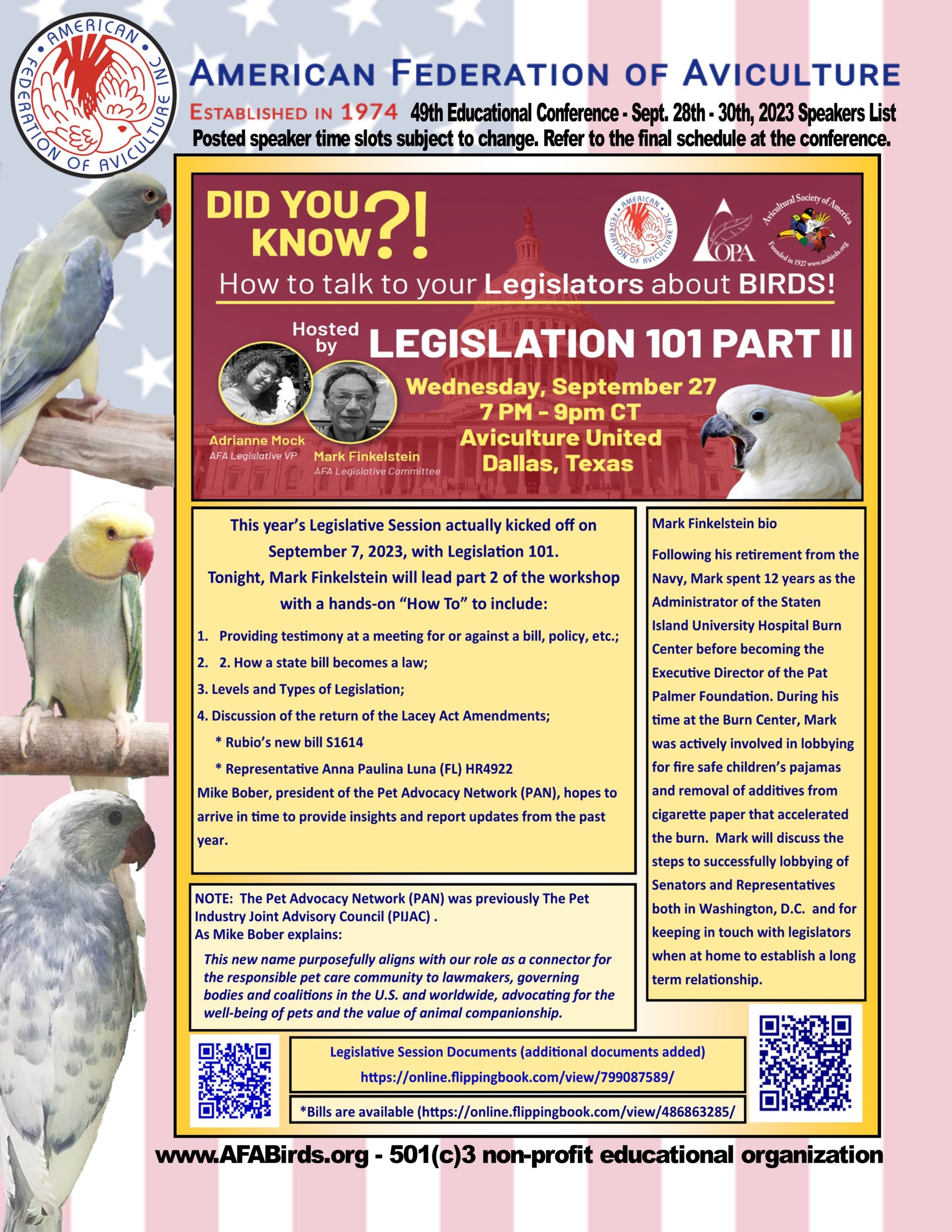
In response to these challenges, the AFA has developed resources like the "Legislation 101" training course to educate bird owners on how to interact with their representatives. The organization emphasizes that advocacy is most effective when it is proactive rather than reactive.
Legal analysts within the aviculture community argue that the best way to protect the future of bird keeping is through the promotion of "Positive Lists" or "Responsible Ownership" models, rather than the "Negative Lists" often favored by animal rights groups. A negative list bans everything except what is specifically allowed, whereas the AFA’s approach focuses on ensuring that owners have the education and resources to provide proper care for their birds.
Broader Impact and Future Implications
The implications of failing to monitor legislation extend beyond the individual bird owner. If restrictive laws are passed in one state, they often serve as templates for other states. This "domino effect" can lead to a fragmented legal landscape where it becomes nearly impossible to move birds across state lines for breeding or sale, even if the species is not endangered.
Furthermore, the loss of private aviculture would have a devastating impact on conservation efforts. Many species of birds that are extinct or critically endangered in the wild continue to thrive in captive environments maintained by private breeders. These captive populations serve as a genetic reservoir that could be used for future reintroduction programs. If legislation makes it impossible for private individuals to keep and breed these birds, a vital pillar of global avian conservation could be lost.
The AFA continues to urge its members and the general public to stay informed through their "Current Legislative Issues" portal. By tracking bills from their inception, bird owners can voice their concerns to legislators before a bill becomes law. The organization maintains that the eventual elimination of birds from private life is not an impossibility, but a potential reality if the community remains silent in the face of increasing legislative pressure. As the legal definitions of "pet," "exotic," and "welfare" continue to be debated in state houses and city halls, the role of the informed citizen remains the most effective defense for the future of aviculture.

