


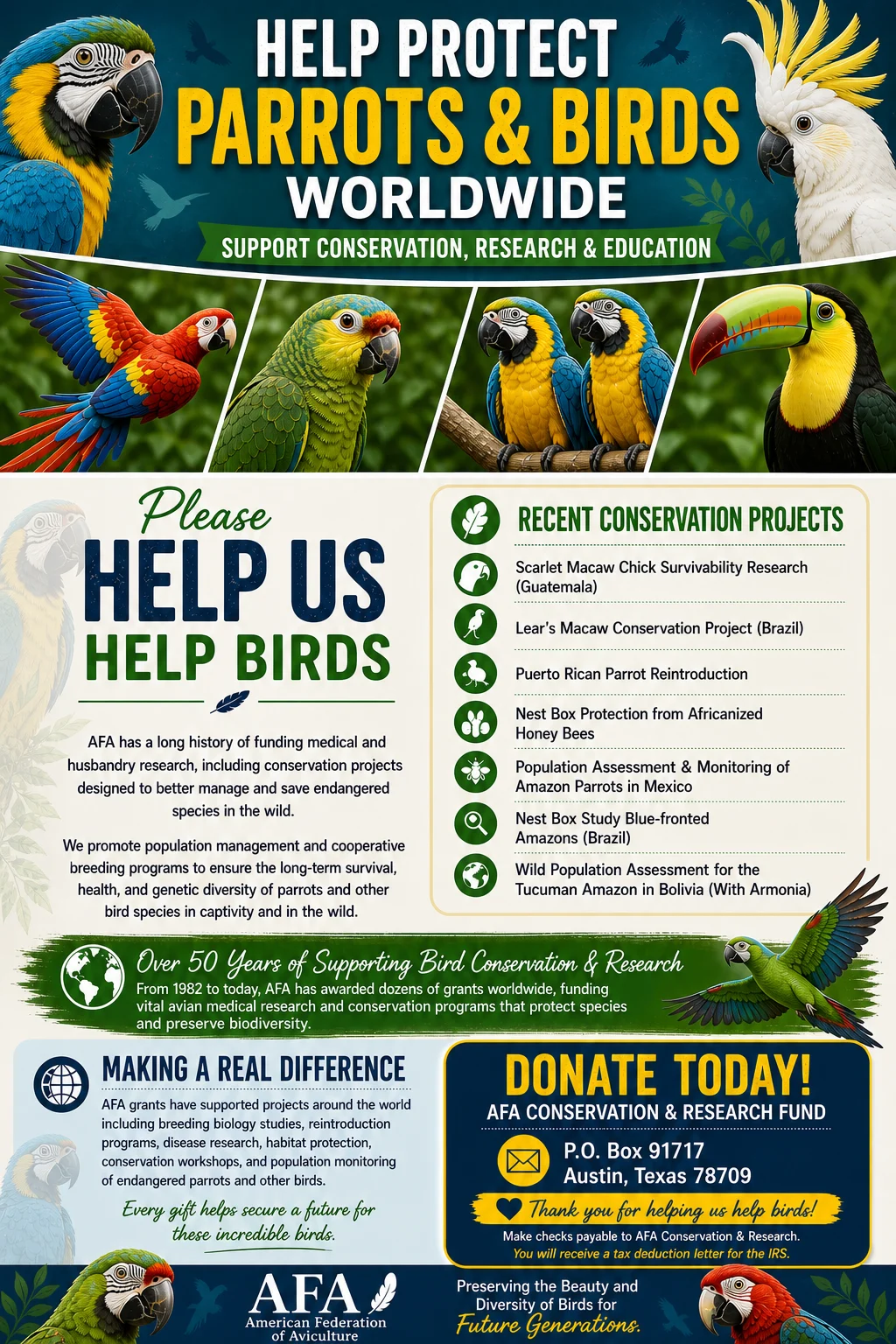
The American Federation of Aviculture (AFA) has officially launched its 2024-2025 conservation cycle, underscored by a significant $25,000 contribution from Harrison’s Bird Foods to bolster wild parrot protection efforts. This partnership aims to provide critical funding for field research, habitat restoration, and species recovery programs across Latin America and beyond. AFA Chief Financial Officer Janice Lang recently accepted the donation, which serves as the cornerstone for the organization’s small-grant program, designed to assist biologists and researchers working directly within native avian habitats. As wild parrot populations face increasing pressure from habitat loss and the illegal wildlife trade, the AFA’s latest initiative represents a coordinated effort between the captive avicultural community and field-based conservationists to ensure the long-term survival of endangered psittacines.
Strategic Allocation of Conservation Grants
The AFA Conservation Committee has established a rigorous framework for the 2024-2025 funding season, prioritizing projects that align with the organization’s mission to promote avian welfare through research and education. While the AFA typically provides modest annual grants of $500 or less to a wide variety of applicants, the partnership with Harrison’s Bird Foods allows for the support of high-impact projects that require specialized equipment and sustained financial commitment.
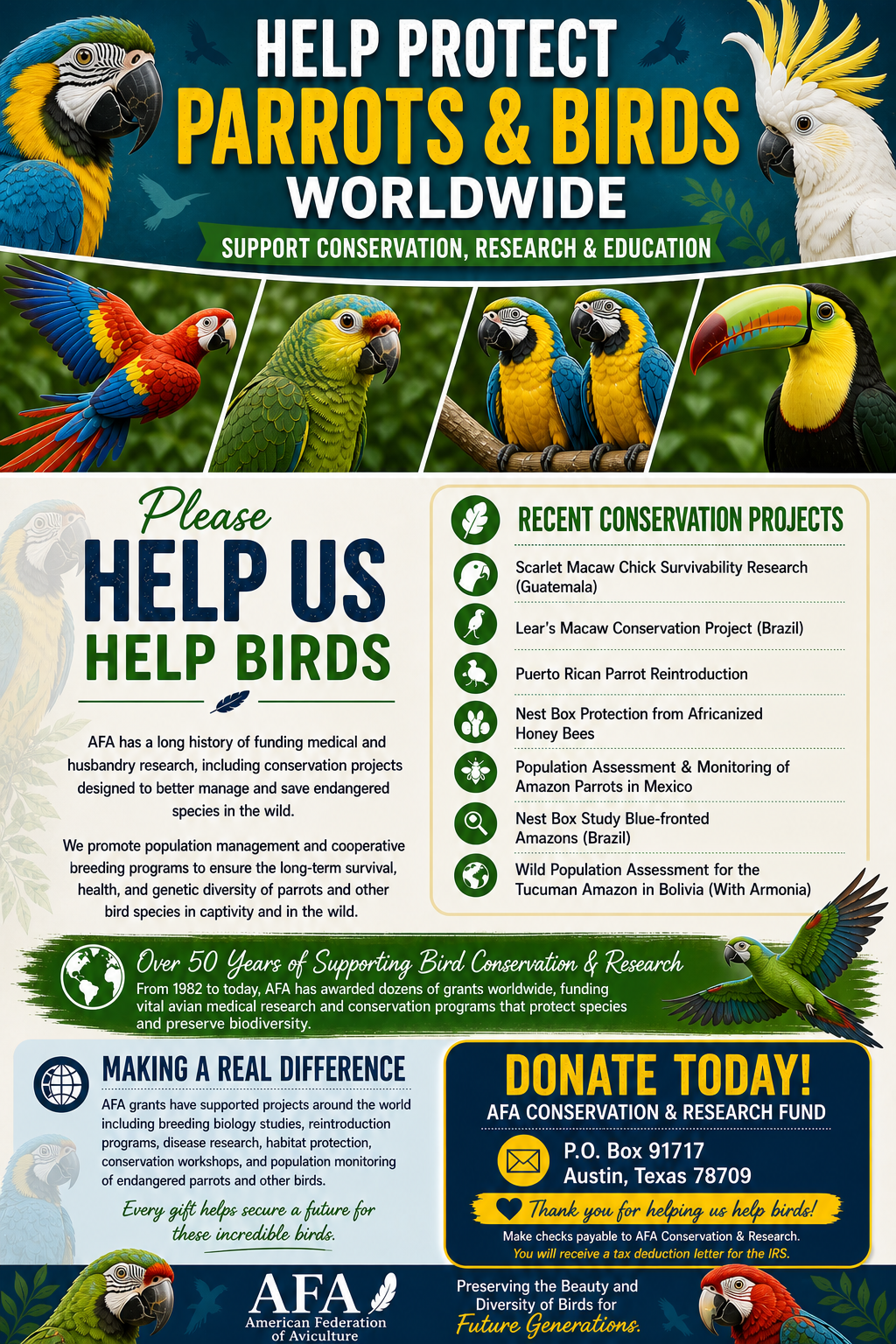
For the current cycle, the AFA is focusing heavily on the Lacandon rainforest of southern Mexico through the Chajul Biology Station and Natura Mexicana. This project is vital for the survival of wild Scarlet Macaws (Ara macao), which have historically suffered near-zero percent fledging rates due to intense poaching for the international pet trade. Biologists at the station engage in intensive nest monitoring and hand-rearing of wild-hatched chicks that are later released back into the forest. To date, the program has successfully fledged over 150 macaws. The 2024 fundraising goal specifically targets $5,000 to procure essential veterinary and husbandry equipment, including incubators, brooders, and medical supplies necessary for neonatal care in the field.
Advancing Research in Guatemala and Peru
Beyond the efforts in Mexico, the AFA is providing support to the Selva Maya Living Landscape Program, managed by the Wildlife Conservation Society (WCS) in Guatemala. Since 2002, the WCS has worked within the Maya Biosphere Reserve to mitigate threats to Scarlet Macaw populations. Current interventions focus on experimental techniques to increase chick survivability and recruitment. This project treats the Scarlet Macaw as a "landscape species," meaning its health is viewed as a primary indicator of the overall ecological integrity of the Selva Maya region.
In Peru, the AFA continues its long-standing collaboration with the Tambopata Macaw Project. This initiative is currently focused on two primary scientific frontiers: hematology and the mystery of clay lick usage. Principal investigators J. Jill Heatley, Lizzie Ortiz-cam, and Donald Brightsmith are conducting field-side blood analysis using i-STAT analyzers to establish physiological baselines for wild macaws. These data are crucial for avian veterinarians and conservationists alike, providing a benchmark for assessing the health of both wild and captive populations. Furthermore, the research into clay licks—geographic features where parrots congregate to consume soil—seeks to determine if these sites provide essential electrolytes or serve as a detoxifying mechanism against secondary plant compounds.
Innovative Solutions for Nest Box Competition
A unique challenge in parrot conservation is the competition for nesting sites, particularly from invasive or aggressive species. The AFA is currently supporting the work of Caroline A. Efstathion, who has developed a "push-pull" protocol to protect parrot nest boxes from colonization by Africanized honey bees. This method utilizes permethrin, a bird-safe insecticide, to repel scout bees from avian nesting sites while simultaneously using pheromone-baited traps to draw them toward more suitable locations.
The success of this protocol is being documented for future publication, with the goal of providing a low-cost, replicable solution for conservationists worldwide. By reducing nest site competition, researchers can significantly improve the reproductive success of secondary cavity nesters like parrots, which do not excavate their own holes and are therefore limited by the availability of natural hollows.
Supporting Local Economies through the Lear’s Macaw Corn Subsidy
In Brazil, the AFA is engaged in a socio-ecological initiative known as the Lear’s Macaw Corn Subsidy Program. The Lear’s Macaw (Anodorhynchus leari) frequently forages on corn crops grown by local farmers, leading to human-wildlife conflict. To prevent retaliatory killing of these endangered birds, the AFA and its partners provide corn subsidies to affected farmers. This program compensates the local community for their losses, transforming the macaws from a perceived pest into a protected asset, thereby fostering a culture of conservation within the birds’ native range.

Historical Foundations and the Legislative Umbrella
The AFA’s commitment to conservation is rooted in its 1974 founding, a response to a catastrophic outbreak of Exotic Newcastle Disease in California. During that period, the USDA euthanized thousands of healthy exotic birds in private collections to contain the virus. The subsequent threat of restrictive legislation prompted bird owners and clubs to form the AFA as a national umbrella organization.
Today, the AFA serves as a critical link between the private sector and international regulatory bodies. The organization holds official Non-Governmental Observer (NGO) status at CITES (Convention on International Trade in Endangered Species of Wild Fauna and Flora) meetings. This allows the AFA to represent the interests of aviculturists and provide expert testimony on the breeding and trade of parrots. By monitoring the Federal Register and participating in CITES Animal Committee meetings, the AFA ensures that domestic and international regulations remain grounded in scientific reality rather than political pressure.
Navigating the Legal Landscape: CITES, WBCA, and ESA
A significant portion of the AFA’s mission involves educating the public on the complex web of laws governing bird ownership and movement. Central to this is the Wild Bird Conservation Act (WBCA) of 1992, which largely halted the mass importation of wild-caught birds into the United States. While the WBCA serves as a "ban" on many species, it includes provisions for "Cooperative Breeding Programs" (CBPs) and an "Exempt List" of captive-bred species that can still be legally imported under specific conditions.

The U.S. Endangered Species Act (ESA) of 1973 provides another layer of protection. While CITES regulates international trade, the ESA governs domestic activities. Species listed under the ESA, such as the Thick-billed Parrot or the Lear’s Macaw, cannot be sold across state lines without specific federal permits, such as an Interstate Commerce Permit or a Captive-bred Wildlife Permit. The AFA provides resources to help breeders navigate these requirements, ensuring that captive populations remain genetically diverse and legally compliant.
The Role of Cooperative Breeding Programs
To maintain self-sustaining populations of exotic birds in the U.S. without relying on wild-caught specimens, the AFA oversees several Cooperative Breeding Programs. These programs, approved by the U.S. Fish and Wildlife Service (USFWS), allow for the limited importation of specific species to broaden the genetic pool. Notable past and present CBPs overseen by the AFA include those for the Red Siskin, Blue-headed Macaw, and the Javan Hill Mynah.
Current efforts are focused on the Blue-eyed Cockatoo (Cacatua ophthalmica) and various species of Black Cockatoos, including the Gang-gang and Red-tailed Black Cockatoos. Managed by Mary Ellen LePage, these programs require participants to adhere to strict reporting and husbandry standards. The ultimate goal is to establish robust, domestically raised populations that eliminate the need for further wild extraction while preserving the species for future generations.
Grant Application and Future Outlook
The AFA continues to invite researchers and conservationists to submit proposals for the 2025 funding cycle. The deadline for grant submissions is September 15 of each year. Proposals are evaluated based on their likelihood of success, their contribution to scientific knowledge, and their alignment with the AFA’s mission to promote avian welfare. Applicants are encouraged to provide concise outlines detailing project objectives, methodologies, and budget requirements.
As the organization looks toward the future, it remains dedicated to the integration of captive husbandry expertise and field biology. The upcoming International Parrot Conference in the Canary Islands, highlighted by the AFA as a key event for global collaboration, will serve as a platform for sharing the results of these funded projects. Through the continued support of partners like Harrison’s Bird Foods and the collective efforts of its worldwide membership, the American Federation of Aviculture remains at the forefront of the fight to protect the world’s avian heritage.
The intersection of scientific research, legislative advocacy, and community-based conservation forms a comprehensive strategy for avian survival. By supporting both the birds in our homes and those in the wild, the AFA ensures that the vibrant colors and complex behaviors of the world’s parrots will continue to thrive in their natural habitats for decades to come.

