


Fifty years after Donald Griffin’s groundbreaking proposition that nonhuman animals possess consciousness, the scientific community continues to grapple with the profound implications of animal awareness. Recent insights, summarized from Dr. Irene Pepperberg’s forthcoming work (2026), underscore the ongoing quest to define, detect, and understand consciousness beyond the human realm, particularly in non-primates like the highly intelligent Grey parrot. This exploration not only challenges anthropocentric views but also carries significant ethical weight for how humanity coexists with other species.
Historical Context: A Paradigm Shift in Understanding Animal Minds
The journey to acknowledging nonhuman consciousness began in earnest with Donald Griffin’s seminal 1976 book, The Question of Animal Awareness. At a time when the prevailing scientific consensus largely dismissed animals as mere instinctual automata or creatures whose behaviors were solely dictated by reward and punishment mechanisms (as detailed in Pepperberg, 1999), Griffin’s assertion was nothing short of revolutionary. He dared to propose that animals might experience subjective states, possess self-awareness, and engage in cognitive processes akin to humans. This concept was met with considerable skepticism, challenging long-held philosophical and scientific doctrines that placed humans uniquely at the apex of cognitive complexity.
The resistance stemmed partly from the inherent difficulty in observing and quantifying internal states. Without language to articulate their experiences, how could one truly know what an animal "feels" or "thinks"? Early behaviorism, dominant in the mid-20th century, intentionally eschewed mentalistic explanations, focusing exclusively on observable behaviors. Griffin’s work forced a re-evaluation, opening the door for future generations of researchers, including Dr. Pepperberg, to meticulously design experiments that could probe deeper into animal minds.
Defining Consciousness: The Elusive Quest
Even today, defining and proving consciousness, whether in humans or nonhumans, remains one of science’s most formidable challenges. The debate often hinges on the distinction between sentience—the capacity to feel, perceive, or experience subjectively—and higher-order consciousness, which includes self-awareness, metacognition (awareness of one’s own thoughts), executive control, and the ability to reflect on one’s experiences. While many studies initially focused on sentience, often through the lens of pain perception due to its more straightforward measurability, this approach is recognized as insufficient for arguing human-like consciousness. As Pepperberg (2026) notes, sensitivity to pain is a necessary aspect but not a sufficient one.
The complexity is compounded by the inherent difficulty humans face in evaluating their own emotions, let alone those of another species. Researchers like Birch et al. (2020) and Bayne et al. (2024) have developed intricate metrics to assess animal consciousness, but these often face criticism for being overly biased towards human cognitive capacities. This anthropocentric trap makes it challenging to design truly objective tests that account for species-specific forms of intelligence and experience.
In the year 2000, Dr. Pepperberg, alongside S. K. Lynn, proposed a framework suggesting that consciousness might exist in levels, directly correlated with a species’ quantifiable cognitive abilities. This framework posited that such cognitive processing levels likely arose from homologous or convergent brain evolution, shared perceptual structures, and similar learning mechanisms. However, this approach immediately introduced another layer of complexity: identifying "neural correlates of consciousness" (NCCs) that could apply across diverse species. The search for NCCs is still ongoing even in humans (Cognitive Consortium, 2025), making cross-species comparisons exceptionally difficult.
Adding to this conceptual maze is the astonishing progress in Artificial Intelligence (AI). Modern AI systems can demonstrate impressive levels of cognitive processing, solving complex problems and even generating creative content. If processing power alone were the determinant, AI might be considered conscious. Yet, as Block (2025) discusses, current AI systems demonstrably lack self-awareness, prompting a re-evaluation of whether the focus should return to sentience rather than merely higher-order cognitive processing. Full consciousness, according to Pepperberg (2026), encompasses not only sensory and mental state monitoring but also executive control, voluntary action, and crucially, awareness that one is aware—a "meta-awareness" that is notoriously difficult to examine in nonhumans lacking symbolic language to report such internal states.
Avian Cognition: The Grey Parrot as a Case Study
Against this backdrop of complex theoretical debate, the Grey parrot (Psittacus erithacus) has emerged as a crucial model organism, largely thanks to the pioneering work of Dr. Irene Pepperberg. Her research, famously with Alex and more recently with Griffin, has provided compelling behavioral evidence that pushes the boundaries of our understanding of avian intelligence and, by extension, consciousness.
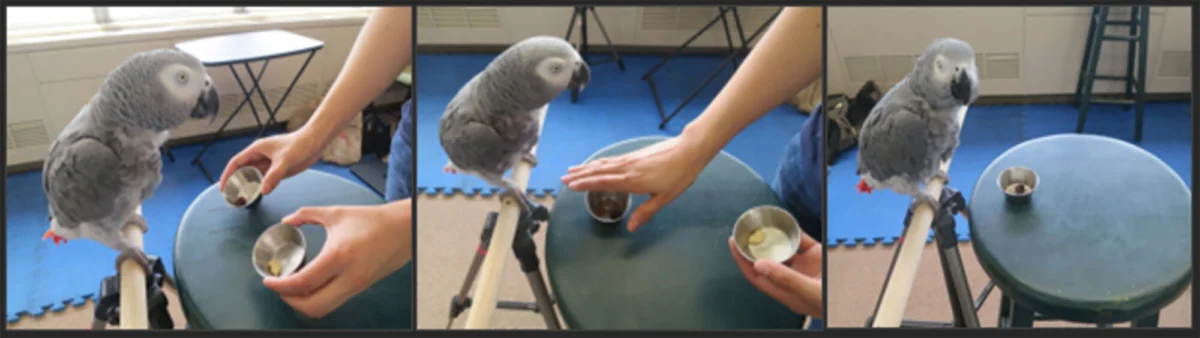
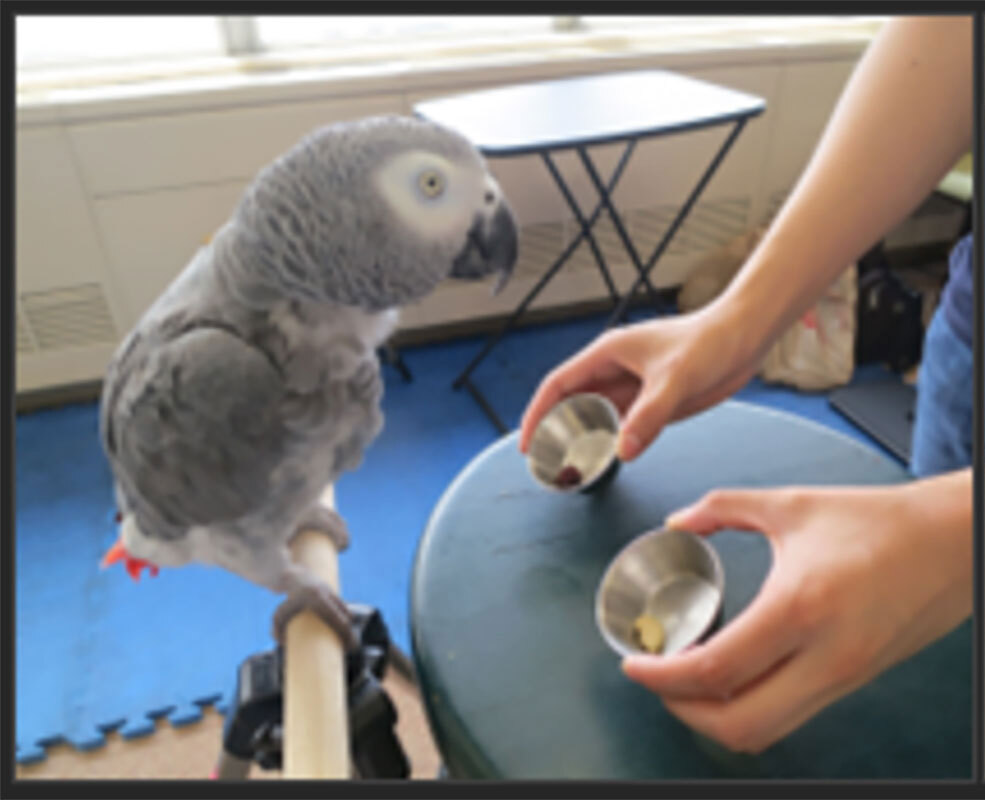
One of the most potent demonstrations of self-awareness in Grey parrots comes from their performance in delayed gratification tasks. These experiments, detailed in studies such as Koepke et al. (2015), Pepperberg & Hartsfield (2023), and Pepperberg & Rosenberger (2022), involve presenting a parrot with an immediate, less desirable reward and the option to wait for a later, more appealing or larger treat. For an animal to succeed in such a task, it must exhibit a suite of complex cognitive abilities:
- Impulse Suppression: The subject must recognize, understand, and actively suppress immediate impulses, needs, and desires.
- Goal Conflict Resolution: It must comprehend the inherent conflict between immediate gratification and a longer-term, more beneficial goal.
- Working Memory: The long-term goal must be actively maintained in memory throughout the delay period.
- Strategic Planning: The animal must devise and execute a strategy, actively engaging its thoughts, to achieve the desired future outcome.
Grey parrots, exemplified by Griffin, have shown remarkable aptitude in these tasks. In typical scenarios, Griffin might be shown two different sets of rewards, then one is taken away, and the other is briefly covered while he is told to "wait." During the delay, he sits with the less appealing, but still desired, reward, resisting the urge to consume it in anticipation of a superior treat. This behavior goes far beyond simple associative learning; it suggests an internal model of future states, an ability to inhibit immediate desires, and a capacity for strategic thinking that strongly hints at self-awareness. While Dr. Pepperberg acknowledges potential issues and alternative explanations for delayed gratification tasks (Pepperberg, 2026), the consistent success of Grey parrots provides significant insights into their cognitive depth.
The New York Declaration: A Call for Recognition
The growing body of evidence, including that from avian studies, culminated in the "New York Declaration on Animal Consciousness" in April 2024 (Andrews et al., 2024). Signed by hundreds of scientists, the declaration asserts "strong scientific support" for nonhuman consciousness in mammals, birds, and potentially all other vertebrates. This declaration represents a significant shift from the skepticism of Griffin’s era, reflecting a broad scientific consensus that the question is no longer if animals are conscious, but how and to what extent.
The declaration, while not providing proof in the strictest sense (a feat difficult even for human consciousness), serves as a powerful statement from the scientific community. It acts as a moral and intellectual pivot point, urging further research and, critically, influencing ethical considerations.
AI and the Consciousness Conundrum
The emergence of sophisticated AI systems has added an unexpected layer to the debate on consciousness. AI can perform tasks that once seemed exclusive to conscious minds – from complex problem-solving to creative endeavors. However, the fundamental difference lies in self-awareness. While AI can process vast amounts of data and mimic human-like responses, there’s no evidence it possesses a subjective inner experience or an awareness of its own existence. This distinction reinforces the idea that consciousness is not merely about processing power or information integration, but about a qualitative, subjective experience. This paradox forces researchers to refine their definitions and tests, ensuring they don’t conflate complex algorithmic performance with genuine self-awareness.
Ethical Imperatives: Coexistence and Responsibility
The implications of demonstrating nonhuman consciousness extend far beyond academic curiosity. If animals, particularly those with demonstrated cognitive complexities like Grey parrots, possess levels of self-awareness, it fundamentally alters humanity’s ethical obligations towards them. As Pepperberg (2026) argues, while rigorous scientific certainty is crucial for theoretical understanding, a different standard might be necessary when considering how best to coexist with nonhumans.
In the spirit of the "Do no harm" principle, as articulated in the New York Declaration, any material indicative of consciousness should be integrated into protocols concerning animal welfare, humane treatment, and conservation. This means that if there is strong suggestive evidence, even if not absolute proof, for a bird’s capacity for complex emotions, strategic thinking, or self-awareness, it should influence how we keep them in captivity, how we interact with them in research, and how we protect their wild populations. For instance, understanding a Grey parrot’s capacity for delayed gratification suggests a rich inner life with preferences and future-oriented thinking, demanding environments that stimulate these cognitive abilities rather than merely providing basic sustenance.
Future Directions and Ongoing Challenges
The quest to fully comprehend nonhuman consciousness is far from over. Future research will undoubtedly continue to develop more refined metrics, leveraging advances in neuroscience, cognitive psychology, and ethology. The challenge remains to design experiments that are free from anthropocentric biases, capable of probing the unique subjective experiences of different species. This will involve:
- Cross-species Comparative Studies: Expanding research beyond primates and birds to a wider range of vertebrates and even invertebrates, as suggested by some researchers.
- Neurological Correlates: Continued search for NCCs in diverse animal brains, perhaps focusing on convergent evolutionary pathways rather than exact structural homologies.
- Behavioral Innovations: Developing novel behavioral tasks that require demonstrable self-awareness without relying on linguistic reportage.
- Ethical Frameworks: Establishing robust ethical frameworks that evolve with scientific understanding, ensuring that research respects animal welfare while advancing knowledge.
The work summarized by Dr. Irene Pepperberg (2026) serves as a vital contribution to this ongoing scientific and philosophical journey. It underscores that while the definitive "proof" of consciousness remains elusive, the accumulating evidence, particularly from the extraordinary cognitive abilities of species like the Grey parrot, compels us to reconsider our place in the natural world and our responsibilities to its diverse, complex inhabitants. The question is no longer whether animals are conscious, but how deeply we are willing to look, and what profound shifts in our worldview we are prepared to embrace once we truly understand.

