


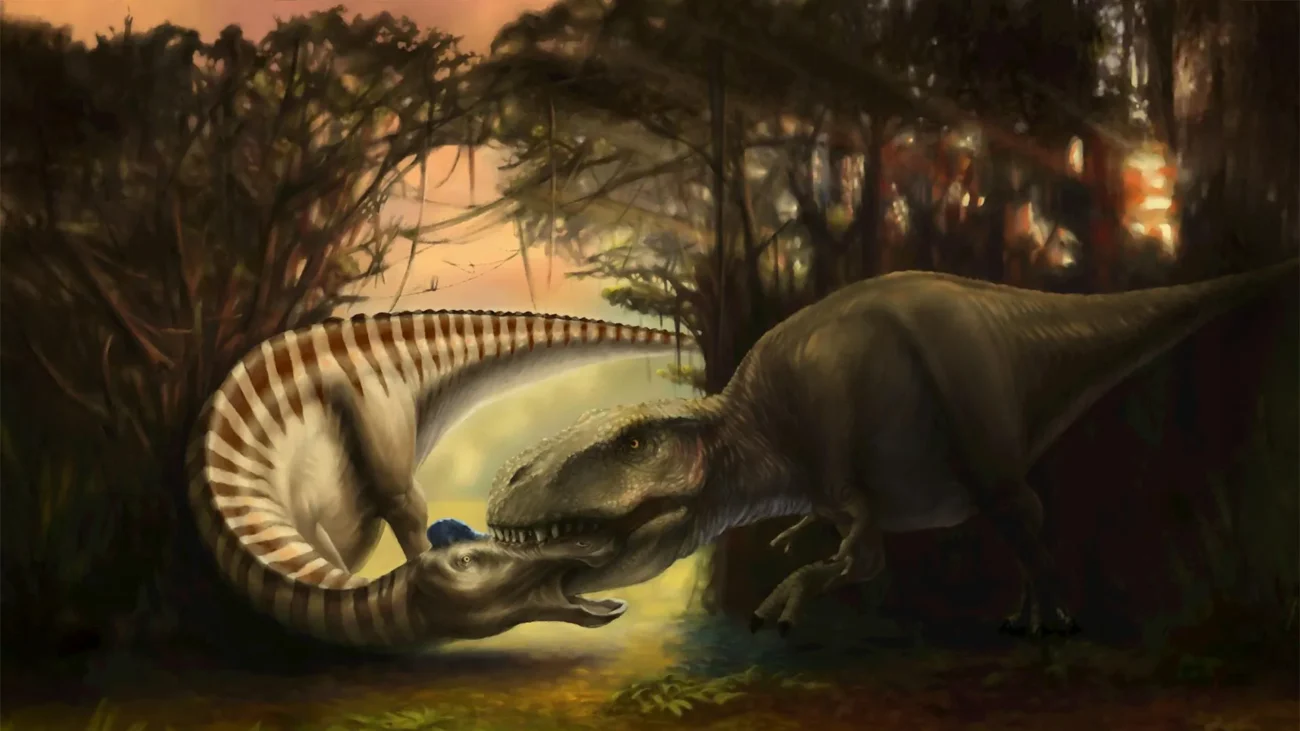
A remarkable fossil discovery at Montana State University’s Museum of the Rockies is providing scientists with an exceptionally detailed look into the hunting and feeding behaviors of Tyrannosaurus rex, the apex predator of the Late Cretaceous period. This extraordinary specimen, featuring a tyrannosaur tooth still lodged within the skull of another dinosaur, is the subject of a groundbreaking new study by researchers from Montana State University and the University of Alberta, Canada. The findings, published in the peer-reviewed journal PeerJ, are shedding new light on a long-standing scientific debate about how these colossal carnivores may have subdued their prey.
The Cretaceous Confrontation: A Violent Encounter Preserved in Stone
Approximately 66 million years ago, at the twilight of the Age of Dinosaurs, the North American continent was a vastly different landscape. In what is now Montana, Tyrannosaurus rex reigned supreme, a fearsome predator that dwarfed most other creatures sharing its domain. This formidable carnivore coexisted with a diverse array of megafauna, including the heavily armored Triceratops and the large, duck-billed herbivore Edmontosaurus. It is within this ancient ecosystem that the dramatic encounter, now frozen in time, took place.
The fossil in question, a nearly complete Edmontosaurus skull, was unearthed in 2005 by researchers working in the Hell Creek Formation of eastern Montana. This geological formation, renowned for its rich fossil deposits, has yielded a wealth of information about the final years of the dinosaurs. The skull, now a prized possession of the Museum of the Rockies’ paleontology collection, possesses a singular feature that immediately captured the attention of scientists: a broken tyrannosaur tooth, deeply embedded in the bone of the Edmontosaurus’s face.
This specimen has since become the focal point of a comprehensive collaborative investigation. Leading the research were Taia Wyenberg-Henzler, a doctoral student at the University of Alberta, and John Scannella, Curator of Paleontology at the Museum of the Rockies. Their meticulous analysis has provided an unprecedented window into the mechanics of a tyrannosaur attack.
Decoding the Evidence: A Tyrannosaur Tooth as a Forensic Tool
The significance of finding an embedded tooth cannot be overstated. While bite marks on dinosaur bones are a relatively common paleontological discovery, providing evidence of predation, finding an actual tooth lodged within the bone is exceptionally rare. "The great thing about an embedded tooth, particularly in a skull, is it gives you the identity of not only who was bitten but also who did the biting," explained Wyenberg-Henzler. "This allowed us to paint a picture of what happened to this Edmontosaurus, kind of like Cretaceous crime scene investigators."
To definitively identify the predator responsible for the fatal bite, the researchers undertook a rigorous comparative analysis. They meticulously compared the embedded tooth with the dental records of every known meat-eating dinosaur species that inhabited the Hell Creek Formation during the Late Cretaceous. This painstaking process led to an unambiguous conclusion: the tooth belonged to a Tyrannosaurus rex.
Further enhancing the study’s depth were advanced imaging techniques. Computed Tomography (CT) scans, performed at Advanced Medical Imaging at Bozeman Health Deaconess Hospital, provided invaluable three-dimensional detail of the skull and the embedded tooth. These scans allowed the researchers to analyze the precise angle and depth of the tooth’s penetration, offering critical clues about the force and nature of the attack.
Reconstructing the Final Moments: Insights from the Fossil Record
The presence of the embedded tooth offers a tangible link to a violent moment in prehistoric history. The skull itself exhibits no signs of healing around the area where the tooth is lodged. This observation is crucial for understanding the timeline of events. "The skull shows no signs of healing around the tyrannosaur tooth, so it may have already been dead when it was bitten, or it may be dead because it was bitten," stated Scannella. This suggests that the bite likely occurred either during the final moments of the Edmontosaurus’s life or immediately after its demise, during the process of scavenging or feeding.
The position of the embedded tooth has provided particularly compelling evidence regarding the predator-prey interaction. Wyenberg-Henzler elaborated on these findings: "Looking at the way the tooth is embedded in the nose of the Edmontosaurus suggests that it met its attacker face-to-face, something that usually happens to an animal that was killed by a predator." This direct confrontation implies that the Edmontosaurus may have been alive and aware of its attacker at the moment of the bite, or that the tyrannosaur approached it from the front, perhaps while it was already incapacitated or already dead and being investigated.
The sheer force required to break off a tooth of such size and density within bone is another significant indicator of the tyrannosaur’s power. "The amount of force necessary for a tooth to have become broken off in bone also points to the use of deadly force," Wyenberg-Henzler emphasized. "For me, this paints a terrifying picture of the last moments of this Edmontosaurus."
A Deeper Understanding of Tyrannosaurus Rex Behavior
The feeding habits and hunting strategies of Tyrannosaurus rex have been a subject of intense scientific debate for decades. As one of the largest and most formidable terrestrial carnivores to have ever existed, its predatory prowess has captivated paleontologists and the public alike. While the iconic image of T. rex is often that of an active hunter, some researchers have posited that it may have also been a significant scavenger.
This new fossil evidence adds a crucial piece to the complex puzzle of T. rex behavior. The direct evidence of a tooth embedded during a forceful bite, particularly in the facial region, suggests a predatory act that involved significant force and potentially a direct engagement with the prey. The fact that the tooth broke off indicates the immense power of the tyrannosaur’s bite, estimated to be among the strongest of any terrestrial animal in Earth’s history. Studies on the biomechanics of T. rex jaws have suggested bite forces exceeding 12,800 pounds per square inch, capable of crushing bone.
Chronology of Discovery and Research
- 2005: The nearly complete Edmontosaurus skull is discovered in the Hell Creek Formation of eastern Montana by researchers.
- Post-2005: The fossil is accessioned into the Museum of the Rockies’ paleontology collection, where its unique feature – the embedded tooth – is noted.
- Undisclosed Date: A collaborative research project is initiated, led by Taia Wyenberg-Henzler (University of Alberta) and John Scannella (Museum of the Rockies).
- Undisclosed Date: CT scans of the fossil are performed at Advanced Medical Imaging at Bozeman Health Deaconess Hospital to provide detailed anatomical information.
- Undisclosed Date: The embedded tooth is meticulously compared with teeth of known predatory dinosaurs from the Hell Creek Formation.
- Present: The findings of the research are published in the scientific journal PeerJ, making the discovery publicly available.
Supporting Data and Scientific Context
The Hell Creek Formation, where this fossil was found, represents a rich snapshot of the North American ecosystem during the Maastrichtian age of the Late Cretaceous epoch, the final stages before the Cretaceous-Paleogene extinction event. This formation is characterized by its abundance of dinosaur fossils, including numerous specimens of Edmontosaurus and Tyrannosaurus rex, as well as Triceratops, Ankylosaurus, and various smaller dinosaurs and early mammals. The co-occurrence of these species in the fossil record strongly supports the predator-prey relationships that are now being illuminated by this new discovery.
The identification of the predator as Tyrannosaurus rex is supported by extensive paleontological research on tyrannosaur dentition. Tyrannosaurus teeth are distinct in their shape and serration patterns, allowing for reliable identification. The force of their bite has been a subject of numerous biomechanical studies, using computer modeling and analysis of bone pathologies in fossilized remains. The embedded tooth in this Edmontosaurus skull provides direct, physical evidence that aligns with these existing scientific understandings of T. rex’s formidable capabilities.
Broader Implications and Future Research
This rare fossil discovery has significant implications for our understanding of dinosaur behavior and paleontology. It provides concrete evidence of the intensity of interactions between apex predators and their prey, moving beyond inferences drawn solely from bite marks or skeletal structures. The study reinforces the view of Tyrannosaurus rex as a highly effective predator, capable of delivering devastating blows.
The findings also highlight the importance of exceptional fossil preservation. Such unique specimens, like the embedded tooth, are invaluable for their ability to offer direct insights into behaviors that are otherwise difficult to reconstruct. They serve as tangible records of dynamic events that occurred millions of years ago.
Future research stemming from this discovery could involve further comparative analysis of other Edmontosaurus fossils from the Hell Creek Formation to identify additional instances of tyrannosaur predation. Advanced imaging techniques may also be employed to reveal more subtle details about the biomechanics of the bite and the potential defensive reactions of the Edmontosaurus. The ongoing study of this single, remarkable fossil promises to continue enriching our knowledge of the ancient world and the magnificent creatures that inhabited it.

