


A groundbreaking study published in the prestigious journal Science Advances on December 19, 2025, offers a compelling new perspective on the intricate dance of evolution, particularly within the complex social structures of ants. The research, led by scientists from the University of Maryland and the University of Cambridge, suggests that the age-old tension between quantity and quality – a fundamental trade-off seen across various biological systems – has played a pivotal role in shaping the evolutionary trajectory of ants, enabling the development of their remarkably large and diverse societies.
The core finding of this extensive research indicates that certain ant species have achieved evolutionary success not by investing in heavily armored, robust individual workers, but by prioritizing sheer numbers. This strategy involves a deliberate reduction in the resources allocated to each worker’s cuticle, the tough outer layer of their exoskeleton. By economizing on this metabolically expensive tissue, ant colonies are able to channel these freed-up nutrients and energy into producing a greater number of workers. This "cheaper worker" model, the researchers argue, has been a key driver behind the emergence of highly complex and diversified ant societies.
Ants: A Microcosm of Social Evolution
Ants, with their vast colony sizes ranging from a few dozen individuals to millions, provide an unparalleled model system for dissecting the principles of social evolution. Their ubiquitous presence across virtually every terrestrial ecosystem and their extraordinary diversification have long fascinated biologists. However, the fundamental biological strategies underpinning these successes have remained somewhat elusive until now.
"There’s this question in biology of what happens to individuals as societies they are in get more complex," explained senior author Evan Economo, chair of the Department of Entomology at the University of Maryland and holder of the James B. Gahan and Margaret H. Gahan Professorship. "For example, the individuals may themselves become simpler because tasks that a solitary organism would need to complete can be handled by a collective." This concept, where individuals become "cheaper" – requiring fewer resources to build and thus producible in greater numbers, even if less physically formidable – has been a theoretical cornerstone in evolutionary biology. However, Economo emphasized, "That idea hasn’t been explicitly tested with large-scale analyses of social insects until now."
The research team, including lead author Arthur Matte, a Ph.D. student in zoology at the University of Cambridge, hypothesized a direct link between colony size and the ant’s investment in its cuticle. This critical anatomical feature serves multiple vital functions: providing a protective barrier against predators, desiccation, and pathogens, as well as offering structural support for muscle attachment. Yet, its construction is resource-intensive, demanding limited nutrients like nitrogen and various minerals. A thicker cuticle necessitates a greater allocation of these resources, thereby imposing a ceiling on the number of individuals a colony can sustain.
Unraveling the Cuticle-Colony Size Connection
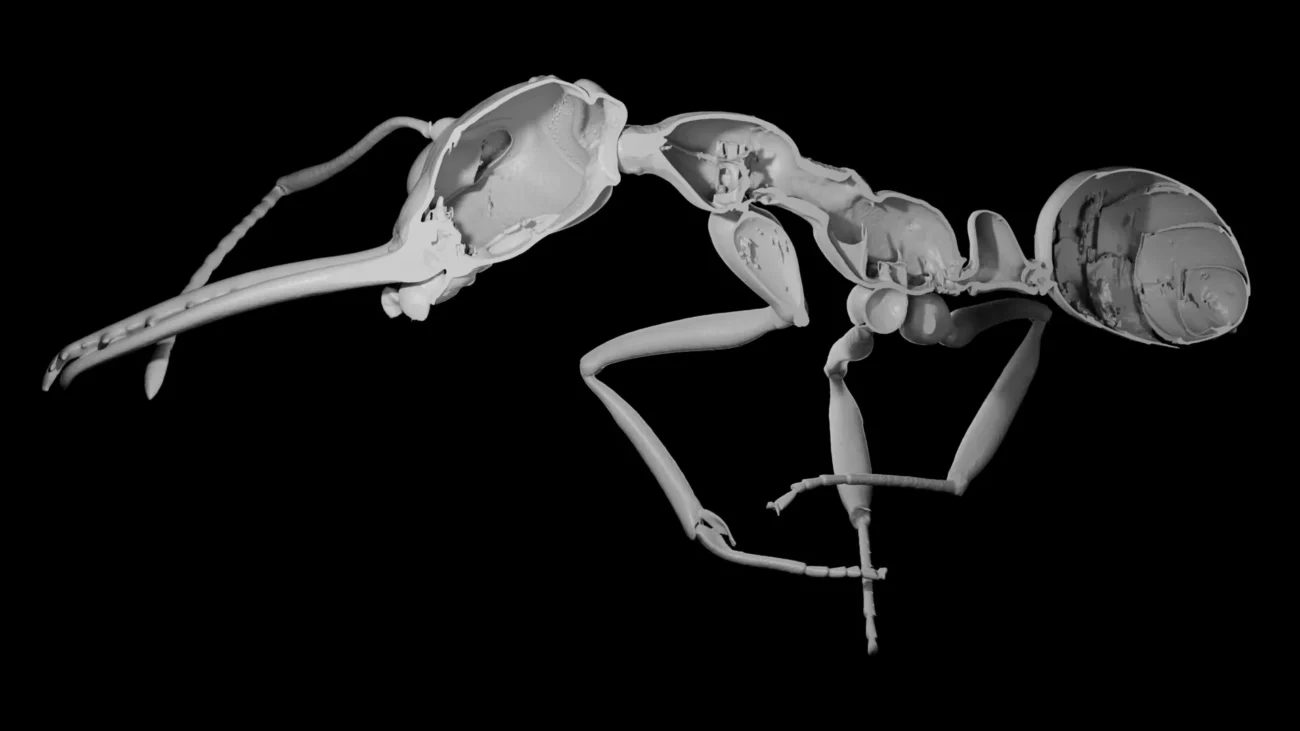
To empirically test their hypothesis, the researchers embarked on an ambitious data collection and analysis effort. They amassed a comprehensive dataset comprising 3D X-ray scans from over 500 ant species. This extensive catalog allowed for precise measurements of both total body volume and cuticle volume for each species. The analysis revealed a striking variation in cuticle investment, with percentages of body mass dedicated to this protective layer ranging from a mere 6% to a substantial 35%.
When these quantitative data were integrated into sophisticated evolutionary models, a clear and consistent pattern emerged: ant species that exhibited lower investment in their cuticles were overwhelmingly found to form significantly larger colonies. This finding provides robust empirical support for the "cheaper worker" hypothesis.
The Advantage of Collective Strength Over Individual Fortitude
While a thinner cuticle might intuitively suggest increased vulnerability for individual ants, the study posits that this very trade-off may have been instrumental in fostering the evolution of large, complex societies. Reduced individual armor, it is suggested, likely co-evolved with a suite of other beneficial social traits that become more pronounced as colony size increases. These include enhanced cooperative foraging strategies, sophisticated shared nest defense mechanisms, and a highly efficient division of labor, all of which contribute to the overall success and resilience of a populous colony.
"Ants reduce per-worker investment in one of the most nutritionally expensive tissues for the good of the collective," Matte elaborated. "They’re shifting from self-investment toward a distributed workforce, resulting in more complex societies. It’s a pattern that echoes the evolution of multicellularity, where cooperative units can be individually simpler than a solitary cell, yet collectively capable of far greater complexity."
Furthermore, the research uncovered an unexpected but significant correlation: lower investment in the cuticle was associated with higher rates of diversification. Diversification, a key metric for evolutionary success, reflects the frequency at which new species arise from existing ones. Economo highlighted the rarity of traits that can be directly linked to diversification in ants, making this finding particularly noteworthy.
Less Armor, More Species: The Speciation Enigma
The precise mechanisms by which reduced cuticle investment might promote speciation remain an area of active investigation. One leading theory suggests that ant species requiring fewer nutritional resources for cuticle development possess greater adaptability. This could enable them to colonize and thrive in environments with limited resources, where more demanding species might struggle.
"Requiring less nitrogen could make them more versatile and able to conquer new environments," Matte speculated, noting that he initiated this line of inquiry during his master’s program while interning in Economo’s lab at the Okinawa Institute of Science and Technology in Japan.
An alternative, yet complementary, perspective offered by the authors is that as ant societies grew in complexity, group-level defenses such as collective nest protection and sophisticated disease control mechanisms may have diminished the selective pressure for heavy individual armor. This could have initiated a self-reinforcing evolutionary cycle: lower cuticle investment permits larger colony growth, and larger colonies, in turn, further reduce the need for each ant to be individually robustly protected.
"I think of this as the evolution of squishability," Economo remarked with a chuckle. "Many kids have discovered that insects aren’t all equally robust." This lighthearted observation underscores the fundamental shift in evolutionary strategy observed.
The study also hints that similar evolutionary pathways may have been trodden by other social organisms, such as termites, although further research is required to confirm these parallels.
Broader Implications: Lessons from the Ant Hill
The insights gleaned from this study extend far beyond the realm of entomology, offering valuable perspectives on broader evolutionary and even human societal dynamics. The researchers draw parallels to historical shifts in human military strategy. The era of heavily armored knights, for instance, eventually gave way to armies composed of specialized, more numerous soldiers like archers and crossbowmen, echoing the quantity-over-quality principle. Economo also referenced Lanchester’s Laws, mathematical models developed during World War I that explore how superior numbers can overcome superior individual strength in combat.
"The tradeoff between quantity and quality is all around," Matte reflected. "It’s in the food you eat, the books you read, the offspring you want to raise. It was fascinating to retrace how ants handled it through their long evolution. We could see lineages taking different directions, being shaped by different constraints and environments, and ultimately giving rise to the extraordinary diversity we observe today."
This research, supported by grants from the Okinawa Institute of Science and Technology, the Japan Society for the Promotion of Science KAKENHI, the University of Cambridge, and the Research Grant Council of Hong Kong, represents a significant leap forward in our understanding of social evolution. By demonstrating a tangible link between reduced individual investment and the proliferation of complex, diversified societies, the study provides a powerful new lens through which to view the evolutionary forces that have shaped life on Earth, including our own. The intricate strategies employed by these tiny social engineers offer profound lessons about the adaptability and ingenuity inherent in the evolutionary process.

