


Migratory birds undertake extraordinary journeys, traversing vast distances that connect landscapes, countries, and even continents. These avian travelers rely on well-established routes known as flyways to navigate between their breeding and non-breeding grounds. A critical component of one such global route, the African-Eurasian Flyway, which spans from the Arctic to the southern reaches of Africa, is the Berg River Estuary in South Africa. Here, conservationists from BirdLife South Africa, in collaboration with the Royal Society for the Protection of Birds (RSPB) and with support from the Ecological Restoration Fund (ERF), are engaged in an ambitious project to safeguard these vital habitats and the birds that depend on them.
The Berg River Estuary: A Crucial Stopover for Migratory Birds
Located approximately two hours north of Cape Town along South Africa’s west coast, the Berg River Estuary is a biodiversity hotspot. It supports an impressive array of over 270 bird species, including significant populations of globally threatened species. For migratory birds, particularly waders, the estuary serves as an indispensable non-breeding site, offering crucial opportunities to rest and refuel during their arduous migrations.

"The estuary is a really important non-breeding site for birds to rest and refuel along the African-Eurasian Flyway," explains Giselle Murison, Western Cape Estuaries Programme Manager at BirdLife South Africa. "In the summer, we see a big influx of migratory waders which travel along the flyway from breeding grounds as far off as northern Europe."
Among the most abundant species observed are the Curlew Sandpiper (Calidris ferruginea) and the Little Stint (Calidris minuta). These small but resilient birds undertake journeys spanning thousands of kilometers, relying on the estuarine environment for survival. The Curlew Sandpiper, recently uplisted to Vulnerable status by the International Union for Conservation of Nature (IUCN), exemplifies the challenges faced by these migrants. Weighing between 50 and 70 grams, these birds can cover over 3,100 kilometers in just 45 hours, a testament to their incredible endurance.
A Mosaic of Habitats Vital for Ecosystem Health
The ecological significance of the Berg River Estuary extends beyond its role as a bird sanctuary. It is a crucial nursery area for a variety of fish species, including both estuarine and larger marine varieties. This ecological function directly supports the local economy, which relies heavily on fishing, salt production, and tourism.

The estuary itself is characterized by a diverse mosaic of interconnected habitats. This includes intertidal mudflats, saltmarshes, sedge marshes, reed marshes, salt pans, and open water. The health and integrity of each of these components are essential for the overall functioning of the estuarine system and the well-being of its inhabitants.
"The estuary itself is made up of a real mosaic of different habitats including intertidal mudflats and saltmarsh, sedge marsh, reed marsh, salt pans and open water. We need to conserve each part of the mosaic in order to ensure the overall health of the system," Murison emphasizes.
Project Initiatives: Combating Erosion and Unraveling Migration Mysteries
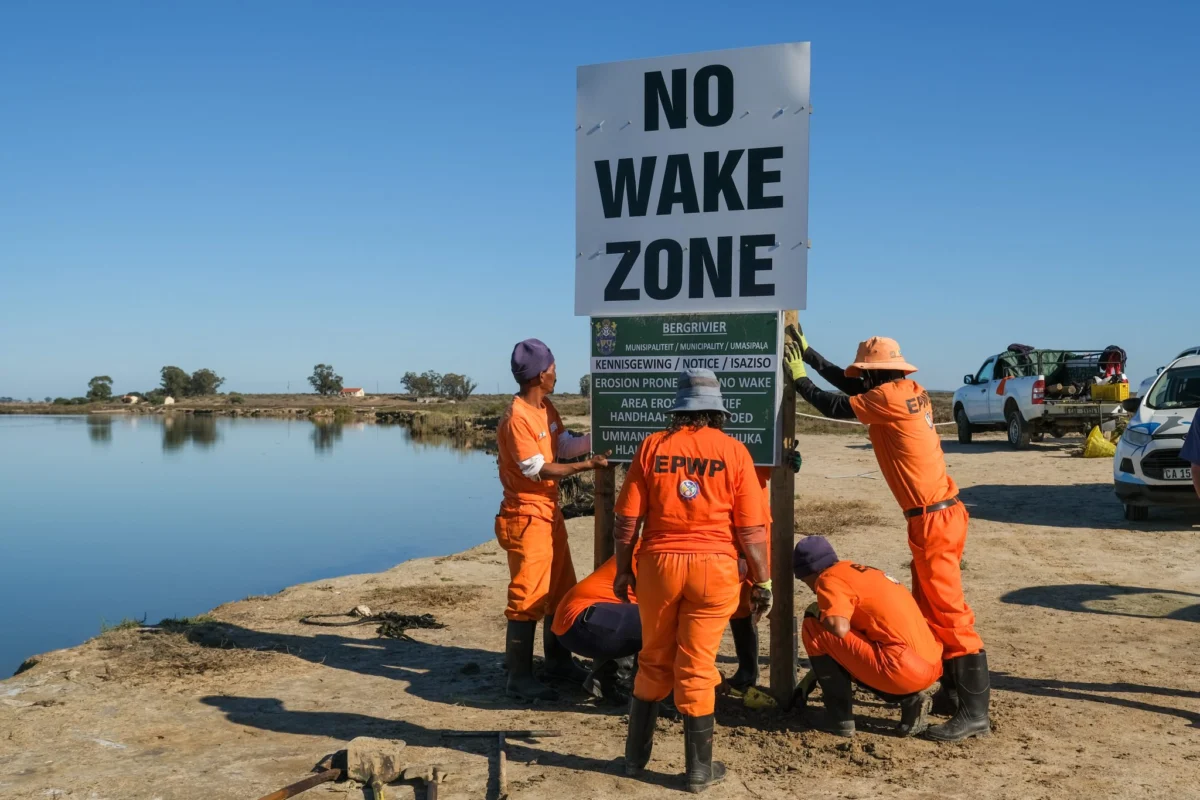
The ERF project, implemented in partnership with the RSPB, is tackling critical conservation challenges at the Berg River Estuary. One of the primary concerns is the loss of estuarine habitat due to accelerated erosion. To address this, the project is actively working with landowners to implement strategies for combating erosion and restoring degraded bank habitats.

"The loss of estuarine habitat is a big problem at the Berg and one of the ways we’re losing important habitat is through accelerated erosion," Murison states. "So through the RSPB and ERF project, we’ve been looking at ways that we can actually combat erosion and help landowners restore habitats along their banks to slow that erosion process."
A significant focus of the project involves the rehabilitation and monitoring of saltmarsh habitats. This includes the re-seeding of degraded areas and the implementation of environmentally sound soft engineering techniques to stabilize banks and mitigate erosion.
Beyond habitat restoration, the ERF project is also funding a groundbreaking satellite tagging and color-ringing initiative for Curlew Sandpipers and Grey Plovers (Pluvialis squatarola). This ambitious undertaking aims to shed light on the complex migratory patterns of these birds along the African-Eurasian Flyway.

"The ERF project has also helped fund a satellite tagging and colour-ringing project at the Berg for Curlew Sandpiper and Grey Plover," says Jessica Wilmot, Flyway & Migrants Project Manager at BirdLife South Africa. "It’s a really exciting project that we’ve recently launched to understand not only the localised movements, so how connected estuarine sites are along the west coast, but also the wider picture right along the flyway."
Unlocking the Secrets of Long-Distance Travel
The satellite tagging initiative represents a pioneering effort in South Africa for migratory waders. It seeks to answer fundamental questions about the birds’ journeys, including their routes from South Africa to their Arctic breeding grounds and the crucial stopover sites they utilize along the flyway.
"Tagging work of this kind has never really been done before for migratory waders in South Africa, so there are lots of questions to answer!" Wilmot explains. "For instance, from South Africa where do the birds travel to reach their breeding grounds in the Arctic tundra? What are the key stop-over sites for them, where they pause to rest and refuel, in the African-Eurasian Flyway? It’s really important to protect those sites too – they essentially connect the pathway that these birds use. So if those sites aren’t protected, then it forces the individuals to travel further distances, or they might not get enough food en route."

The initial results from this project have been remarkable. In February 2026, 20 Curlew Sandpipers and three Grey Plovers were tagged. Early data reveals astonishing migratory paths: one Curlew Sandpiper was tracked reaching South Sudan in a matter of hours, while others have crossed the Red Sea into Asia. Another individual took a divergent route, traversing the Sahara Desert towards Europe.
The expertise required for such advanced tracking has necessitated collaboration with international partners, including Wetlands International and the Max Planck Institute for Biological Intelligence. South Africa currently lacks the specialized expertise in trapping waders and attaching tiny trackers, making this collaboration a valuable upskilling opportunity for local conservationists.
A Call for Custodianship and Collective Action
The conservation efforts at the Berg River Estuary highlight the profound importance of flyway conservation and the interconnectedness of global ecosystems. Both Murison and Wilmot emphasize the need for broader public awareness and engagement.

"I wish people here saw migratory birds coming to South Africa as a privilege. We are in a way custodians of the environment that they’re dependent on for an entire season of their lives. And without those habitats, they won’t survive," Wilmot states. "I don’t think people realise the distances some birds travel, which is why putting trackers on is important, not just for the data, but so that people can actually visually see a map and realise – ‘My word! this bird is travelling 15,000 kilometres in two and a half months and manages to survive. What can I do to help protect that bird’s journey or alleviate the pressures that it’s already facing?’"
Murison echoes this sentiment, stressing the collaborative nature of flyway protection: "Protecting the African-Eurasian Flyway is a partnership effort. We are just one link in the chain and we all have to play our part to make sure that this important flyway is protected and the birds are conserved."
Challenges and Hope in Estuarine Conservation
Despite the critical ecological value of South Africa’s estuarine systems, they face significant threats and often lack adequate formal protection. The Berg River Estuary, despite being declared a Ramsar site in 2022—a designation recognizing its international importance for wetlands—still lacks formal protection status, a common situation for many estuaries in the country.

"South Africa’s estuarine systems are amongst the most threatened ecosystems in the country. They are incredibly productive but unfortunately they have very little formal protection," Murison notes. "At BirdLife South Africa we’re trying to increase formal protection of our estuaries, including the Berg, and improve its management."
The dedication of conservationists on the ground provides a powerful source of optimism. Wilmot observes, "It’s easy to become overwhelmed or feel hopeless at times but witnessing how birds survive despite the immense challenges they face every day is motivation enough to want to help protect them and the journeys they undertake." She adds, "I think caring deeply about the natural world is both a privilege and a burden – a privilege because of that innate connection with nature, which so many people have lost, and a burden because conservation can sometimes feel hopeless. But the people involved are some of the most passionate and inspiring individuals you’ll ever meet, and that gives me a lot of hope."
The Curlew Sandpiper: An Icon of Resilience
When asked to choose a single species to represent the flyway, Wilmot selects the Curlew Sandpiper, a bird that embodies both vulnerability and extraordinary resilience. "This little bird weighs between 50 and 70 grams and they fly vast distances – one of our tracked birds flew over 3,100km in just 45hrs – incredible! They’ve recently been uplisted to Vulnerable by the IUCN. And if you think about the challenges they have to overcome just to get here, and then still survive the threats that they face on a daily basis, it’s quite astounding. It’s crazy to think that they breed in areas where there’s snow and then they come here and acclimatise well enough to survive."

The conservation work at the Berg River Estuary is a vital piece of a larger global puzzle. By protecting this critical stopover point, BirdLife South Africa, with support from the RSPB and the ERF, is contributing to the survival of migratory birds and the health of the interconnected ecosystems they inhabit. The challenges are significant, but the passion and dedication of the conservationists, coupled with scientific advancements like satellite tracking, offer a promising outlook for the future of these remarkable avian travelers and the landscapes they connect.
Acknowledgements and Future Directions
The Ecological Restoration Fund (ERF) plays a crucial role in supporting initiatives that safeguard biodiverse hotspots, rejuvenate degraded landscapes, and promote local environmental activism. Its commitment lies in re-establishing nature’s essential interconnections while fostering cultural, social, and economic opportunities for the communities that depend on these landscapes. The ongoing work at the Berg River Estuary, including habitat restoration and advanced migratory bird research, directly aligns with the ERF’s mission. Future efforts will likely focus on expanding formal protection for estuaries, enhancing community engagement in conservation, and continuing the vital research that informs effective flyway management.

