


A giant barn owl, a rodent known as a hutia, and a burrowing bee entered a cave. Only two of them left. The one that remained behind was the one that could not fly. This seemingly simple riddle unlocks a remarkable scientific discovery, revealing how millennia ago, the skeletal remains of prey within a Caribbean cave became unexpected nurseries for a species of burrowing bee. The findings, published in the prestigious journal Proceedings of the Royal Society B, shed light on an unprecedented form of insect behavior and the intricate ways life adapts to its environment.
The narrative of the owl, hutia, and bee, while presented as a riddle, encapsulates a prehistoric ecological drama that played out on the island of Hispaniola. Evidence suggests that thousands of years ago, a giant barn owl, a formidable predator of its time, would regularly transport hutias – sizable Caribbean rodents – back to its den within a cave. These caves, like the Cueva de Mono in the southern Dominican Republic, served as consistent feeding grounds for these avian hunters, with generations of owls likely utilizing the same locations. The unfortunate hutias, once captured, would become sustenance for the owl’s young. Following these meals, the skeletal remnants of the hutias would be left behind, their jaws and other bones accumulating on the cave floor.
It was within this ancient tableau of predator and prey that a new chapter in the cave’s history began. Much later, a small burrowing bee, driven by its innate instinct to find a safe and suitable location to build its nest, entered the same cave. Unlike many of its insect cousins, this particular bee species sought out subterranean environments and, crucially, would excavate its brood cells within the earth. However, the cave’s interior, composed of fine, clay-rich silt that had accumulated over time, presented a unique challenge.
The Discovery: Unearthing an Ichnological Marvel
The groundbreaking discovery was not the result of a single, dramatic find, but rather the culmination of meticulous observation and persistent scientific inquiry. Lazaro Viñola Lopez, a doctoral student at the Florida Museum of Natural History, was conducting paleontological excavations at the Cueva de Mono. His focus was on a specific species of hutia, one that was rarely found elsewhere on the island, making the abundance of its fossils in this cave particularly significant. The sheer volume of hutia remains suggested that the cave had been a long-term, prime feeding site for giant barn owls over an extended period.
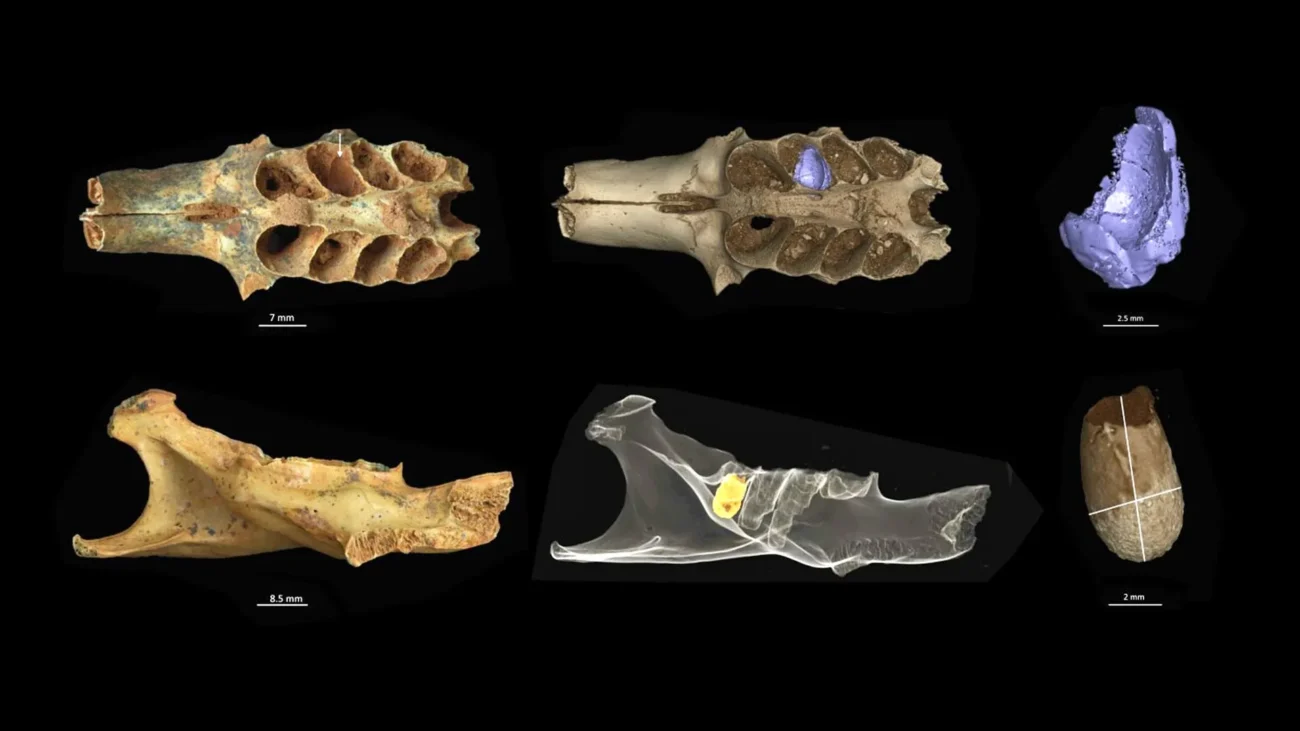
During the excavation process, Viñola Lopez adhered to a principle that often separates groundbreaking discoveries from routine finds: careful inspection. While the standard practice in fossil collection involves thoroughly cleaning out any sediment or debris from bone cavities, including the alveoli – the small sockets in the jawbone where teeth were once anchored – Viñola Lopez was drawn to something unusual. He noticed that some of these alveoli, instead of being rough and irregular as expected after the removal of teeth, appeared remarkably smooth on their inner surfaces.
This anomaly piqued his scientific curiosity. His mind immediately cast back to a similar observation made years earlier in Montana while excavating dinosaur fossils in 2014. At that time, he and his colleagues had discovered what they believed to be wasp cocoons embedded within fossilized bone material. The initial hypothesis for the smooth-walled structures in the Dominican cave was that they were also evidence of wasp nesting activity. Viñola Lopez even entertained the idea of publishing a brief report on the occurrence of these presumed wasp nests within the hutia mandibles.
A Collaborative Correction: From Wasps to Bees
The theory of wasp nests, however, was not immediately embraced by all. Viñola Lopez shared his observations with Mitchell Riegler, another doctoral student at the museum. Riegler, initially preoccupied with other research, expressed a degree of skepticism, viewing the potential project as rather niche. The idea was thus put on hold.
Fate, however, intervened in the form of a challenge from a former advisor, prompting Riegler to undertake the ambitious task of writing a scientific paper within a single week. This spurred a collaborative effort between Viñola Lopez and Riegler, engaging in a friendly competition to produce a paper within the tight deadline. It was during this intensive period of research and writing that the initial assumptions began to unravel.
As the team delved deeper into the study of ichnofossils – the traces of past biological activity, such as footprints, burrows, or nests – they began to notice inconsistencies with their wasp hypothesis. Wasp nests are typically characterized by rough, irregular walls, constructed from a mixture of chewed plant material and saliva. The smooth, polished interiors of the structures found within the hutia fossils did not align with this established morphology.
A crucial breakthrough came when they considered the nesting habits of bees. Certain species of burrowing bees, known for their meticulous construction, often coat the interior of their brood cells with a waxy secretion. This secretion serves a dual purpose: it provides a waterproof lining and creates a smooth, almost polished surface. This characteristic perfectly matched the observations made by Viñola Lopez and Riegler, leading them to the startling conclusion: they were not documenting wasp nests, but rather the fossilized remains of bee nests.
Unprecedented Behavior: Bees Colonizing Ancient Bone
The correction from wasps to bees transformed the discovery from an interesting observation to a scientifically significant finding. The documented behavior of these burrowing bees was, by all accounts, unprecedented. While there are other known instances of bees nesting in unusual locations, including a previous report of bees drilling into human bones, the act of utilizing pre-existing, unaltered fossilized cavities as ready-made nesting sites was entirely novel. Furthermore, the specific context of bees colonizing the skeletal remains of a long-extinct prey animal within a cave added another layer of extraordinary adaptation.
Recognizing the profound implications of their findings, the researchers shifted their approach. They slowed down their investigation, expanding their scope to include a more comprehensive review of scientific literature on modern bee behavior and consulting with experts in entomology. Viñola Lopez also made a return trip to the Cueva de Mono to conduct a more detailed geological survey of the cave’s strata, aiming to better understand the environmental conditions that might have favored such behavior.
The urgency of their work was heightened by a potential threat to the integrity of the cave. Plans were once in motion to develop the land surrounding the cave, with proposals to convert it into a septic tank. Although this development was ultimately halted, the researchers had to act swiftly to secure as many fossils as possible, undertaking what Viñola Lopez described as a "rescue mission" to recover the invaluable specimens before they could be lost.
A Multifaceted Cemetery: Nests Beyond Hutia Jaws
The final comprehensive study revealed that the bees’ innovative nesting strategy was not confined to the jaws of hutias. The researchers discovered evidence of bee nests within a variety of fossilized remains recovered from the cave. In one remarkable instance, a nest was found nestled within the pulp cavity of a sloth tooth. These sloths, once native to the Caribbean, had long since vanished, likely due to the arrival of humans on the islands. Another nest was identified within a hutia vertebra, occupying the space that once housed the animal’s spinal cord.
Advanced imaging techniques, such as CT scans, provided further insights into the intricate construction and reuse of these ancient nesting sites. The scans revealed that some cavities contained multiple, superimposed layers of nests. Rather than excavating entirely new tunnels, certain bee individuals demonstrated a remarkable ability to reuse existing cavities if they were found to be empty. In one striking example, six distinct bee nests were found stacked sequentially within a single hutia alveolus, arranged one inside another, reminiscent of the iconic Russian nesting dolls. This suggests a level of resourcefulness and efficiency in their nesting behavior, maximizing the use of limited suitable spaces.
Environmental Pressures: The Karst Landscape as a Catalyst
The study also proposed a compelling explanation for why these bees might have adopted such an unusual nesting strategy. The region where the Cueva de Mono is located is characterized by karst topography – a landscape formed from soluble rocks, primarily limestone, which is often sharp, rugged, and lacks stable soil cover. Mitchell Riegler elaborated on this, noting, "The area we were collecting in is karst, so it’s made of sharp, edgy limestone, and it’s lost all of its natural soils." He even recounted a personal experience of falling on the terrain, emphasizing its treacherous nature.
In such environments, any soil that does accumulate on the surface is prone to being washed away by rainfall, often accumulating in subterranean pockets within caves. These deposits, while perhaps meager, may have represented some of the only stable and suitable conditions for burrowing bees to establish their nests in the region. The cave, therefore, provided a sheltered and consistent environment, offering a unique advantage for these insects, particularly when combined with the ready-made cavities within the ancient bones. The hutia skeletons, in essence, offered pre-excavated, structurally sound, and protected nesting chambers, a rare commodity in the challenging karst landscape.
Echoes of the Past: A Cave Still Yielding Secrets
The Cueva de Mono continues to be a treasure trove of paleontological and paleoecological information. The research team is actively engaged in studying other fossils recovered from the cave, anticipating further revelations that will be shared in future publications. This ongoing work promises to provide a more comprehensive understanding of the cave’s complex history, its ancient inhabitants, and the remarkable adaptive strategies employed by various life forms over vast stretches of time.
The discovery of bees nesting within fossilized remains represents a profound example of how life finds ingenious ways to persist and adapt, often in the most unexpected circumstances. It underscores the interconnectedness of ancient ecosystems and the enduring legacy of biological processes that can be preserved for millennia. The cave, once a site of predation and eventual skeletal deposition, transformed into a sanctuary for a new generation of life, a testament to the resilience and adaptability of nature. This research not only illuminates the behavior of a specific bee species but also provides a broader perspective on the dynamic interplay between geology, paleontology, and entomology, demonstrating that even the most seemingly inert remnants of the past can harbor vibrant stories of life.

