



The landscape of professional photography equipment has seen a massive shift toward digital mirrorless systems, yet the allure of high-end analog machinery remains a potent force in the industry. At the heart of this movement is KEH, recognized as one of the largest pre-owned camera sales operations globally. Based in the Peach State of Georgia, KEH has spent decades as a primary hub for the acquisition, refurbishment, and resale of photographic history. Recently, the PetaPixel editorial team, led by Editor-in-Chief Jaron Schneider and lead reviewer Chris Niccolls, conducted a rare site visit to the KEH headquarters to explore the inner workings of an operation that fuels the global used camera market.

Among the sprawling rows of inventory that define the KEH warehouse lies a highly restricted area known as the "secret vault." This secure climate-controlled environment serves as a repository for some of the rarest and most significant cameras ever manufactured. The vault houses an eclectic collection ranging from limited-edition Rolleiflex Twin Lens Reflex (TLR) cameras and 24K gold-plated commemorative models to a comprehensive array of Nikon rangefinders and Alpa SLRs. In a unique collaboration, KEH granted the PetaPixel team permission to select a single high-value unit from this collection for a real-world field test through the streets of Atlanta. While the vault offered numerous extravagant options, the team’s choice settled on a surprisingly diminutive yet legendary device: the Minolta TC-1.

The Genesis of the Premium Compact Era
To understand the significance of the Minolta TC-1, one must look back to the mid-1990s, a period often referred to as the "Golden Age" of premium 35mm compact cameras. During this era, manufacturers competed to see how much professional-grade glass and mechanical precision could be squeezed into a pocket-sized chassis. Released in 1996, the TC-1—which stands for "Tiny Craft"—was Minolta’s definitive answer to the Ricoh GR series, the Nikon Ti series, and the Contax T-series.
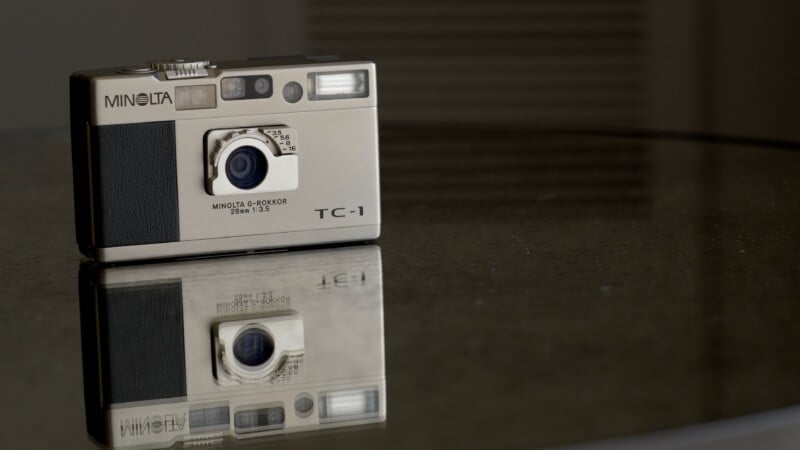
While many competitors opted for slightly larger frames to accommodate complex electronics, Minolta’s engineers prioritized extreme miniaturization without sacrificing optical integrity. The result was a camera encased in a rigid titanium shell, weighing a mere 225 grams (8 ounces). The TC-1 was not merely a consumer point-and-shoot; it was a flagship statement of engineering prowess, marketed to professionals who required a discrete "everyday carry" tool that could produce gallery-quality negatives.
Engineering Excellence: The G-Rokkor 28mm f/3.5 Lens
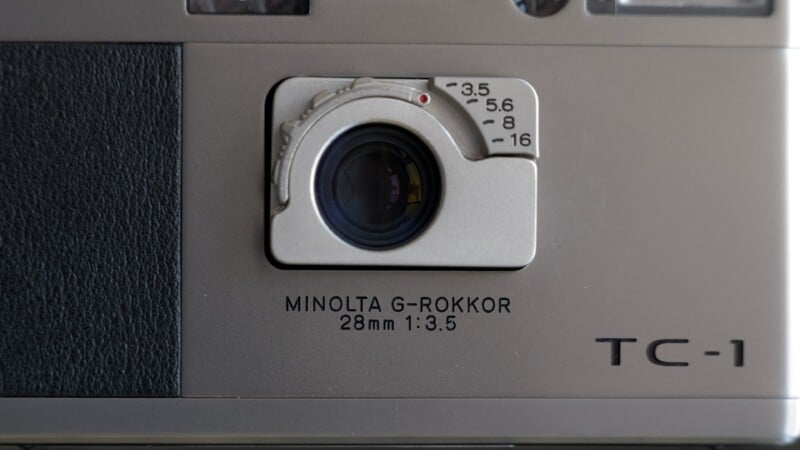
The defining characteristic of the Minolta TC-1 is its 28mm f/3.5 G-Rokkor lens. In the hierarchy of Minolta optics, the "G" designation was reserved for their most elite, professional-grade lenses, equivalent to Canon’s "L" series or Nikon’s "Gold Ring" optics. The lens construction consists of five elements in five groups, including three aspherical surfaces to minimize aberrations.
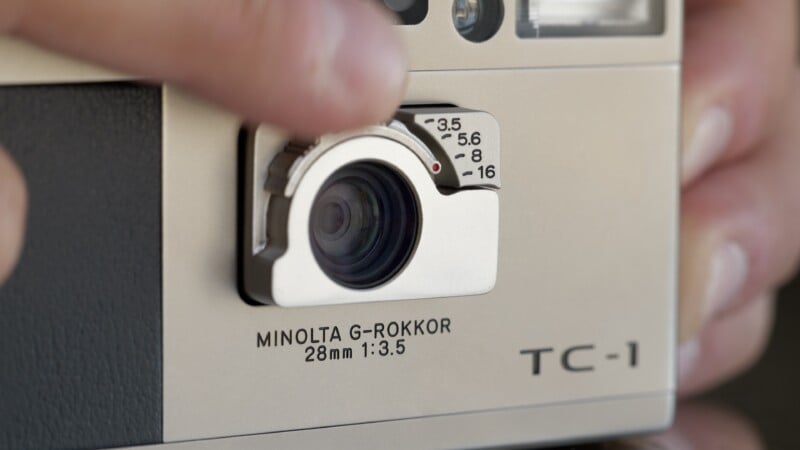
The TC-1 features a unique lens assembly that remains tucked behind a protective titanium plate until the power is engaged. Once activated, the assembly extends with high rigidity. Most notably, the TC-1 eschews traditional iris-style aperture blades. Instead, it utilizes a series of physical, perfectly circular aperture plates. When a photographer selects an f-stop using the toothed wheel on the lens barrel—options include f/3.5, f/5.6, f/8, and f/16—the camera rotates a specific circular cutout into the optical path.

This design choice has significant implications for "bokeh," or the quality of out-of-focus areas. Because the apertures are perfectly circular, out-of-focus highlights remain smooth and round, avoiding the polygonal shapes often seen in cameras with traditional blades. However, this mechanical limitation resulted in the omission of an f/11 setting, a quirk that photographers must work around in bright conditions.

Operational Nuances and Field Performance in Atlanta
During the field test in Atlanta, the TC-1 demonstrated the "quirky but capable" nature that has made it a cult classic. The camera operates primarily in aperture priority mode, allowing the photographer to control depth of field while the internal light meter determines the shutter speed. The shutter speeds range from 8 seconds to 1/750th of a second. However, a technical limitation exists: the 1/750th speed is only available at f/3.5 and f/5.6. At smaller apertures like f/8 or f/16, the leaf shutter is limited to a maximum speed of 1/350th of a second.

To compensate for overly bright environments, Minolta implemented a feature known as "Automatic Aperture Priority Compensation" (AAPC). When the scene brightness exceeds 11.5 EV at f/3.5, the camera automatically engages the shutter mechanism to act as a secondary aperture, effectively reaching an f/13.5 equivalent. While this ensures proper exposure, field testing revealed that this mode can occasionally produce harsh or oddly shaped highlights in the bokeh, as it bypasses the perfectly circular aperture plates.

The user interface of the TC-1 is centered around a multi-function top dial and a small LCD screen. This dial allows for rapid adjustments of:

- ISO settings (overriding DX coding)
- Flash modes
- Exposure compensation (+/- 2 EV)
- Self-timer
- Manual focus distances
Despite its small size, the TC-1 includes a sophisticated spot metering system, activated by a dedicated button near the grip. This allows photographers to meter for specific highlights or shadows within the central circle of the viewfinder, a feature rarely found in compact cameras of this size.

Chronology of the Field Test and Results
The PetaPixel team’s evaluation took place over a 24-hour period, moving from the industrial backdrop of the KEH warehouse to the urban sprawl of downtown Atlanta.

- Morning Session: The team focused on architectural details and street photography, testing the 28mm wide-angle perspective.
- Afternoon Session: A visit to the iconic Jackson Street Bridge provided a high-contrast environment to test the light meter’s accuracy and the lens’s flare resistance.
- Evening Session: The team attended a "Beers and Cameras" event, utilizing the TC-1’s built-in electronic flash for candid portraits and low-light environmental shots.
The film rolls—consisting of Agfa APX100, Oriental Seagull 400, and Kodacolor 100—were sent to Blue Moon Camera in Portland, Oregon, for professional processing and scanning. The resulting images confirmed the G-Rokkor’s reputation for extreme sharpness and high contrast. While a minor light leak was detected on the specific unit from the vault—a common occurrence in vintage cameras with aging light seals—the overall image quality was described as "punching well above its weight."

Market Context and Broader Implications
The resurgence of interest in cameras like the Minolta TC-1 is reflective of a broader trend in the photographic community. According to industry data, the demand for premium 35mm compacts has seen a 200% to 300% price increase over the last five years. Models that once sold for $300 on the used market now frequently command prices exceeding $1,000.

However, the rise in value comes with increased risk. These "luxury compacts" are notoriously difficult to repair due to their miniaturized electronics and the scarcity of replacement parts. This is where organizations like KEH play a vital role. By maintaining a rigorous grading system and offering warranties on used gear, they provide a layer of security for photographers investing in analog technology.

The TC-1, in particular, is often compared to the Contax T2 or T3. While the Contax models have gained massive popularity due to celebrity endorsements, many purists argue that the Minolta TC-1 is the superior tool for actual photography. Its manual controls are more intuitive, its body is smaller, and its lens is arguably sharper than the Zeiss glass found on its competitors.

Final Analysis of the TC-1 Legacy
The Minolta TC-1 remains a testament to a time when camera manufacturers were willing to take significant risks to achieve perfection. It is a camera of contradictions: it is tiny but feels indestructible; it is simple to use but offers professional-level control; it is mechanical but relies on sophisticated electronic sensors.

For the modern photographer, the TC-1 represents an escape from the "perfection" of digital sensors. The slight vignetting, the tactile click of the aperture wheel, and the anticipation of waiting for film to be developed offer a sensory experience that no smartphone or mirrorless camera can replicate. The PetaPixel team’s journey into the KEH vault underscores a vital truth in the world of imaging: while technology always moves forward, the "Tiny Craft" of the past still has much to teach us about the art of seeing.

As the analog revival continues, the Minolta TC-1 stands as a benchmark for what a compact camera can be. It is not just a relic of the 90s; it is a precision instrument that, when placed in the right hands, remains as relevant today as it was nearly thirty years ago. For those willing to navigate the quirks of vintage film stocks and the limitations of mechanical shutters, the TC-1 offers a unique window into the world—one perfectly circular aperture at a time.

