


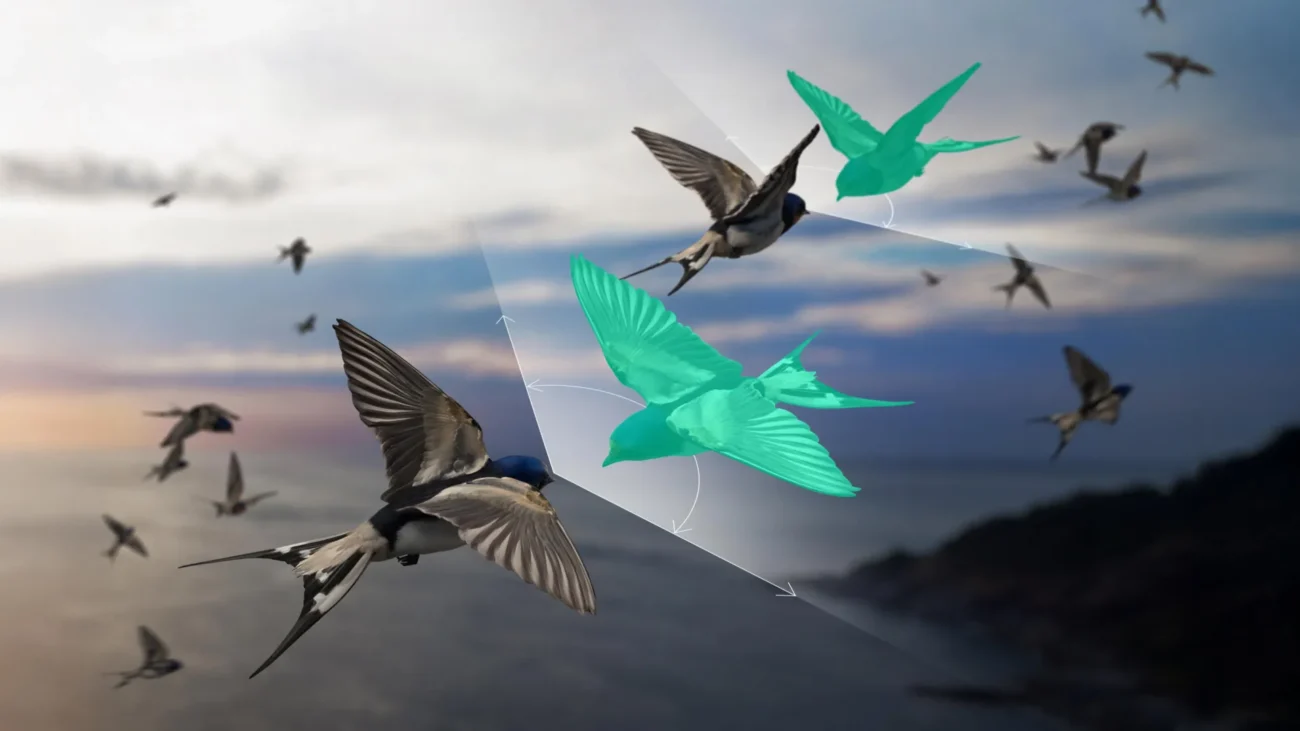
Birds, with their breathtaking aerial ballets, have long captivated human observation. A flock in flight presents a mesmerizing spectacle of synchronized movement, a testament to complex coordination. Yet, beneath this apparent harmony lies a scientific puzzle that has challenged physicists for centuries: the behavior of these avian formations appears to defy one of the most fundamental laws of physics – Newton’s third law of motion. While individual birds possess a wide field of vision, their collective navigation focuses on immediate neighbors, overlooking those behind them. This directional attention, researchers have discovered, creates a dynamic that deviates from the classic "for every action, there is an equal and opposite reaction." This seemingly minor discrepancy has profound implications, extending beyond the skies to encompass a wide array of natural phenomena, from microscopic bacterial colonies to bustling human crowds. Now, a groundbreaking theory developed by a team of physicists promises to bridge this gap, offering unprecedented precision in simulating these "non-reciprocal" systems.
The Enduring Pillar of Classical Physics
For over 300 years, Newton’s third law has served as a cornerstone of classical physics. Its elegant simplicity, often encapsulated as the action-reaction principle, explains myriad everyday occurrences. When a runner pushes off the ground, the ground reciprocates with an equal and opposite force, propelling them forward. Similarly, the propulsion of a car, the rowing of a boat, and the backward flight of a deflating balloon are all direct manifestations of this law. "Whatever we normally teach our students in theoretical mechanics, it ultimately rests on the action-reaction principle," explains Professor Marin Bukov, a leader of the research group at the Würzburg-Dresden Cluster of Excellence ctd.qmat. This principle dictates that interactions between two objects are always symmetrical; if object A exerts a force on object B, object B simultaneously exerts an equal and opposite force on object A.
Beyond the Skies: The Pervasive Nature of Non-Reciprocity
The anomaly observed in bird flocks is far from an isolated incident. Scientists have identified similar patterns in diverse systems, including swarms of bacteria, dense human crowds, and even the intricate collective behavior of cells within living tissues. In these instances, individual components of the collective do not react to their entire environment but rather selectively to specific parts. This selective attention leads to an imbalance, where the "action" and "reaction" are no longer equal or even in opposite directions.
These deviations from Newtonian physics are termed "non-reciprocal interactions." Traditional theoretical frameworks, meticulously designed for reciprocal interactions where action and reaction are balanced, have struggled to accurately model these one-sided dynamics. The inability to precisely simulate these systems has hampered scientific progress in crucial areas. Understanding the collective motion of animals, predicting crowd behavior during emergencies, and unraveling complex biological processes at the cellular level have all been hindered by this limitation. The need for a more comprehensive theoretical framework has become increasingly apparent.
A Dresden Breakthrough: Redefining the Rules of Interaction
In response to this long-standing challenge, researchers in Dresden, Germany, led by Professor Roderich Moessner, a Principal Investigator at the Würzburg-Dresden Cluster of Excellence ctd.qmat and director of the Max Planck Institute for the Physics of Complex Systems, have developed a novel theoretical approach. This breakthrough promises to extend the applicability of classical physics principles to systems previously considered outside their purview.
"The research team has developed and proven a theory that makes much of what we teach our students applicable to non-reciprocal systems as well," states Professor Bukov. "These systems, where Newton’s third law does not apply, can now finally be described exactly and simulated precisely – even using established methods. This is exactly the kind of tool that has been missing in recent years."
The core of their innovation lies in an ingenious extension of the traditional action-reaction framework. By introducing carefully designed "artificial variables," the researchers have devised a method to analyze non-reciprocal systems using the same sophisticated tools already employed for their reciprocal counterparts. This elegant solution sidesteps the fundamental limitations of existing models.
The Art of the Imaginary Partner: A New Simulation Paradigm
Traditionally, physicists model natural phenomena using variables that represent tangible properties, such as a bird’s position and velocity, a fish’s location within a school, or a car’s placement in traffic. The Dresden team’s approach, however, introduces a conceptual leap. As Professor Bukov’s colleague, biophysicist Ricard Alert, explains, "The trick behind the new theory is that it constructs a partner for each component of the system – a fictitious partner that doesn’t exist in nature. The original non-reciprocal interactions are replaced by reciprocal interactions with these auxiliary degrees of freedom."
To illustrate this concept, consider the flock of birds. Instead of trying to directly model the complex, one-way interactions between real birds, the new theory proposes an ingenious workaround. "To simulate the birds’ movements precisely, we describe the dynamic system ‘flock of birds’ using established methods – as if it were a reciprocal system, even though it is not," says Alert. "The elegant solution is to artificially place a fictitious bird in front of each real bird, aligned in exactly the opposite direction."
These "imaginary birds" are not literal creatures; they are mathematical constructs, auxiliary variables that enable the transformation of inherently non-reciprocal interactions into a form that can be readily analyzed by existing reciprocal models. By artificially introducing these partners, the researchers effectively create a closed system of reciprocal interactions, allowing for precise simulation and analysis that was previously unattainable. This innovative methodology essentially allows scientists to "trick" the system into behaving reciprocally for the purposes of mathematical modeling, without altering the fundamental nature of the real-world phenomenon.
Implications and Future Horizons
The development of this new theoretical framework has far-reaching implications across numerous scientific disciplines. The ability to accurately simulate non-reciprocal systems opens up a wealth of new possibilities for research and discovery.
Enhanced Biological Understanding: Biologists can now develop more accurate models of cellular self-organization, the collective behavior of microorganisms, and the complex dynamics of tissue development. Understanding how cells interact and coordinate their movements is fundamental to fields like developmental biology, regenerative medicine, and cancer research. For instance, simulating how cancer cells migrate and form metastases could lead to more effective treatment strategies.
Improved Crowd Dynamics and Safety: In urban planning and public safety, understanding how large groups of people move is crucial for designing safe public spaces and managing crowds during events. The new theory can contribute to more realistic simulations of crowd behavior, helping to identify potential bottlenecks, predict stampede risks, and design more effective evacuation protocols. Data from crowd simulations at major sporting events and concerts, for example, could be significantly refined.
Advanced Robotics and Artificial Intelligence: The principles underlying non-reciprocal interactions are also relevant to the development of autonomous systems. Robots designed to operate in complex, dynamic environments, such as swarms of drones or collaborative robotic systems, could benefit from models that accurately capture their interactions with each other and their surroundings. This could lead to more robust and adaptable robotic systems.
Fundamental Physics Research: Beyond applied sciences, this breakthrough also holds promise for fundamental physics. Professor Moessner’s own research at the Cluster of Excellence ctd.qmat focuses on quantum matter, where particles interact under specific conditions to produce phenomena like magnetism and lossless current transport. The team is now exploring whether these deviations from Newton’s law in macroscopic systems might manifest in entirely new forms of collective quantum behavior. "The exciting question now is whether these exceptions to Newton’s law lead to entirely new forms of collective quantum behavior," Moessner stated. "We still know very little about this – and that is precisely what makes this so fascinating."
The research team’s findings, published in the prestigious journal Nature Physics, represent a significant leap forward in our understanding of collective behavior. By providing a robust theoretical and computational tool, this work not only resolves a long-standing puzzle in physics but also paves the way for deeper insights and novel applications across a broad spectrum of scientific inquiry. The seemingly simple observation of birds in flight has, through the ingenuity of these physicists, led to a profound re-evaluation of fundamental principles and an exciting glimpse into the future of scientific exploration. The long-held reliance on Newton’s third law as the sole descriptor of interaction dynamics is now being complemented, offering a more nuanced and comprehensive view of the complex, dynamic world around us.

