


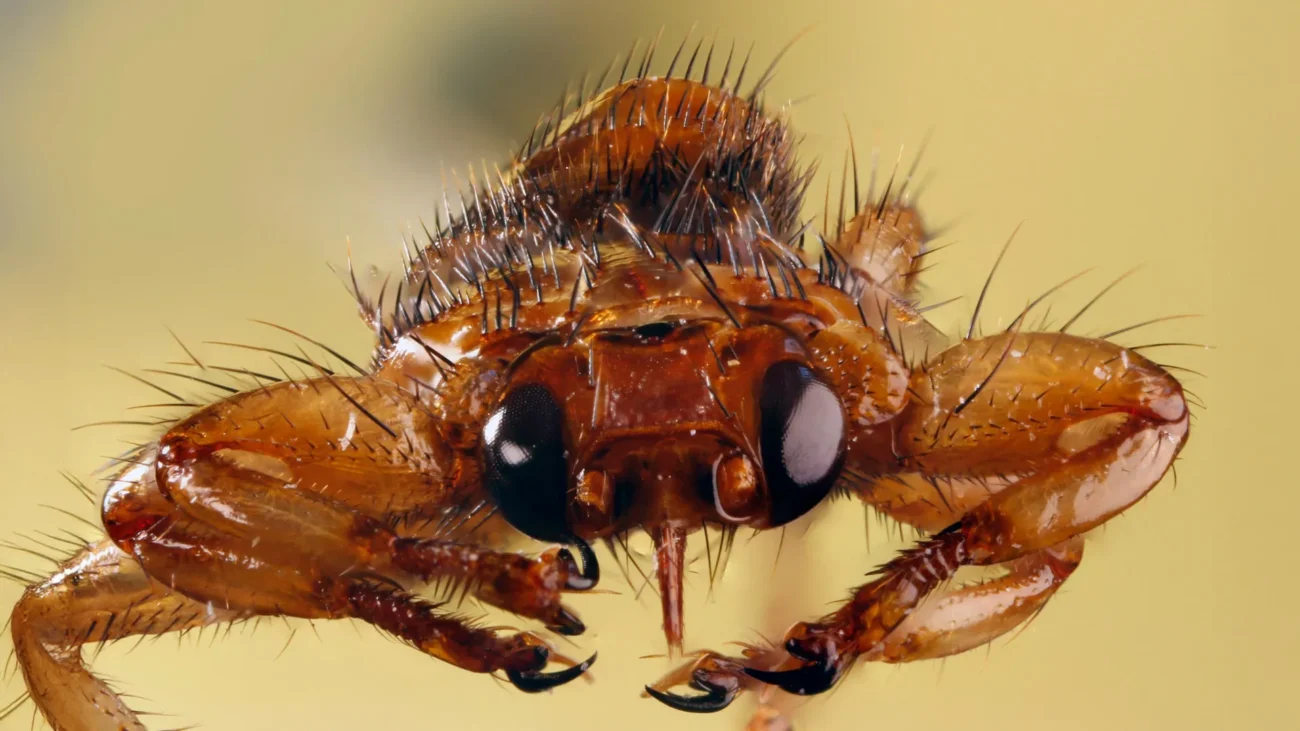
A remarkable transformation in the sensory capabilities of deer keds, a common blood-feeding fly, has been uncovered by a joint research effort from Aberystwyth University and the University of Florence. The study, published in the esteemed Journal of Experimental Biology, reveals that these parasites, after successfully locating a host and permanently shedding their wings, significantly reduce their visual sensitivity. This evolutionary adaptation allows them to reallocate vital energy resources from the energetically demanding process of vision to functions more critical for their parasitic lifestyle, such as digestion and reproduction.
Deer keds, scientifically known as Lipoptena cervi, are found across vast geographical regions, encompassing Europe, Asia, Africa, and the Americas. As free-flying adults, they employ a dual strategy of flight and keen vision to locate their preferred hosts, which are predominantly deer. However, their predatory pursuit abruptly ends once they alight upon a suitable mammal, at which point their biological priorities undergo a drastic shift.
The Dramatic Metamorphosis: From Aerial Hunter to Grounded Parasite
The life cycle of a deer ked presents a fascinating case study in adaptive evolution. Initially, these flies are equipped with fully functional wings, enabling them to cover considerable distances in their search for a blood meal. Their vision is crucial during this airborne phase, allowing them to detect and track potential hosts from afar. This period of active hunting is characterized by a high metabolic rate and a reliance on sensory input for survival.
Upon successful landing on a host, a profound metamorphosis begins. The most striking physical change is the permanent shedding of their wings. This act signifies an irreversible commitment to a sedentary, parasitic existence. No longer needing to navigate the open air or pursue prey, the ked’s environment becomes the dense, warm fur of its host. Within this microhabitat, the fly’s primary focus shifts from locomotion and detection to feeding and propagation.
This radical transition in lifestyle is not merely behavioral; it is deeply rooted in physiological changes, as evidenced by the research findings. Scientists have observed a corresponding recalibration of the deer ked’s sensory apparatus, with vision bearing the brunt of this energy-saving initiative.
Investigating the Sensory Shift: A Comparative Approach
The research team, led by Dr. Roger Santer from the Department of Life Sciences at Aberystwyth University, embarked on a meticulous comparative study to understand how deer keds adapt their sensory systems to their changing roles. The investigation involved examining deer keds at distinct stages of their life cycle. Winged adults, representing the active host-seeking phase, were collected and analyzed. These were then contrasted with wingless adults that had been retrieved from deer hosts, signifying their established parasitic existence.
The scientists specifically targeted genes associated with visual sensitivity, known as opsins. Opsins are photoreceptor proteins that play a pivotal role in detecting light and color, forming the basis of an organism’s vision. By quantifying the expression levels of these opsin genes in both winged and wingless deer keds, the researchers could ascertain how the flies’ visual systems respond to their dramatic shift from aerial hunters to sessile parasites.
"Vision plays a vital role in animal behavior, but it is also energetically expensive," Dr. Santer explained. "Evolution favors sensory systems that are efficiently matched to an animal’s way of life. Some blood-feeding flies rely heavily on vision, while others live permanently on hosts and have little need for it. Deer keds are especially interesting because they switch between these two lifestyles."
The Genetic Blueprint of Reduced Vision
The findings from this genetic analysis were compelling. Dr. Santer revealed, "We found that a flying deer ked’s visual system is much like that of a tsetse fly, which famously hunt out mammal hosts in Africa. However, after a deer ked loses its wings and becomes an ectoparasite, activity of its opsin genes reduces to around half the previous level."
This significant reduction in opsin gene activity does not equate to complete blindness. Instead, it indicates a deliberate scaling back of visual acuity. The fly’s visual sensitivity is demonstrably lowered, a strategic compromise to conserve energy. "We think the fly might be sacrificing sight to conserve energy for functions such as digestion and reproduction," Dr. Santer elaborated. This suggests a finely tuned evolutionary trade-off, where the considerable energy demands of maintaining a highly functional visual system are deemed unnecessary once the need for aerial navigation and host detection is eliminated.
The implications of this research are substantial, suggesting that deer keds do not simply become blind upon finding a host. Rather, they appear to actively downregulate their visual capabilities, a process that likely involves complex genetic and biochemical mechanisms. This down-regulation is a testament to the efficiency of natural selection in optimizing an organism’s physiology for its specific ecological niche.
Broader Implications for Parasitology and Pest Control
The study’s publication in the Journal of Experimental Biology marks a significant contribution to our understanding of parasite adaptation. It provides novel insights into the intricate ways in which organisms modify their sensory systems in response to profound changes in their ecological roles. For entomologists and parasitologists, this research offers a deeper appreciation of the behavioral and physiological plasticity exhibited by blood-feeding insects.
The potential applications of this research extend beyond fundamental biological inquiry. A more comprehensive understanding of how deer keds and other biting flies utilize their senses could pave the way for more effective monitoring and control strategies. For instance, if the reduced visual sensitivity is linked to specific environmental cues or metabolic states, this knowledge could be leveraged in developing targeted attractants or repellents.
Furthermore, the study highlights the energetic costs associated with sensory systems. This principle is not unique to deer keds; it is a fundamental consideration in the evolution of all organisms. The ability to reallocate energy from less critical functions to those that are vital for survival and reproduction is a hallmark of successful adaptation.
The research also implicitly raises questions about the evolutionary history of deer keds and their ancestors. Did their lineage always involve this dramatic shift, or did they evolve from exclusively flying, visually-oriented ancestors, or perhaps from entirely sedentary, non-visual forms? Understanding the phylogenetic context of this adaptation could further illuminate the selective pressures that have shaped their current biology.
The energetic efficiency gained by reducing visual sensitivity is likely substantial. Maintaining functional photoreceptor cells, processing visual information, and coordinating visually-guided behaviors require a constant and significant supply of ATP. By diminishing this demand, the deer ked can channel its metabolic resources towards more immediate survival needs within the host environment. This includes the continuous process of blood digestion, which requires specialized enzymes and metabolic pathways, and the crucial task of reproduction, ensuring the continuation of the species.
The Timeline of Transformation
While the study focused on the state of gene expression before and after wing shedding, a deeper dive into the precise timeline of this visual system recalibration could offer further insights. It is plausible that the reduction in opsin gene activity begins even before the wings are completely shed, or perhaps it is a rapid process that occurs within hours or days of the wing loss event. Understanding this temporal aspect could reveal the signaling pathways that trigger this significant physiological change.
The researchers have provided a critical snapshot of the deer ked’s adaptation, revealing a sophisticated evolutionary response to a drastic change in lifestyle. The transition from an aerial hunter to a permanently attached parasite necessitates a fundamental re-evaluation of an organism’s biological priorities. In the case of the deer ked, this re-evaluation prominently features a strategic curtailment of its visual prowess, a testament to the power of natural selection in optimizing life for survival and reproduction in diverse and challenging environments. The ongoing research into these fascinating creatures promises to unlock further secrets of parasitic adaptation, potentially leading to novel approaches in managing their impact on wildlife and human health.

