


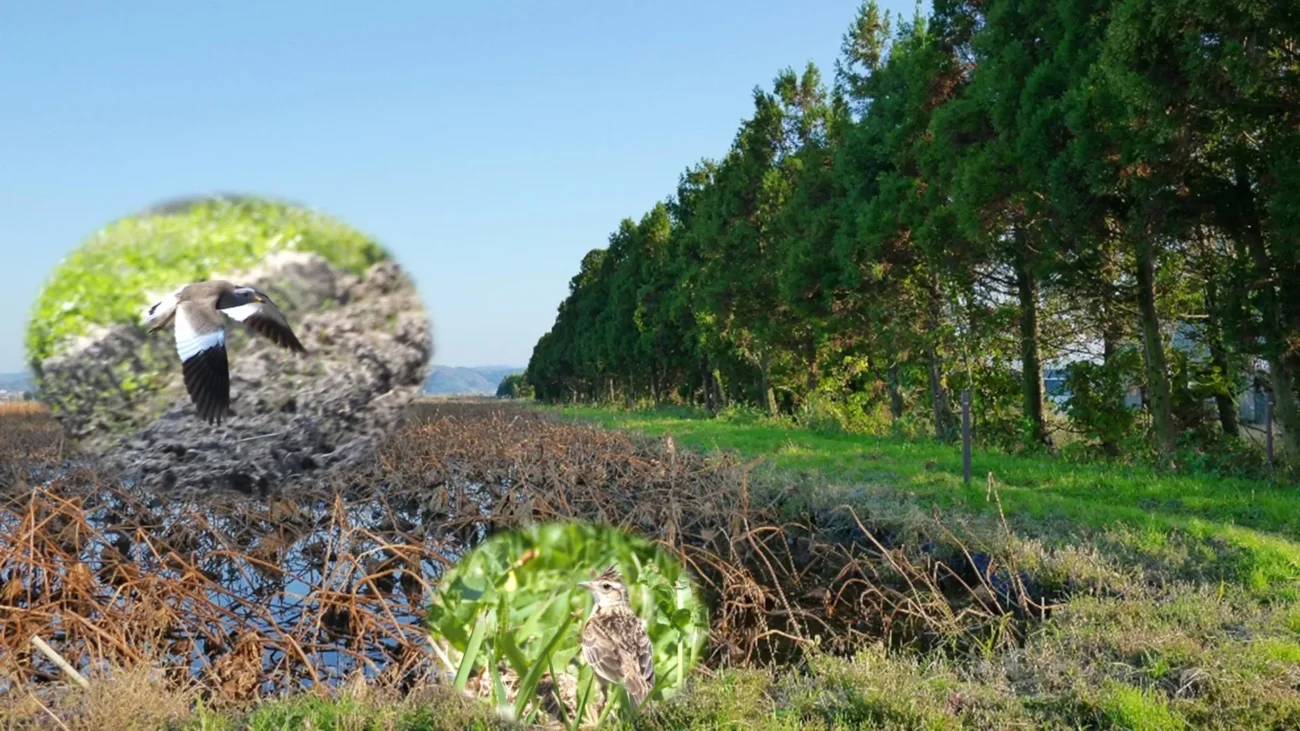
Trees planted along farmland to shield crops from strong winds are often viewed as a simple way to support biodiversity. But new research suggests the picture is more complicated, especially in agricultural wetlands where many bird species depend on open landscapes. A groundbreaking study published in the Journal of Environmental Management reveals that while these windbreaks, known as shelterbelts, can benefit some avian species, they can also negatively impact others, creating a delicate ecological trade-off that demands careful consideration in conservation planning.
The research, conducted by a team of international scientists, focused on the agricultural wetlands of Japan’s western coast, specifically around Lake Kahokugata. This region, characterized by extensive rice paddies and other cultivated wet landscapes, is a critical stopover point along the East Asian-Australasian Flyway, supporting a vast array of migratory and resident bird populations. The findings challenge the prevailing assumption that all woody linear features, such as shelterbelts, uniformly enhance biodiversity in agricultural settings, particularly in wetland ecosystems which are increasingly under pressure globally.
The Prevailing Narrative and Emerging Questions
For years, agricultural conservation programs worldwide have advocated for the integration of trees, hedgerows, and other woody structures into farmlands. The rationale is straightforward: these features are believed to provide essential habitat, food sources, and shelter for a variety of wildlife, thereby increasing overall biodiversity. This approach has been widely adopted in many regions, particularly in Europe and North America, where research has largely supported the positive impact of such landscape modifications on bird populations and insect life within predominantly cropland and grassland systems.
However, the ecological dynamics of Asian agricultural wetlands, such as rice paddies, present a unique set of challenges and opportunities. These environments, crucial for food production, also serve as vital surrogate wetlands for numerous bird species, especially those undertaking long-distance migratory journeys. The rapid decline of natural wetlands globally has amplified the importance of these agricultural landscapes as critical refuges. This context raises a crucial question: do shelterbelts, while beneficial to some, inadvertently degrade the habitat quality for species that specifically rely on the open expanses characteristic of wetland environments?
Dr. Masumi Hisano, the corresponding author of the study and an assistant professor at Hiroshima University’s Graduate School of Advanced Science and Engineering, articulated the core of their investigation: "The central question of our study is, ‘Do shelterbelts and other woody linear features benefit all farmland birds equally in agricultural wetland landscapes, or do they create trade-offs by disadvantaging species that depend on open habitats?’" This inquiry is particularly pertinent given the dual role of agricultural wetlands – supporting human food production and functioning as indispensable habitats for avian wildlife. The potential for conservation efforts to have unintended negative consequences necessitates a more nuanced understanding.
A Detailed Look at Lake Kahokugata: The Study Site
The researchers chose the agricultural landscape surrounding Lake Kahokugata in central Japan as their study area. This region is a mosaic of rice paddies, lotus fields, cultivated croplands, and pasturelands. Its geographical location makes it a significant ecological hub, particularly for avian life. Lake Kahokugata is a vital resting and feeding ground for birds traversing the East Asian-Australasian Flyway, one of the most important migratory routes for birds globally. This flyway stretches from the Arctic to Australia and New Zealand, connecting breeding grounds in Siberia and Alaska with non-breeding grounds in Southeast Asia and Australasia. Millions of birds rely on a network of wetlands and stopover sites along this route, making areas like Lake Kahokugata indispensable for their survival.
The region is also known for its challenging climatic conditions, frequently experiencing strong winter winds and storms. This environmental pressure has historically led local farmers to adopt measures like planting shelterbelts – linear rows of trees and shrubs – to protect their crops from wind damage and erosion. These windbreaks are a common sight, strategically positioned to create a buffer zone around fields.
The biodiversity of the Lake Kahokugata area is remarkable, with nearly 300 bird species recorded in the vicinity. This diverse avian community includes wintering species that seek refuge from colder climates further north and breeding species that utilize the area during the warmer months. The presence of both migratory and resident birds, coupled with the widespread use of shelterbelts, made it an ideal location to investigate the complex interactions between artificial landscape features and bird populations in agricultural wetlands.
Methodology: Quantifying the Impact
To address their research question, the team conducted rigorous bird surveys over two distinct periods: February and March 2021, and again in June 2023. These survey periods were strategically chosen to capture the avian communities present during both the wintering and breeding seasons, respectively. Bird abundance and diversity were measured using the point count method. This widely accepted ecological survey technique involves observers standing at fixed points for a set duration, recording all bird species seen and heard within a specified radius. By conducting these surveys at sites with varying proximity to shelterbelts and at open sites located further away, the researchers aimed to quantify the differential impact of these woody features on bird communities.
The study design specifically compared bird populations at sites immediately adjacent to shelterbelts with those at open sites situated approximately one kilometer away. This distance was chosen to represent areas less directly influenced by the immediate presence of the windbreaks, allowing for a clearer assessment of their localized effects. The careful selection of study sites and the systematic approach to data collection ensured the reliability and robustness of the findings.
The Unveiling of Ecological Trade-offs: Shelterbelts as "Ecological Walls"
The results of the comprehensive bird surveys painted a clear and compelling picture of ecological trade-offs. The shelterbelts were found to actively support certain bird species, particularly those that thrive in shrubby environments and at habitat edges. These species often benefit from the increased structural complexity and the availability of perching sites and nesting opportunities offered by the trees.
However, the benefit was not universal. Crucially, the study revealed that the presence of shelterbelts substantially reduced both the abundance of grassland birds and the diversity of wetland species that are intrinsically linked to large, open areas. This indicates that the introduction of woody features, intended to enhance biodiversity, can inadvertently lead to habitat fragmentation and a decline in the suitability of the landscape for open-habitat specialists.
Dr. Hisano elaborated on these findings: "We found that the abundance of grassland birds was more than 70 percent lower at sites next to shelterbelts compared with open sites located about one kilometer away." This stark quantitative difference underscores the significant ecological impact that even relatively narrow rows of trees can exert on the composition of bird communities within an agricultural landscape.
The researchers aptly described the function of shelterbelts in this context: "A useful way to think about this is that shelterbelts act like ecological walls." This analogy highlights how these linear features can effectively partition habitats, creating barriers or altering the microenvironment in ways that favor some species while disfavoring others. For birds that rely on open spaces for foraging, nesting, and predator detection, the encroaching woody vegetation can reduce available habitat and potentially increase their vulnerability to predators that might utilize the shelterbelts for concealment.
Implications for Conservation Strategies and Land-Use Planning
The findings from the Lake Kahokugata study carry significant implications for the design and implementation of agricultural conservation programs. The traditional approach of encouraging tree planting as a blanket solution for biodiversity enhancement in all agricultural landscapes may need to be re-evaluated, especially in ecologically sensitive areas like agricultural wetlands.
"Our study provides clear, quantitative evidence that small-scale landscape features can have large ecological consequences, directly relevant to land-use planning and environmental management," stated Dr. Hisano. This underscores the need for site-specific assessments and a more nuanced understanding of how landscape modifications interact with local ecological conditions.
The researchers advocate for a shift from a one-size-fits-all approach to one that emphasizes strategic placement and thoughtful integration of woody features. "Biodiversity-friendly farmland management must balance structural complexity with the ecological needs of open-habitat species, especially in landscapes where wetlands have already been heavily modified by humans," Hisano advised. This suggests that conservation efforts should aim to create a mosaic of habitats, preserving and enhancing open areas while strategically incorporating woody elements where they provide the greatest net benefit without compromising the integrity of critical open habitats.
The study’s relevance is amplified by the fact that many agricultural conservation initiatives continue to promote tree planting without a thorough understanding of their potential impact on entire bird communities. This can lead to well-intentioned efforts inadvertently contributing to the decline of species that depend on the very open landscapes these wetlands provide.
The Path Forward: Future Research and Holistic Planning
Looking ahead, the research team emphasizes the need for further in-depth studies to refine our understanding of the complex relationship between shelterbelts and biodiversity. Future research should delve into the specific characteristics of shelterbelts, such as their width, height, spacing between rows, overall configuration within the landscape, and the species composition of the trees themselves. Understanding how these variables influence wildlife across different geographical regions and during various seasons is crucial for developing effective management strategies.
Furthermore, the researchers highlight the importance of investigating indirect effects. Shelterbelts can alter predator-prey dynamics, influence microclimates, and affect habitat connectivity, all of which can have cascading impacts on bird populations. Comprehensive ecological modeling that incorporates these indirect effects will be vital for a complete picture.
The ultimate goal, according to Dr. Hisano, is to "help design evidence-based agri-environmental policies that work in wet-farmed landscapes worldwide." This involves moving beyond simplistic solutions and supporting "landscape-level planning that combines open habitats and woody features in ways that sustain diverse bird communities and the ecosystem functions they provide." By embracing this holistic approach, agricultural wetlands can continue to fulfill their essential role in global food security while simultaneously serving as vital havens for wildlife in an increasingly human-dominated and rapidly changing world. The collaborative efforts of institutions such as Hiroshima University, The University of Tokyo, Kyoto University, and various environmental research centers, supported by organizations like the Kahokugata Lake Institute and the Japan Society for the Promotion of Science, are instrumental in advancing this critical field of research and conservation.

