


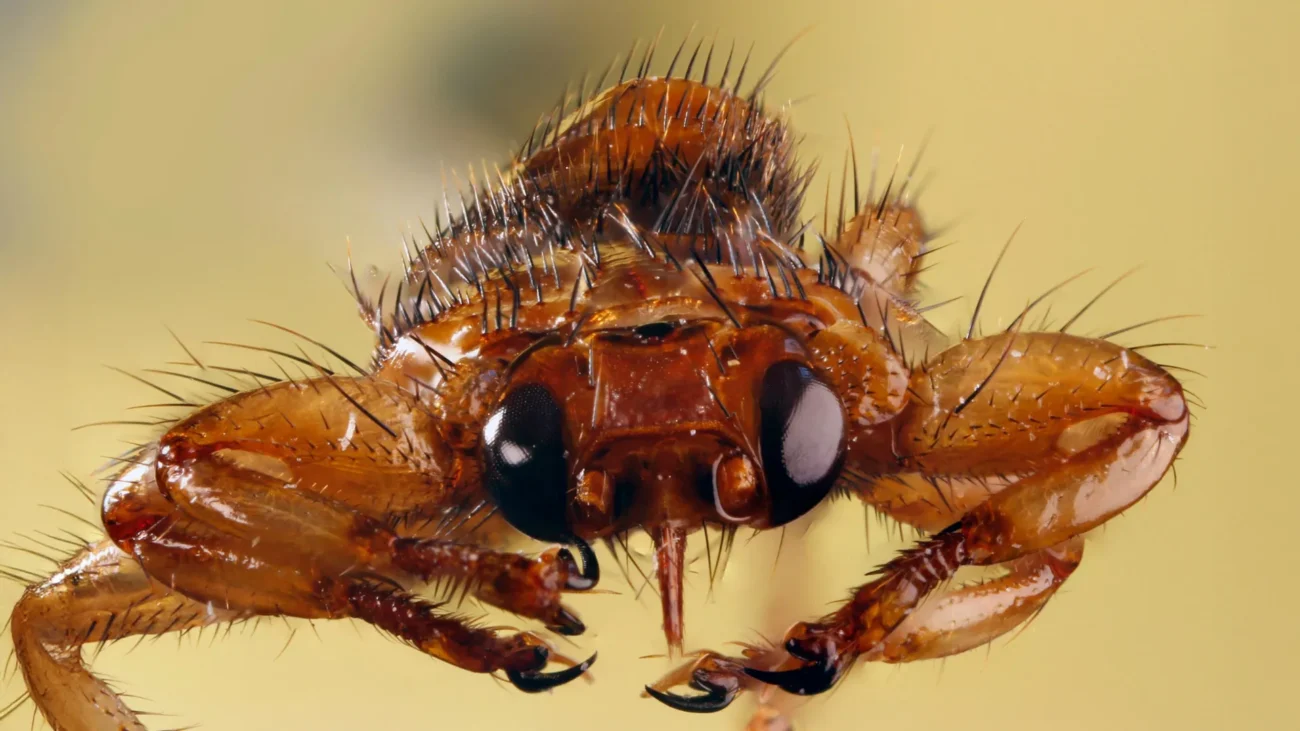
New scientific findings reveal a fascinating adaptation in the life cycle of deer keds, a type of wingless, blood-feeding fly. These parasites, once they successfully locate a host, appear to significantly reduce their visual acuity, a strategic shift that scientists believe allows them to conserve energy for more critical functions in their permanent parasitic existence. This research, a collaborative effort between scientists at Aberystwyth University in the United Kingdom and the University of Florence in Italy, sheds new light on the complex evolutionary strategies employed by ectoparasites.
From Airborne Hunter to Ground-Dweller: The Deer Ked’s Dramatic Transformation
Deer keds, scientifically known as Lipoptena cervi, are an intriguing group of insects that exemplify a remarkable transition in lifestyle. Widely distributed across Europe, Asia, Africa, and the Americas, these flies spend the initial phase of their adult lives as mobile hunters, utilizing both flight and keen vision to seek out suitable hosts. Their primary targets are deer, but they are not averse to feeding on other mammals, including humans, when the opportunity arises. This aerial pursuit phase is characterized by a reliance on visual cues to navigate and locate potential blood meals.
However, the moment a deer ked successfully lands on a host, its existence undergoes a profound and irreversible metamorphosis. In a dramatic evolutionary gamble, the insect permanently sheds its wings. This act signifies the end of its migratory, aerial phase and the commencement of a sedentary, parasitic life spent embedded within the fur of its host. From this point onward, the deer ked’s primary modes of locomotion shift to crawling through dense hair, and its sole focus becomes continuous blood feeding. This radical change in behavior necessitates a re-evaluation of its sensory priorities.
Unraveling the Sensory Shift: A Gene-Centric Investigation
The research team, led by Dr. Roger Santer from the Department of Life Sciences at Aberystwyth University, embarked on a comprehensive study to understand how these insects adapt their sensory systems to such a drastic shift in their ecological niche. The core of their investigation centered on the genetic underpinnings of the flies’ visual capabilities.
"Vision plays a vital role in animal behavior, but it is also energetically expensive," explained Dr. Santer. "Evolution favors sensory systems that are efficiently matched to an animal’s way of life. Some blood-feeding flies rely heavily on vision, while others live permanently on hosts and have little need for it. Deer keds are especially interesting because they switch between these two lifestyles."
To capture this transition, the scientists collected and analyzed deer keds at distinct stages of their adult life. They studied actively flying, winged adults that were in the process of searching for hosts. These were then meticulously compared with wingless adults that had already established themselves on deer, signifying their adoption of the permanent parasitic lifestyle.
The research team’s focus narrowed to a specific class of genes known as opsins. These genes are crucial for the production of photopigments, which are the light-sensitive molecules within an organism’s eyes that enable vision. By examining the activity levels of these opsin genes in both winged and wingless deer keds, the researchers could directly assess how the flies’ visual systems responded to their significant change in habitat and behavior.
Opsin Gene Activity: A Biomarker for Reduced Vision
The results of this genetic analysis were striking. The study revealed that the visual system of a flying deer ked bears a significant resemblance to that of tsetse flies, another group of well-known blood-feeding insects that rely heavily on vision to hunt their mammalian prey in African landscapes. This suggests that, when actively seeking a host, deer keds possess a well-developed and sensitive visual apparatus.
However, the most compelling discovery emerged when comparing these with the wingless, parasitic individuals. "After a deer ked loses its wings and becomes an ectoparasite, activity of its opsin genes reduces to around half the previous level," Dr. Santer stated. This reduction in gene activity is a strong indicator that the flies are not simply discarding their eyes but are actively downregulating the biochemical processes that support high levels of visual sensitivity.
The researchers interpret this finding to mean that deer keds do not become completely blind after settling on a host. Instead, their visual capabilities are deliberately curtailed. This strategic "scaling back" of vision is hypothesized to be an energy-saving mechanism. By reducing the investment in maintaining a highly sensitive visual system, the flies can redirect valuable metabolic resources towards other functions that are paramount for survival and reproduction in their new, stationary parasitic environment. These critical functions likely include digestion, immune response to host defenses, and reproductive processes.
The Evolutionary Rationale: Prioritizing Survival and Reproduction
The implications of this research extend beyond the specific biology of deer keds. It offers a compelling case study in how organisms adapt their sensory machinery in response to fundamental shifts in their ecological roles. The evolutionary pressure to optimize energy allocation is a driving force behind many biological adaptations. In the case of the deer ked, the energetic cost of maintaining sophisticated vision becomes a liability once the need for long-range host detection through flight is eliminated.
Dr. Santer’s explanation highlights the principle of sensory optimization. "Evolution favors sensory systems that are efficiently matched to an animal’s way of life," he reiterates. For an ectoparasite that lives permanently on a host, navigating the host’s fur, locating blood vessels, and reproducing are the immediate priorities. The ability to detect movement or fine visual details from a distance becomes a low-priority, high-cost function.
The research suggests a nuanced trade-off: while vision is essential for the initial hunt, its utility diminishes drastically once a host is secured. The energy saved by reducing visual sensitivity could then be channeled into increasing digestive efficiency, bolstering reproductive output, or strengthening resistance to the host’s immune responses. This biological recalibration ensures that the parasite’s limited energy budget is allocated to activities that directly contribute to its long-term survival and propagation.
Broader Implications for Parasite Control and Understanding
The study, published in the esteemed Journal of Experimental Biology, contributes significantly to our understanding of parasite adaptation strategies. By dissecting the molecular mechanisms behind the deer ked’s sensory adjustments, scientists gain valuable insights into the general principles that govern how parasites evolve to exploit their hosts.
This deeper knowledge could have practical applications in the future. An enhanced understanding of how deer keds and other biting flies utilize their senses, and how these senses change in response to their life cycle, may eventually lead to the development of more effective monitoring and control strategies. For instance, if the reduced visual sensitivity of established keds makes them less responsive to certain visual stimuli, this could be exploited in traps or repellents. Conversely, understanding the visual cues that attract them to hosts in the first place could inform methods for early detection and prevention.
The research also underscores the remarkable plasticity of biological systems. The deer ked’s ability to undergo such a dramatic sensory shift, driven by genetic regulation, highlights the intricate and often surprising ways in which life adapts to environmental challenges and opportunities. As the scientific community continues to explore the complex interactions between hosts and parasites, findings like these provide crucial pieces of the puzzle, illuminating the evolutionary arms race that has shaped the natural world. The deer ked, in its seemingly simple transition from flying hunter to embedded parasite, offers a profound lesson in the economics of survival and the power of evolutionary adaptation.

