


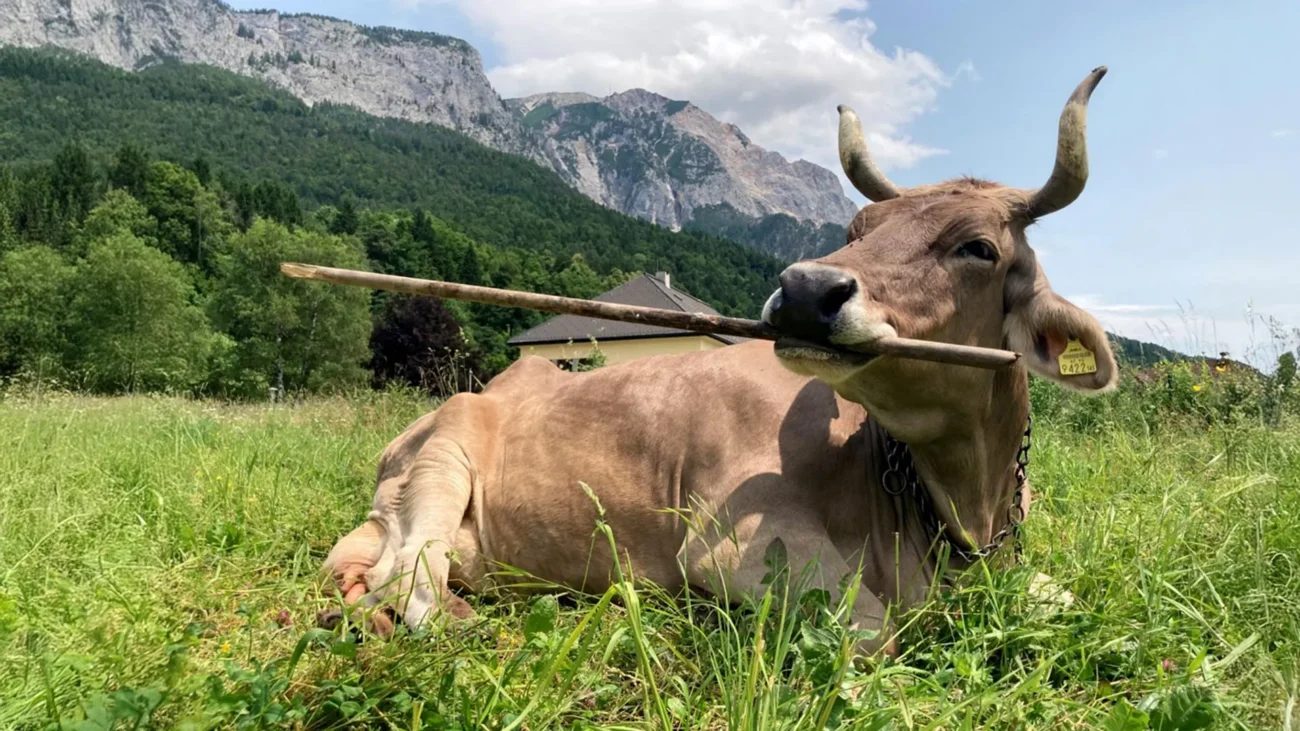
In 1982, cartoonist Gary Larson’s iconic Far Side strip, "Cow Tools," humorously depicted a cow proudly presenting a collection of nonsensical implements, playing on the widespread notion that cattle were intellectually incapable of tool creation or utilization. This cultural trope, ingrained in public perception, has now been profoundly challenged by a groundbreaking scientific study published in Current Biology. The research details the first documented instance of sophisticated tool use in a pet cow named Veronika, suggesting that cattle may possess cognitive abilities far exceeding previous estimations and that our understanding of livestock intelligence might be limited by our own observational biases.
A Bovine Breakthrough: Veronika’s Ingenious Behavior
The subject of this remarkable discovery is Veronika, a Swiss Brown cow who lives not on a commercial farm destined for food production, but as a cherished companion animal. Her owner, Witgar Wiegele, an organic farmer and baker, considers Veronika an integral member of his family. It was Wiegele who, over a decade ago, first observed Veronika engaging in an unusual behavior: picking up sticks and using them to scratch her own body. This peculiar habit, initially a private curiosity, eventually gained scientific attention when Wiegele recorded it on video and shared it with researchers.
Alice Auersperg, a cognitive biologist at the University of Veterinary Medicine, Vienna, and a lead author on the study, recalls her initial reaction upon viewing the footage. "When I saw the footage, it was immediately clear that this was not accidental," Auersperg stated. "This was a meaningful example of tool use in a species that is rarely considered from a cognitive perspective." This observation marked a significant departure from the prevailing scientific and public understanding of cow cognition.
Rigorous Scientific Investigation: Testing Veronika’s Skills
To move beyond anecdotal observation and scientifically validate Veronika’s capabilities, the research team designed a series of controlled experiments. The core of these tests involved presenting Veronika with a deck brush placed in various positions within her enclosure. The researchers meticulously observed her interactions with the brush, analyzing her choices and techniques.
The results were compelling. Across multiple trials, Veronika demonstrated a remarkable ability to select specific parts of the brush depending on her scratching needs. Her choices were far from random; they were consistently tailored to the body region she intended to alleviate an itch. This indicated a level of understanding and purposeful action that went beyond simple object manipulation.
Antonio Osuna-Mascaró, another key researcher on the project, emphasized the significance of these findings. "We show that a cow can engage in genuinely flexible tool use," Osuna-Mascaró explained. "Veronika is not just using an object to scratch herself. She uses different parts of the same tool for different purposes, and she applies different techniques depending on the function of the tool and the body region." This nuanced approach to tool use highlighted a level of cognitive flexibility previously unobserved in cattle.
Flexible and Multi-Purpose Tool Use: A Deeper Dive
The detailed analysis of Veronika’s behavior revealed sophisticated patterns in her tool utilization. When targeting larger, more robust areas of her body, such as her back, she consistently favored the bristled side of the deck brush. Conversely, for more sensitive areas on her lower body, she strategically switched to the smoother handle. This adaptation demonstrated an understanding of the different tactile properties of the brush and their suitability for various body parts.
Furthermore, Veronika adjusted her physical movements to match the purpose and location of her scratching. Broad, powerful strokes were employed for her upper body, suggesting a need for more vigorous action. In contrast, when attending to her lower extremities, her movements became slower and more precise, indicating a finer control and an awareness of the differing sensitivities of these regions.
The scientific definition of tool use involves employing an external object to achieve a goal through physical interaction. Veronika’s actions not only met this basic definition but also surpassed it by exhibiting flexible, multi-purpose tool use. This specific type of behavior, where an individual utilizes different features of the same object for distinct outcomes, is exceptionally rare in the animal kingdom. Prior to this study, it had been clearly documented in non-human species predominantly among chimpanzees, making Veronika’s demonstration even more extraordinary.
Overcoming Physical Limitations: Dexterity in the Absence of Hands
Veronika’s tool use is categorized as egocentric, meaning it is directed towards her own body. While egocentric tool use is often considered less complex than using tools on external objects, it nonetheless presents significant challenges, particularly for an animal lacking prehensile hands. Cows, like Veronika, must rely on their mouths to manipulate tools.
Despite this inherent physical limitation, Veronika displayed remarkable control and apparent anticipation of the effects of her actions. She demonstrated the ability to adjust her grip and movements with her mouth to achieve the desired scratching outcome. This suggests a sophisticated level of motor control and an understanding of cause and effect, even when operating with a restricted appendage. The study noted her capacity to maintain a stable grip and to reposition the tool as needed, further underscoring her deliberate and skillful approach.
Explaining the Rarity: Environmental and Social Catalysts
The researchers posit that Veronika’s unique living conditions likely played a crucial role in fostering her exceptional behavior. Unlike the vast majority of cattle, which are raised in more confined or routine environments, Veronika has experienced a long life within a complex and stimulating setting. Her daily existence involves significant human interaction and access to a diverse array of objects that she can explore and manipulate.
These enriched environmental factors are believed to have provided the necessary opportunities for exploration, experimentation, and innovation that are typically absent in the lives of most farm animals. This contrasts sharply with the common perception of cows as passive creatures with limited cognitive engagement. The study speculates that similar, yet unobserved, tool-using behaviors might exist in other cattle if provided with comparable environments.
The researchers eloquently summarized this point in their paper: "[Veronika] did not fashion tools like the cow in Gary Larson’s cartoon, but she selected, adjusted, and used one with notable dexterity and flexibility," they wrote. "Perhaps the real absurdity lies not in imagining a tool-using cow, but in assuming such a thing could never exist." This statement directly confronts the ingrained assumptions that have historically limited our perception of bovine intelligence.
Rethinking Animal Intelligence: Broader Implications and Future Directions
The discovery of Veronika’s tool use represents a significant milestone, marking the first confirmed case in cattle and expanding the known repertoire of species capable of this complex behavior. This finding compels a broader re-evaluation of animal intelligence, particularly among livestock species that have been historically underestimated. It raises the compelling possibility that similar sophisticated cognitive abilities may be present in other cattle populations but have simply gone unnoticed due to a lack of appropriate observation and experimental conditions.
The research team is now focused on understanding the specific environmental and social factors that facilitate the development of such behaviors. Their work aims to unravel the conditions under which tool use might emerge in cattle, potentially leading to new insights into animal welfare and cognitive science.
Osuna-Mascaró extended an invitation to the wider community, encouraging the reporting of any similar observations. "Because we suspect this ability may be more widespread than currently documented," he stated, "we invite readers who have observed cows or bulls using sticks or other handheld objects for purposeful actions to contact us." This open call for citizen science underscores the researchers’ belief that Veronika may not be an isolated anomaly, but rather a harbinger of a more complex cognitive landscape in cattle than previously imagined.
The implications of this research extend beyond the scientific community. It challenges anthropocentric views of intelligence and encourages a more nuanced appreciation for the cognitive capacities of all species. As we continue to explore the animal kingdom, discoveries like Veronika’s serve as a powerful reminder that our understanding is often a reflection of our curiosity and the depth of our investigation, rather than an inherent limitation of the subjects themselves. The legacy of Gary Larson’s whimsical cow may soon be replaced by the reality of a remarkably intelligent bovine, prompting a necessary and fascinating shift in our perception of animal cognition. The study is expected to pave the way for further research into the cognitive abilities of various livestock species, potentially revealing a richer and more complex tapestry of animal intelligence than we have historically acknowledged. The scientific community is now keen to understand the evolutionary pressures and environmental cues that might have led to the development of such sophisticated behaviors in cattle. This discovery also has potential implications for animal welfare, suggesting that enriched environments and opportunities for cognitive engagement could be crucial for the well-being of farm animals.

