


The landscape of avian ownership and conservation is increasingly defined not just by biological expertise or husbandry skills, but by the complex and often opaque machinery of legislative action. In the contemporary legal environment, the traditional definition of legislation—the proposing of a law or laws—has evolved into a sophisticated process where "Bills" serve as the primary instruments of change. While these documents are presented as solutions to public concerns, they frequently originate from organized lobbying efforts rather than the direct initiative of elected representatives. For the American Federation of Aviculture (AFA) and the broader community of bird keepers, breeders, and exhibitors, monitoring these developments is no longer an optional endeavor but a fundamental necessity for the survival of their practice.
The Anatomy of Modern Legislation and the Influence of Lobbying
Most legislation introduced today arrives in the form of a Bill, a draft of a proposed law that outlines specific mandates, enforcement mechanisms, and intended societal impacts. While the introductory summaries of these Bills are designed to be accessible, they can often be misleading, masking broader agendas under the guise of general welfare. A significant portion of animal-related legislation is drafted by lobbying arms of Animal Rights and Animal Welfare organizations. These entities present pre-written drafts to sympathetic legislators for introduction into local, state, or federal systems.
The challenge for the avicultural community lies in the fact that the agendas of these organizations rarely align with the practical realities of bird ownership or the nuanced needs of conservation-minded breeders. Where a hobbyist sees the preservation of a species through captive breeding, a lobbying group may see an opportunity to categorize all non-traditional pets as "exotic" or "inherently dangerous," seeking to phase out their presence in private homes. This ideological divide necessitates a vigilant approach to legislative monitoring, as the language used in these Bills often sets the stage for future, more restrictive regulations.
The "Ordinance" Trap: Local Law and the Slippery Slope
For many bird owners, the most immediate threats do not emerge from Washington D.C., but from local city councils and county boards. At the local level, Bills are referred to as ordinances. These laws are often framed as "common sense" measures to address urban issues like noise or sanitation. A frequent example involves pet limit laws, which may initially target dogs and cats to prevent "hoarding" or nuisance situations.
However, the AFA warns that these ordinances are frequently subject to amendments that broaden their scope. A law originally written to limit a household to six dogs can easily be amended to include "all animals" or specifically "birds." For a specialized canary breeder or a parrot enthusiast with several pairs of birds, such a change can transform a lawful activity into a civil violation overnight. Because ordinances are civil rather than criminal, the enforcement mechanism usually involves fines rather than arrest. However, persistent non-compliance leads to court appearances, escalating financial penalties, and potential contempt of court charges. This "creeping" nature of local legislation is why the AFA Legislative Committee monitors even those Bills that do not initially mention birds.
A Chronology of Avian Legislative Milestones in the United States
Understanding the current legislative climate requires a look at the historical trajectory of bird-related laws in the United States. This timeline illustrates how federal oversight has expanded over decades, often shifting from conservation-focused efforts to more stringent welfare regulations.
- 1918: The Migratory Bird Treaty Act (MBTA): One of the earliest federal environmental laws, established to protect migratory birds from unregulated hunting and commercial trade.
- 1966: The Animal Welfare Act (AWA): Originally focused on laboratory animals and certain pets, the AWA established the framework for federal oversight of animal treatment, though birds were excluded from its primary protections for decades.
- 1973: The Endangered Species Act (ESA): This landmark legislation provided a mechanism for protecting species at risk of extinction, impacting how certain rare birds could be moved across state lines or traded.
- 1992: The Wild Bird Conservation Act (WBCA): This act significantly restricted the importation of exotic birds into the United States, effectively ending the mass importation of wild-caught parrots and shifting the focus of the American bird trade toward domestic captive breeding.
- 2004: The Avian Influenza Outbreaks: These events led to increased scrutiny of bird movement and biosecurity, resulting in stricter USDA and CDC regulations regarding the transport of poultry and pet birds.
- 2023: USDA Standards for Birds: After years of litigation and public comment, the USDA’s Animal Care program finalized new standards for birds not bred for use in research. This marked a major expansion of the AWA to include thousands of bird breeders and exhibitors who were previously exempt.
Data and Economic Context of the Avicultural Community
The importance of monitoring legislation is underscored by the sheer scale of the avian community in the United States. According to data from the American Pet Products Association (APPA), birds remain the fourth most popular pet in the country, following dogs, cats, and fish. It is estimated that nearly 6 million American households own at least one bird, with the total pet bird population exceeding 20 million individuals.
The economic impact of this sector is substantial. The "bird economy" includes not only the sale of the birds themselves but also a multi-billion dollar industry encompassing specialized feed, cage manufacturing, avian veterinary services, and educational programs. Legislative shifts that restrict the keeping or breeding of birds do not just affect individual owners; they threaten the livelihoods of thousands of small business owners and the infrastructure that supports avian health and conservation.
Furthermore, data from the AFA indicates that private breeders play a critical role in the survival of certain species that are extinct or critically endangered in the wild. Legislative barriers that discourage breeding programs can inadvertently lead to the total loss of these species’ genetic diversity.
The Regulatory Process: Beyond the Vote
While laws and ordinances require a vote by elected officials, "Regulations"—the specific rules used to implement a law—can often be changed through administrative processes. For example, when the U.S. Fish and Wildlife Service (USFWS) considers adding a species to the Endangered Species Act, they follow a process of "notice and comment" rather than a congressional vote.
The AFA Legislative Committee emphasizes that these administrative changes can be just as impactful as new laws. A change in a regulation might redefine what constitutes an "adequate enclosure" or "humane transport," potentially making it impossible for average owners to comply. Monitoring the Federal Register and participating in public comment periods is a vital part of the AFA’s strategy to ensure that avian experts, rather than just political activists, have a voice in the regulatory process.
Broader Impacts and the Analysis of "Anti-Animal Use" Trends
The current trend in legislation is characterized by what many analysts call "anti-animal use" sentiment. This movement often uses emotionally charged verbiage to eliminate inhumane treatment or overpopulation. While these goals are universally supported in principle, the legislative language used to achieve them often "insinuates" broader bans.
For instance, a local "circus prohibition act" might seem irrelevant to a parrot owner. However, if the Bill defines "circus" or "entertainment" so broadly that it includes any public display of a bird, it could effectively ban educational school programs or local bird club shows. This strategy of using unchecked amendments allows proponents to include other animals or birds later in the legislative process, often after initial public scrutiny has faded.
If a restrictive law is passed in one state, it often serves as a "model" for other jurisdictions. This contagion effect means that a bird owner in Texas has a vested interest in a legislative battle occurring in New York or California. The eventual goal of the most radical lobbying groups is often the total elimination of birds and other animals from human lives, whether in business, exhibition, or companionship.
Official Responses and the Path Forward
The AFA, in collaboration with other animal-keeping organizations such as the National Animal Interest Alliance (NAIA) and the Organization of Professional Aviculturists (OPA), continues to advocate for "rational" legislation. These organizations argue that laws should be based on peer-reviewed science and the expertise of those who actually work with the animals, rather than emotional appeals.
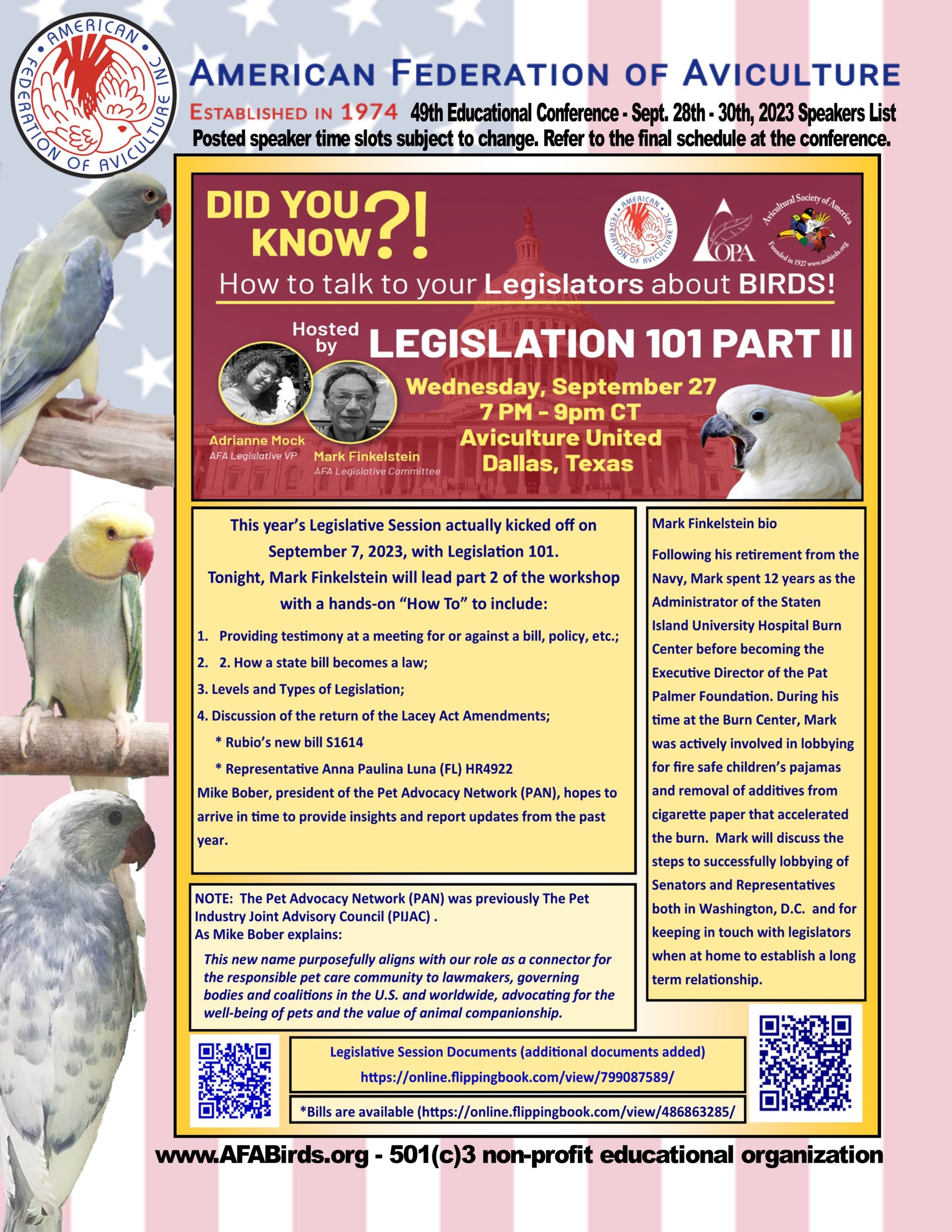
The AFA’s stance is that responsible bird ownership and breeding are essential for conservation and education. They encourage their members to stay informed through resources like the "Current Legislative Issues" portal and the "Legislation 101" training course. By educating the public on how to read a Bill, identify misleading language, and contact their representatives, the AFA aims to create a more informed and proactive constituency.
In conclusion, the monitoring of legislation is the first line of defense for the avicultural community. The transition from a pet-friendly society to one governed by restrictive animal ordinances is rarely the result of a single, dramatic law. Instead, it is the result of a slow accumulation of small, seemingly minor changes in wording and regulation. By maintaining a vigilant watch over local, state, and federal developments, bird enthusiasts can ensure that the joy of avian companionship and the vital work of conservation continue for future generations. The cost of apathy in the face of these legislative shifts is the potential loss of the right to keep birds entirely—a reality that the AFA and its partners are committed to preventing.

