


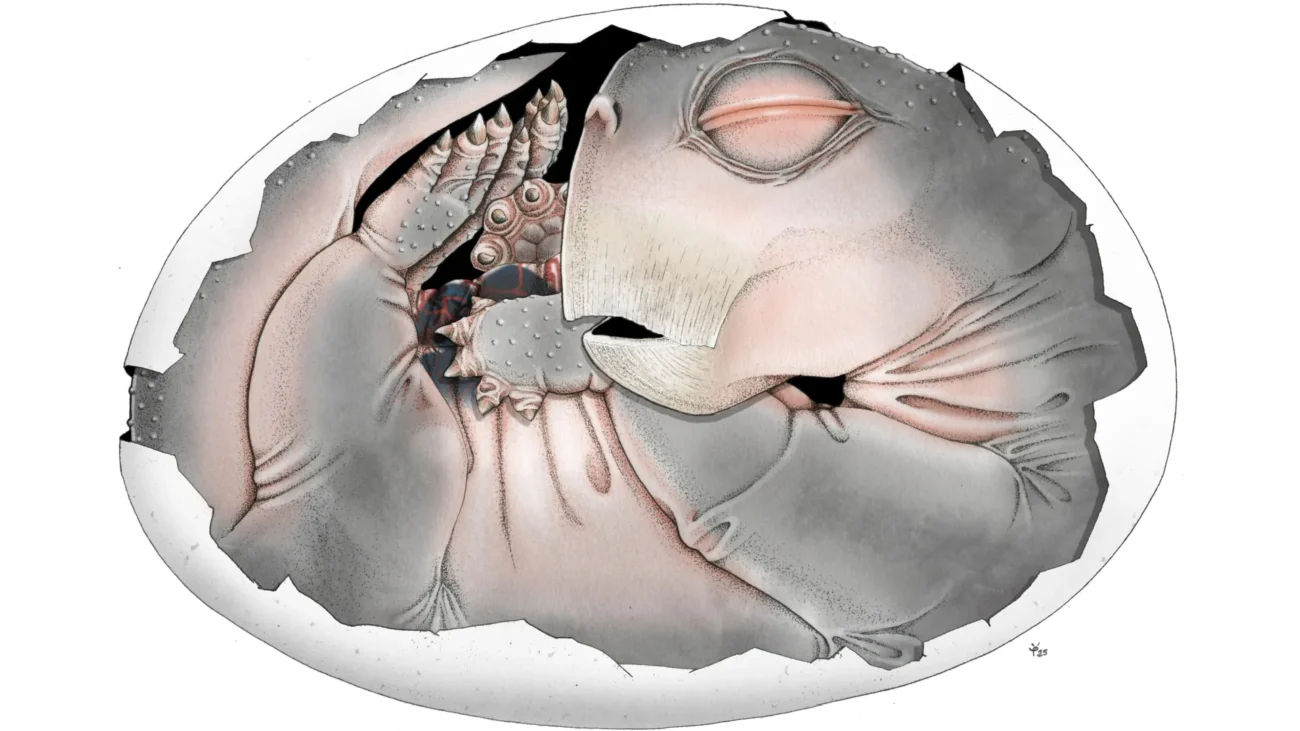
The discovery of a remarkably preserved 250-million-year-old fossilized egg, containing the embryo of Lystrosaurus, a pivotal ancestor of mammals, is poised to revolutionize our understanding of early mammalian evolution and the extraordinary resilience of life following one of Earth’s most devastating extinction events. This groundbreaking find, detailed in a recent publication in PLOS ONE, not only provides the first definitive proof that mammal ancestors laid eggs but also sheds crucial light on the survival strategies that allowed Lystrosaurus to dominate the post-apocalyptic landscape of the End-Permian Mass Extinction.
The Dawn of a New Era for Mammal Ancestors
For decades, the reproductive habits of early mammal ancestors, particularly those belonging to the lineage leading to modern mammals, have been a subject of intense scientific debate and speculation. The absence of fossilized eggs from these ancient creatures left a significant void in our knowledge, prompting questions about their evolutionary path. Did these pioneers of terrestrial life, who predated the age of dinosaurs, reproduce like reptiles or birds, or did they exhibit more advanced mammalian traits? The answer, now definitively revealed, is that they laid eggs, a trait inherited by many modern amniotes, including birds and monotremes like the platypus.
The international research team, spearheaded by Professor Julien Benoit of the National Museum of Natural History in Paris, Professor Jennifer Botha from the Evolutionary Studies Institute at the University of the Witwatersrand in South Africa, and Dr. Vincent Fernandez from the European Synchrotron Radiation Facility (ESRF) in France, utilized cutting-edge synchrotron X-ray computed tomography (CT) scanning technology to peer inside the fossil. This advanced imaging technique allowed them to visualize the delicate skeletal structures of the Lystrosaurus embryo, confirming its presence within what appears to be a soft-shelled egg.
A Glimpse into the End-Permian Cataclysm
The significance of this discovery is inextricably linked to the dramatic backdrop against which Lystrosaurus rose to prominence: the End-Permian Mass Extinction. This cataclysm, which occurred approximately 252 million years ago, stands as the most severe extinction event in Earth’s history, often referred to as the "Great Dying." It marked the boundary between the Permian and Triassic periods and resulted in the obliteration of an estimated 96% of all marine species and 70% of terrestrial vertebrate species.
The precise causes of this extinction are still being elucidated by scientists, but a leading hypothesis points to massive volcanic activity in the Siberian Traps. These eruptions released colossal amounts of greenhouse gases, including carbon dioxide and methane, into the atmosphere. This triggered a runaway greenhouse effect, leading to extreme global warming, ocean acidification, and widespread anoxia (lack of oxygen) in marine environments. On land, the planet likely experienced prolonged droughts, altered rainfall patterns, and a drastically changed atmosphere. The aftermath was a barren, desolate world, a stark testament to the fragility of life in the face of profound environmental upheaval.
The Unsung Hero of the Triassic: Lystrosaurus
In this devastated landscape, where most life forms perished, Lystrosaurus emerged as a singular survivor and a dominant force. This genus of dicynodonts, a group of herbivorous synapsids that are considered direct ancestors of mammals, possessed a unique set of adaptations that allowed it to thrive where others failed. Lystrosaurus was a relatively small, pig-sized animal, characterized by its beaked snout and a pair of tusks projecting downwards from its upper jaw. Its robust build and herbivorous diet, likely consisting of tough, low-lying vegetation that could withstand arid conditions, provided it with a crucial advantage.
The fossil record indicates that Lystrosaurus became incredibly abundant in the immediate aftermath of the End-Permian extinction, occupying a wide range of ecological niches across what was then the supercontinent of Pangaea. Its ability to colonize diverse environments, from arid plains to semi-aquatic settings, is a testament to its remarkable adaptability. However, the exact mechanisms behind its widespread success and the specific reproductive strategies it employed remained elusive until this recent egg discovery.
Decades of Searching: The Elusive Egg
The rarity of fossilized eggs from early mammal ancestors like Lystrosaurus can be attributed to their presumed soft-shelled nature. Unlike the hard, calcified eggs of dinosaurs, which are readily preserved in the fossil record, soft-shelled eggs are far more susceptible to decay. They would typically decompose before geological processes could fossilize them, leaving behind little to no trace.
The breakthrough specimen that ultimately led to this discovery was first unearthed during a field excursion in 2008, led by Professor Botha. A meticulous preparator and exceptionally skilled fossil finder, John Nyaphuli, identified a small nodule that initially revealed only faint traces of bone. With painstaking care and expertise, Nyaphuli prepared the specimen, gradually uncovering a perfectly curled Lystrosaurus hatchling. Even at that early stage, Professor Botha harbored a strong suspicion that the creature had died within its egg. However, the technology available at the time lacked the sophistication to definitively confirm this hypothesis.
Advanced Imaging: Unveiling the Hidden Embryo
The advent of advanced synchrotron X-ray CT scanning, particularly at facilities like the ESRF, provided the necessary tools to revisit and re-examine this crucial fossil. These powerful X-rays can penetrate dense rock and reveal intricate details of internal structures with astonishing clarity. Dr. Vincent Fernandez, a key member of the research team, emphasized the critical role of these advanced imaging capabilities.
"Understanding reproduction in mammal ancestors has been a long-lasting enigma, and this fossil provides a key piece to this puzzle," Dr. Fernandez stated. "It was essential that we scanned the fossil just right to capture the level of detail needed to resolve such tiny, delicate bones." The scans not only confirmed the presence of the embryo within the egg but also revealed crucial developmental information.
Developmental Clues and Reproductive Strategies
Professor Benoit’s examination of the synchrotron scans yielded a particularly exciting observation: the incomplete mandibular symphysis. The mandible, or lower jaw, in many vertebrates, is initially formed from two halves that must fuse together to create a complete, functional jaw. The incomplete fusion in the Lystrosaurus embryo indicated that the individual had not yet reached the stage where it could independently feed itself.
This developmental insight, coupled with the size of the egg, points towards a specific reproductive strategy. The study suggests that Lystrosaurus produced relatively large eggs for its body size. In modern animals, larger eggs are typically rich in yolk, providing ample nourishment for the developing embryo, thereby enabling it to reach a more advanced stage of development before hatching. This suggests that Lystrosaurus hatchlings were likely precocial – born at a relatively mature stage, capable of independent feeding and survival shortly after birth. This strategy contrasts sharply with modern placental mammals, which are born in a less developed state and rely on parental care, including nursing with milk.
The large size of the eggs would have also offered a significant advantage in the arid, unpredictable climate of the early Triassic. Larger eggs are more resistant to desiccation, reducing the risk of the embryo drying out before hatching. This would have been a critical factor for survival in a world prone to prolonged droughts.
A Winning Strategy for a Harsh World
The combination of large, yolk-rich eggs and precocial hatchlings represents a highly effective survival strategy for Lystrosaurus in the challenging post-extinction environment. By being able to hatch at an advanced developmental stage, these young animals would have been immediately capable of foraging for the limited vegetation available, evading predators, and growing rapidly. This strategy allowed Lystrosaurus to exploit resources efficiently and reproduce quickly, contributing to its rapid proliferation and dominance.
This discovery provides the first direct, irrefutable evidence that mammal ancestors laid eggs, resolving a long-standing scientific mystery. Furthermore, it offers a compelling explanation for Lystrosaurus‘s remarkable success in recolonizing a devastated planet.
Broader Implications: Resilience in the Face of Climate Change
The findings from the Lystrosaurus egg discovery extend far beyond paleontology, offering valuable insights into the broader principles of survival and adaptability in the face of extreme environmental change. The research highlights a recurring pattern observed throughout Earth’s history: resilience during global crises is often driven by adaptability, robust physiological mechanisms, and effective reproductive strategies. Lystrosaurus appears to have masterfully combined all three.
In the context of today’s world, which is grappling with unprecedented rates of climate change and biodiversity loss, this deep-time perspective is particularly relevant. Understanding how ancient organisms navigated similar global upheavals can provide scientists with crucial data to predict how modern species might respond to ongoing environmental stress. The ability of Lystrosaurus to thrive in a rapidly warming and ecologically disrupted world serves as a potent reminder of the complex interplay between life and its environment, and the remarkable capacity of some species to adapt and persist.
Professor Benoit articulated the broader significance of this research: "This research is important because it provides the first direct evidence that mammal ancestors, such as Lystrosaurus, laid eggs, resolving a long-standing question about the origins of mammalian reproduction. Beyond this fundamental insight, it reveals how reproductive strategies can shape survival in extreme environments: by producing large, yolk-rich eggs and precocial young, Lystrosaurus was able to thrive in the harsh, unpredictable conditions following the end-Permian mass extinction. In a modern context, this work is highly impactful because it offers a deep-time perspective on resilience and adaptability in the face of rapid climate change and ecological crisis. Understanding how past organisms survived global upheaval helps scientists better predict how species today might respond to ongoing environmental stress, making this discovery not just a breakthrough in paleontology, but also highly relevant to current biodiversity and climate challenges."
Professor Botha further underscored the milestone nature of the find: "What makes this work especially exciting is that we were able to quite literally follow in John Nyaphuli’s footsteps, returning to a specimen he discovered nearly two decades ago and finally solve the puzzle he uncovered. At the time, all we had was a beautifully curled embryo, but no preserved eggshell to prove it had died within an egg. Using modern imaging techniques, we were able to answer that question definitively. It is also thrilling because this discovery breaks entirely new ground. For over 150 years of South African paleontology, no fossil had ever been conclusively identified as a therapsid egg. This is the first time we can say, with confidence, that mammal ancestors like Lystrosaurus laid eggs, making it a true milestone in the field."
The collaborative effort, spanning multiple institutions and continents, and the successful application of advanced scientific tools, underscore the power of international cooperation in pushing the boundaries of scientific knowledge. The Lystrosaurus egg, a tiny vessel of ancient life, has opened a vast window into Earth’s deep past, offering profound lessons for the present and future of life on our planet.

