


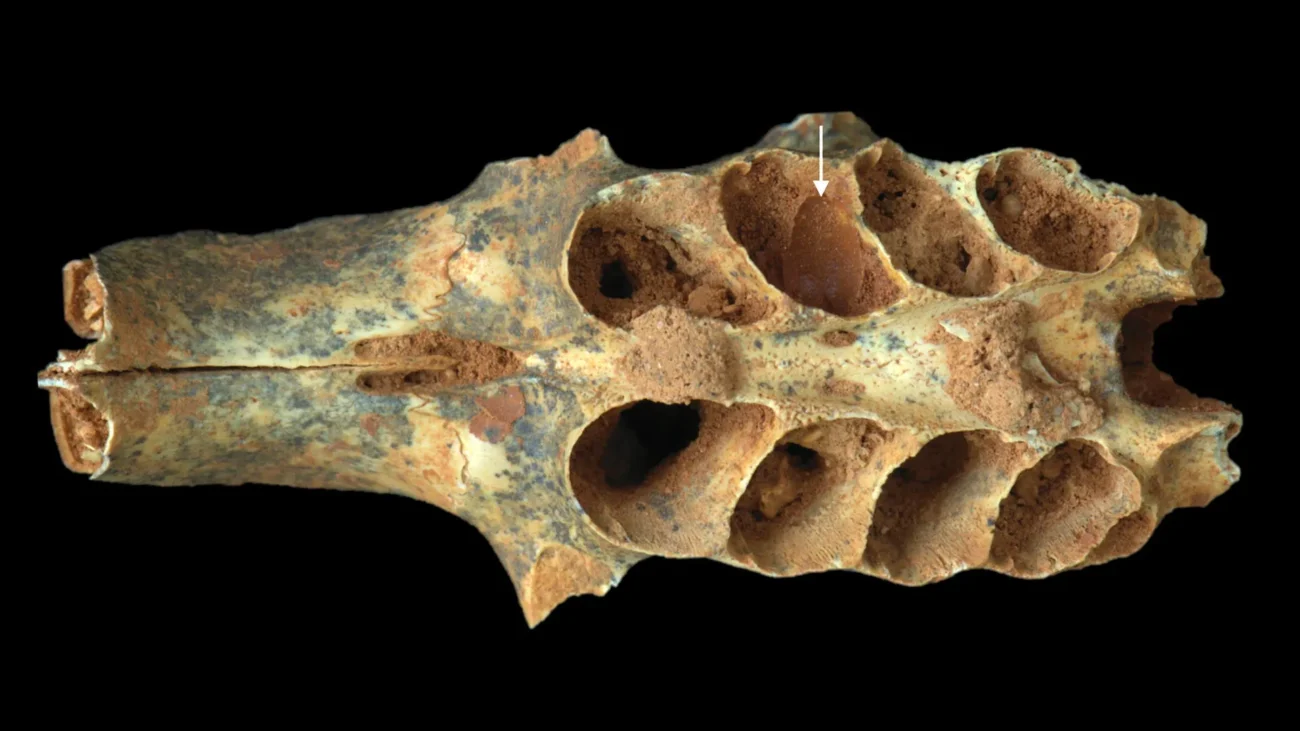
Deep within the limestone labyrinths of the Caribbean island of Hispaniola, a remarkable prehistoric real estate market operated twenty millennia ago. Long before human footprints marked the tropical landscape, a subterranean cavern functioned simultaneously as an apex predator roost and a maternity ward for some of nature’s most resourceful micro-architects. According to a landmark study published in the journal Royal Society Open Science, ancient solitary bees utilized the fossilized tooth sockets of rodent jaws as microscopic nurseries for their offspring. This discovery provides the first documented evidence in the scientific record of insects utilizing vertebrate skeletal remains as nesting sites, fundamentally shifting how paleontologists interpret trace fossils within cave ecosystems.
The revelation emerged from meticulous fossil preparation conducted by an international team of researchers led by Lazaro Viñola López, a postdoctoral researcher at the Field Museum in Chicago. While analyzing thousands of bones recovered from a remarkably rich deposit on the island shared by Haiti and the Dominican Republic, Viñola López identified smooth, concave sedimentary structures packed inside the empty tooth sockets of ancient rodent mandibles. These organic containers, measuring smaller than a standard pencil eraser, represent a previously unknown behavioral adaptation among prehistoric insects, highlighting the ecological ingenuity required to survive in specialized Pleistocene environments.
Unearthing the Fossil-Rich Cave of Hispaniola
The site of this discovery is a testament to the complex geological and biological history of the Greater Antilles. Hispaniola’s karst topography is defined by extensive limestone formations riddled with sinkholes and subterranean conduits. Juan Almonte Millán, curator of paleobiology at the Museo Nacional de Historia Natural in the Dominican Republic, initially identified the cave as an exceptional repository of Pleistocene fossils. Viñola López and his colleagues later descended into the cavern system while completing doctoral research through the University of Florida and the Florida Museum of Natural History.
Accessing the fossil beds required a technical descent. Researchers rigged ropes to the rim of the sinkhole and rappelled roughly ten meters down into the subterranean chamber. The environment is inhabited by modern arachnids, with the reflective eyes of tarantulas greeting nighttime visitors, before narrowing into a ten-meter-long horizontal tunnel system where the fossil deposits accumulate.
Stratigraphic analysis revealed that the cave preserved multiple distinct fossil layers separated by clean carbonate crusts. These mineral layers formed during ancient pluvial, or rainy, periods when increased water seepage triggered calcium carbonate precipitation. The accumulated bonebed spans a diverse cross-section of the island’s prehistoric fauna. Researchers recovered skeletal remains from more than 50 vertebrate species, dominated heavily by extinct rodents, alongside remains of ground sloths, native birds, reptiles, and occasional larger animals such as tortoises and crocodiles that suffered fatal falls into the vertical shaft.
The Ecological Dynamics of a Pleistocene Raptor Roost
The primary accumulation agent for the vast majority of the mammalian fossils was not direct mortality within the pit, but rather avian predation. For generations spanning hundreds or potentially thousands of years, the cave served as a communal roosting site for nocturnal raptors, most notably owls.
As these birds hunted across the rich forests and grasslands of Pleistocene Hispaniola, they consumed small mammals, reptiles, and amphibians whole. Unable to digest fur, bones, and chitin, the raptors regularly regurgitated these indigestible components in the form of tightly packed pellets onto the cave floor. Over millennia, the decomposition of these pellets, combined with the natural mortality of cave-dwelling fauna and animals trapped by the geography of the sinkhole, created an exceptionally dense accumulation of skeletal elements.
It was within this matrix of discarded rodent mandibles and crania that the micro-ecosystem intersected with the lifecycle of ancient solitary bees. While examining the micro-anatomy of mammalian jawbones, Viñola López noticed that several empty tooth sockets contained compacted sediment shaped in a manner inconsistent with natural mechanical or water-borne infilling. The smooth, concave linings bore an uncanny resemblance to structures he had previously encountered during undergraduate fieldwork in Montana, where he was shown fossilized wasp cocoons. Subsequent comparative analysis confirmed that these structures were constructed mud chambers designed to protect developing insect larvae.
Entomological Sleuthing and Micro-CT Scanning
To verify the nature of the subterranean chambers without destroying the rare Pleistocene fossils, the research team employed high-resolution micro-computed tomography (micro-CT) scanning. This non-destructive imaging technique generated detailed three-dimensional visualizations of the material packed inside the microscopic confines of the tooth sockets.
The scans revealed structural signatures matching the mud-based nesting architecture produced by contemporary solitary bees. Unlike honey bees or paper wasps, which invest energy into building elaborate social colonies, the vast majority of modern bee species live solitary existences. A female solitary bee typically locates a small pre-existing cavity, constructs a protected cell, provisions it with a concentrated mixture of pollen and nectar as nutritional capital for her offspring, lays a single egg, and seals the chamber.
The micro-CT scans not only confirmed the structural integrity of the mud nests but also preserved minute grains of ancient pollen trapped within the sediment. This botanical evidence verified that the chambers served a biological provisioning function. The mother bees had mixed fine-grained soil with oral secretions to synthesize a durable mortar, shaping it within the hollowed anatomical architecture of rodent jaws.
Utilizing the hollow bones of larger vertebrates provided distinct evolutionary advantages. By embedding their nurseries inside dense skeletal elements, the bees gained a reinforced micro-habitat shielded from thermal fluctuations and potential invertebrate predators, such as parasitic wasps seeking to lay their own eggs inside unprotected insect larvae.
Taxonomic Classification: Osnidum almontei
Because the tropical climate and high humidity of Hispaniola are inimical to the preservation of delicate chitinous insect exoskeletons, the researchers did not recover any fossilized bee bodies within the nests. Consequently, determining the precise species responsible for constructing the chambers remains impossible through direct morphological identification of the insects themselves.
However, in accordance with the rules of ichnotaxonomy—the formal naming and classification of trace fossils representing organism behavior rather than the organism’s body—the researchers formally named the fossil nests Osnidum almontei. The genus name reflects the specialized cavity-nesting habit, while the specific epithet honors Juan Almonte Millán in recognition of his decades of foundational paleontological work in the Dominican Republic.
The absence of adult bee specimens leaves two primary hypotheses regarding the taxonomic status of the architects. It is entirely feasible that the structures were built by a species of solitary bee that persists in the Caribbean today, given that the ecological habits, distribution, and life histories of many island insect populations remain understudied. Conversely, because a significant proportion of the vertebrate fauna preserved in the same cave strata represents extinct Pleistocene species, the bees themselves may belong to an extinct lineage that vanished alongside the island’s megafauna and specialized habitats.
Broader Implications and Paleontological Significance
The identification of Osnidum almontei represents a paradigm shift in how paleoentomologists and vertebrate paleontologists view the interplay between different biological kingdoms in the fossil record. Historically, researchers studying bonebeds and cave deposits tended to compartmentalize their findings, focusing either on vertebrate skeletal remains or invertebrate trace fossils, rarely anticipating complex behavioral interactions between the two.
Several ecological pressures likely drove this unprecedented evolutionary behavior on Pleistocene Hispaniola. The regional limestone geology is characterized by thin, rocky soils and dense bedrock outcrops, which severely limits the availability of traditional ground-burrowing substrates utilized by many solitary bee species. Furthermore, the absence of widespread decaying timber suitable for wood-boring bees in certain sectors of the island created a micro-habitat deficit.
By contrast, the relentless activity of generations of owls ensured a continuous, reliable supply of durable, pre-formed cavities in the form of mammalian tooth sockets scattered across the cave floor. This intersection of avian predation and insect resourcefulness underscores the opportunistic adaptability of solitary bees when confronted with ecological constraints.
Furthermore, the discovery highlights the critical importance of multidisciplinary awareness during fossil preparation. Had Viñola López not possessed prior exposure to insect trace fossils from his undergraduate research in Montana, the smooth sediment lining the rodent jaws might have been dismissed as standard detritus and systematically cleaned away during standard bone preparation protocols.
As researchers continue to analyze the rich fossil matrix of the Hispaniola cave system, the findings serve as a potent reminder that the fossil record holds layers of biological history far more intricate than previously imagined. The unexpected partnership between nocturnal raptors, deceased rodents, and resourceful Pleistocene bees demonstrates that even the most overlooked anatomical structures—down to a millimeter-wide tooth socket—can harbor extraordinary stories of survival, adaptation, and ecological connectivity across deep time.

