


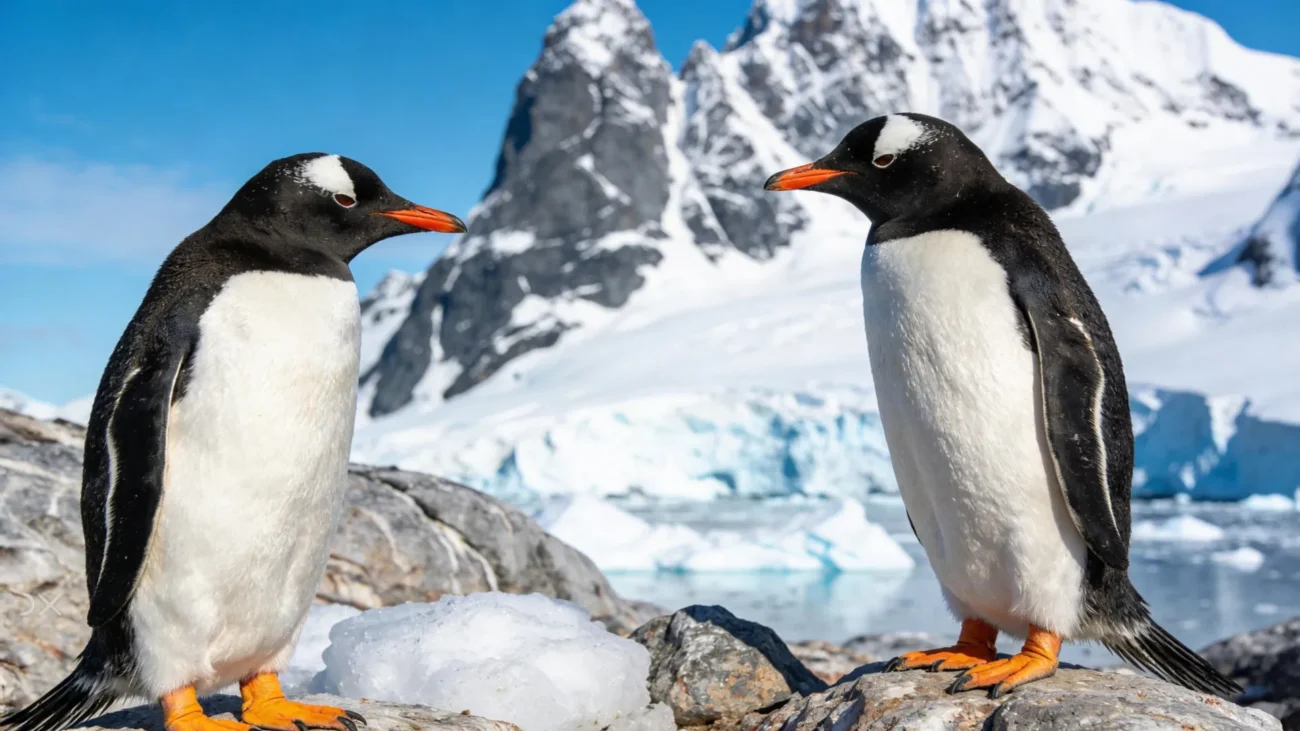
For generations, the gentoo penguin (Pygoscelis papua) has been a familiar fixture of popular culture, wildlife documentaries, and polar tourism. Characterized by its striking white crown stripe, bright orange-red bill, and familiar tuxedo-like plumage, the bird was long considered a single, cohesive species distributed broadly across the Southern Hemisphere. However, a landmark international genomic study has fundamentally altered this understanding. By analyzing the complete genetic blueprints of gentoo populations spanning their entire geographic range, researchers have determined that what was once treated as a single species is actually a complex of four distinct species—including one entirely new to science.
Published in the journal Communications Biology, the findings mark the first time in more than a century that a new penguin species has been formally identified and named. Led by an international consortium of scientists based in Chile and at the University of California, Berkeley, the research resolves a century-old taxonomic debate while sounding an urgent alarm regarding the conservation status of sub-Antarctic island populations facing rapid climate disruption.
Main Facts and the Discovery of a Cryptic Species
The core revelation of the study centers on genetic divergence among populations previously lumped together under the banner of the gentoo penguin. Using whole-genome sequencing of 64 individual penguins gathered from 10 distinct breeding colonies, the research team compared thousands of genetic variations known as single nucleotide polymorphisms (SNPs).
The data revealed that the gentoo lineage has fractured into four separate species over the past 300,000 to 500,000 years. Three of these populations were previously recognized as subspecies, but the genetic divergence is now deemed profound enough to elevate them to full species status. Crucially, the fourth lineage had never been formally recognized by science.
This newly discovered bird inhabits the Kerguelen Islands—an isolated French archipelago in the southern Indian Ocean often referred to as the Desolation Islands, situated nearly 2,000 miles away from any permanently inhabited landmass. While this southeastern gentoo penguin, now classified as Pygoscelis kerguelensis, closely resembles other gentoos in physical appearance, voice, and behavior, its DNA sets it apart definitively. Such an organism is known to biologists as a "cryptic species"—an animal that looks remarkably similar to related species despite possessing deep genetic divergences driven by long-term geographic isolation.
In addition to Pygoscelis kerguelensis, the researchers confirmed the validity of three other species within the complex:
- Pygoscelis papua (the northern lineage, restricted to the Falkland/Malvinas and Martillo Islands).
- Pygoscelis taeniata (the eastern lineage, found north of the Antarctic Polar Front on the Crozet, Marion, and Macquarie Islands).
- Pygoscelis ellsworthi (the southern lineage, inhabiting the Antarctic Peninsula, coastal Antarctica, and South Georgia Island).
A Century of Taxonomic Debate and Chronology of Research
The classification of the gentoo penguin has been a persistent headache for ornithologists and taxonomists for well over a century. Over the decades, various researchers proposed anywhere from two to six distinct subspecies based on superficial differences in body size, bill length, and regional distribution. However, without comprehensive genetic sampling from across the species’ entire circumpolar range, a definitive consensus remained elusive.
The breakthrough was achieved through a collaborative effort spanning nearly a decade of field and laboratory work. The project was spearheaded by co-senior authors Dr. Juliana Vianna, a professor of ecosystems and environment at Andrés Bello National University in Santiago, Chile; Dr. Rauri Bowie, a professor of integrative biology and curator at UC Berkeley’s Museum of Vertebrate Zoology; and Dr. Elie Poulin, a professor at the University of Chile. Daly Noll, a graduate student at the University of Chile, served as the paper’s first author, steering the complex genomic bioinformatics.
The historical timeline of the genus Pygoscelis stretches back tens of millions of years. Previous evolutionary modeling by Bowie and Vianna established that ancestral penguins originated near the coasts of Australia and New Zealand approximately 22 million years ago. As geological epochs shifted, Emperor and King penguins diverged early from the main lineage, securing niches in high-latitude Antarctica and sub-Antarctic islands, respectively.
Approximately 12 million years ago, the establishment of the Antarctic Circumpolar Current—the world’s most powerful ocean current—facilitated the dispersal of other penguin lineages. This massive marine highway allowed ancestral gentoos to colonize remote sub-Antarctic archipelagos and eventually reach as far north as South America and Africa. Over hundreds of thousands of years, the Antarctic Polar Front—a sharp oceanic boundary where cold, acidic polar waters meet warmer sub-Antarctic seas—acted as a formidable thermal and ecological barrier, cutting off gene flow between island populations and setting the stage for speciation.
Genomic Adaptations to Diverse Environments
The researchers looked beyond simple taxonomy to investigate how each of the four gentoo species adapted to its specific regional habitat. Because gentoos possess a dietary flexibility uncommon among other penguins—consuming a varied diet of fish, krill, squid, and cuttlefish rather than relying on a single prey source—they established permanent, localized breeding colonies rather than undertaking massive seasonal migrations.
This sedentary lifestyle on isolated islands allowed natural selection to uniquely sculpt the genome of each population:
- The Southern Gentoo (Pygoscelis ellsworthi): Thriving in the harsh conditions of the Antarctic Peninsula and coastal Antarctica, this species exhibits genomic enrichment in areas linked to heat production, lipid and fat storage, and light perception. The latter adaptation is vital for surviving extreme seasonal shifts in daylight and navigating intense solar reflection off sea ice and glaciers.
- The Eastern Gentoo (Pygoscelis taeniata): Inhabiting islands north of the Polar Front where marine biological productivity can be lower, this lineage shows genetic adaptations favoring efficient carbohydrate metabolism and enhanced diving performance. Key genes associated with oxygen transport, blood vessel formation, lung development, and mitochondrial activity enable these birds to forage underwater for extended periods.
- The Northern Gentoo (Pygoscelis papua): Found in the milder waters of the Falklands and South America, this population’s genome displays enhancements in digestion, heart contraction, and muscle excitation, supporting prolonged physical exertion during foraging dives.
- The Southeastern Gentoo (Pygoscelis kerguelensis): Isolated on the Kerguelen and Heard islands near the Polar Front, this newly minted species evolved specialized traits tailored to its remote sub-Antarctic volcanic habitat.
Official Responses and Conservation Implications
While the discovery of a new bird species is a rare and celebrated milestone in modern ornithology, the findings carry urgent conservation implications. As global temperatures rise due to anthropogenic climate change, the four gentoo species face vastly different futures.
Projections based on climate modeling suggest that Pygoscelis ellsworthi, the Antarctic gentoo, may see its suitable habitat expand southward as continental ice sheets recede. In stark contrast, the three sub-Antarctic island-dwelling species—Pygoscelis papua, Pygoscelis taeniata, and the newly named Pygoscelis kerguelensis—face a precarious trajectory.
"In Antarctica, of course, other species, not the gentoo, are threatened by climate change," explained Dr. Juliana Vianna. She pointed out that while iconic ice-obligate species like Emperor, Adélie, and chinstrap penguins are suffering population declines due to disappearing sea ice and depleted krill stocks beneath the ice, gentoos on the Antarctic Peninsula are currently holding steady or increasing. "But the gentoo is of most concern in the sub-Antarctic region," she added, highlighting the vulnerability of isolated island ecosystems.
Because these sub-Antarctic islands are separated by vast expanses of open ocean, island-endemic penguins cannot simply migrate northward or southward when environmental conditions shift. "Galapagos and other island penguin species, because they’re endemic to these islands, will find no place to go after a change in their environment," Vianna noted. "Those islands are very isolated, and these penguins cannot adapt easily to colonize any other region."
Because the sub-Antarctic islands are governed by a patchwork of international jurisdictions—including Chile, France, South Africa, Australia, New Zealand, and the Netherlands—coordinated protection is complex. "It’s very important that conservation institutions in all the different countries involved recognize and take appropriate action to save these three gentoo penguin species," Vianna urged.
Beyond climate change, these isolated populations contend with compounding anthropogenic pressures, including warming ocean temperatures, habitat destruction, invasive predators like rats and feral cats introduced by historical sealers, competition with commercial fisheries, and accidental entanglement in fishing gear.
Broader Impact and Future Research
The genomic dataset assembled by the international team extends far beyond resolving taxonomic debates. Dr. Rauri Bowie emphasized the utility of whole-genome sequencing in modern wildlife management, noting that understanding the genetic architecture of wild populations provides essential tools for conservation biologists.
Currently, Dr. Vianna and her colleagues are already expanding their genomic inquiries, analyzing penguin DNA to identify genetic markers associated with natural resistance or vulnerability to avian influenza—a pathogen that has increasingly devastated wild bird and marine mammal populations globally. By pinpointing which colonies possess innate genetic defenses and which are critically vulnerable, conservationists can prioritize monitoring and intervention efforts.
"Whole genome sequencing has transformed our ability to not only look at adaptation from a perspective of how things diversify, but it has really important conservation value," Bowie concluded. As global biodiversity faces unprecedented threats from a changing climate and human encroachment, the formal recognition of Pygoscelis kerguelensis and its sister species serves as a reminder of how much remains unknown about the natural world—and how rapidly science must move to protect it.

