


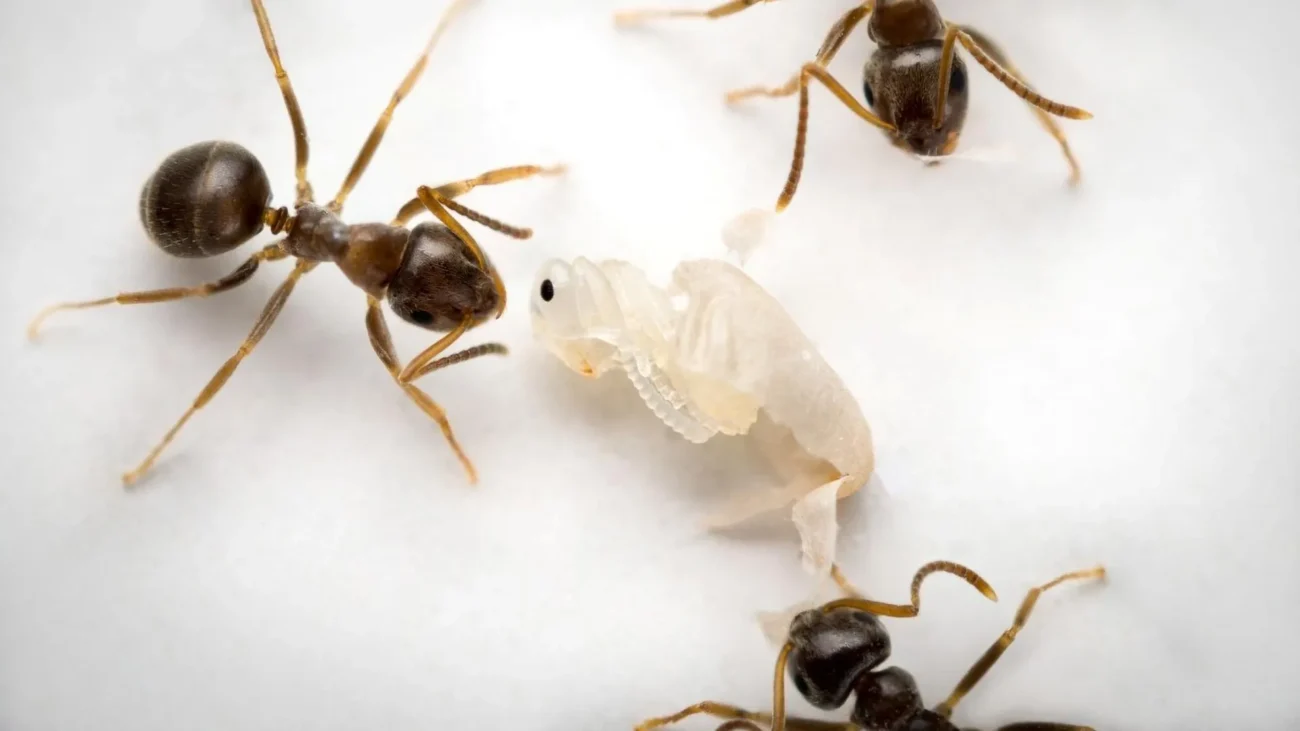
Ant colonies, long recognized for their remarkable social organization, operate as intricate "superorganisms," a concept where the collective functions with the coordinated efficiency of a single, larger entity. This biological analogy has been further illuminated by groundbreaking research from the Institute of Science and Technology Austria (ISTA). Scientists at ISTA have unveiled a sophisticated communication system within ant colonies, revealing that terminally ill ant brood release a distinct chemical alarm. This unique odor, akin to the distress signals emitted by infected cells in a human body, serves as a vital early warning system, enabling the colony to swiftly identify and neutralize nascent infections before they can jeopardize the entire community. The seminal findings of this research were recently published in the prestigious journal Nature Communications.
The Unseen Language of Illness in the Ant Colony
While many social animals, including humans, tend to conceal signs of illness to avoid social stigma or rejection, ant pupae exhibit a strikingly different behavior. When faced with an infection that proves fatal, these developing ants do not remain silent. Instead, they proactively produce a specific chemical signature, a potent alarm that alerts their nestmates to the imminent danger they represent. This strategy, seemingly counterintuitive at first glance, is a testament to the extreme cooperative nature of ant societies and their evolved mechanisms for collective survival.
This discovery challenges the conventional understanding of individual survival versus group benefit in social insects. The research meticulously details how this altruistic disease signaling functions, providing a previously undocumented example of such a mechanism in social insects. Prior to this study, the exact means by which ant colonies managed internal threats of disease on a microscopic level remained largely speculative.
Worker Ants: The Colony’s First Responders
Upon detecting this specific chemical alarm emanating from infected pupae, worker ants initiate a rapid and decisive response. Their actions are precise and immediate: they meticulously open the cocoon of the afflicted pupa, carefully create small incisions in its outer surface, and then apply formic acid. This naturally produced antimicrobial compound, a staple in the ant’s own defensive arsenal, acts as a potent disinfectant. The application of formic acid effectively eradicates the pathogens proliferating within the pupa. However, this rigorous treatment also invariably leads to the demise of the pupa itself.
Dr. Erika Dawson, the study’s lead author and a former postdoctoral researcher in the "Social Immunity" research group at ISTA, headed by Professor Sylvia Cremer, elaborates on this complex behavior. "What appears to be self-sacrifice at first glance is, in fact, also beneficial to the signaler," Dr. Dawson explains. "It safeguards its nestmates, with whom it shares many genes. By warning the colony of their deadly infection, terminally ill ants help the colony remain healthy and produce daughter colonies, which indirectly pass on the signaler’s genes to the next generation." This intricate interplay highlights a profound level of genetic investment in the colony’s overall health, extending the concept of kin selection beyond immediate familial bonds to the entire social unit.
The collaborative effort between the infected pupa’s distress signal and the worker ants’ swift intervention is crucial. Without such an early warning system, a dying ant pupa could become a highly infectious source, posing a catastrophic threat to the entire colony. By broadcasting their condition proactively, these incurably ill individuals empower the colony to preemptively neutralize the threat before it escalates into a widespread epidemic.
The Superorganism Analogy: Extreme Cooperation for Survival
The research, conducted in collaboration with chemical ecologist Dr. Thomas Schmitt from the University of Würzburg in Germany, underscores the profound implications of this "altruistic disease signaling" for the survival and propagation of ant colonies. At the colony level, ants exhibit the characteristics of a "superorganism," a biological concept where a group of individuals functions as a single, cohesive unit. In this model, distinct roles are assigned to different members, all contributing to the collective survival and reproductive success. Queens are dedicated to reproduction, ensuring the continuation of the species, while worker ants manage the day-to-day operations of the colony, encompassing tasks such as foraging, nest construction, defense, and crucially, health maintenance. This division of labor mirrors the functional specialization observed in a multicellular organism, where different cell types perform specific tasks essential for the body’s overall well-being.
Both biological organisms and superorganisms are fundamentally dependent on the seamless cooperation between their reproductive and non-reproductive components. In ants, this interdependence is so deeply ingrained that it manifests in behaviors that prioritize the colony’s welfare, even at the direct expense of an individual. The sacrifice of a fatally infected pupa is a prime example of this extreme form of cooperation, where individual life is willingly relinquished for the greater good of the collective.
The Necessity of an Early-Warning System
A pertinent question arises: why has such a sophisticated alarm system evolved if sick individuals can simply isolate themselves? Professor Sylvia Cremer, head of the Social Immunity research group at ISTA, addresses this point, drawing parallels with adult ant behavior. "Adult ants that approach death leave the nest to die outside the colony," Professor Cremer notes. "Similarly, workers that have been exposed to fungal spores practice social distancing." This self-imposed isolation is a crucial survival mechanism for mobile individuals. However, this option is not available to developing brood, such as pupae, which lack independent mobility. Like infected cells within a body, these immobile entities require external intervention to manage and eliminate pathogens.
The parallels between developing ant pupae and infected body cells are striking. Both face similar challenges in containing and eliminating threats to their respective systems. Consequently, they employ analogous strategies: they release chemical cues that attract specialized responders. In the case of ant pupae, these cues draw worker ants, which act as the colony’s immune cells. In the human body, similar chemical signals attract immune cells to the site of infection. Immunologists refer to these cues as "find-me and eat-me" signals, which effectively guide the immune system to the source of the threat.
Professor Cremer emphasizes the critical requirements for such a signaling system: "The signal must be both sensitive and specific," she states. "It should help to identify all terminally-sick ant pupae but be precise enough to avoid triggering the unpacking of healthy pupae or those capable of overcoming the infection with their own immune system." This precision is paramount to prevent unnecessary resource expenditure and the premature culling of potentially viable individuals. The question then becomes: how do ants achieve such a refined level of discriminatory signaling?
Decoding the Scent of Infection: How Pupal Odor Changes
Dr. Thomas Schmitt, whose research expertise lies in chemical communication within social insects, highlights the remarkable ability of worker ants to pinpoint a single infected pupa amidst a multitude of healthy ones. "This means the scent cannot simply diffuse through the nest chamber but must be directly associated with the diseased pupa," Dr. Schmitt observes. This implies that the signal is not composed of highly volatile compounds that would dissipate quickly, but rather of non-volatile compounds that adhere to the pupal body surface, creating a localized scent signature.
The research revealed that when a pupa becomes fatally infected, two specific components of its natural scent profile are significantly amplified. To definitively ascertain whether this altered odor alone was sufficient to trigger the colony’s disinfection response, the researchers conducted a series of controlled experiments. They meticulously extracted the altered scent from signaling pupae and then applied it to healthy, uninfected pupae. The subsequent observation of worker ant behavior provided compelling evidence.
"We extracted the smell from the signaling pupae and applied it to healthy brood," Professor Cremer recounts. The results were unambiguous: the application of the altered scent alone was sufficient to elicit the characteristic response from worker ants. They proceeded to unpack the treated pupae, demonstrating that the modified odor of terminally infected brood functions precisely as the "find-me and eat-me" signal observed in infected body cells. This direct experimental validation provides a robust link between the chemical alteration and the behavioral response.
The Selective Nature of the Alarm: Who Signals and Why?
An important aspect of this altruistic signaling system is its selective activation. Dr. Dawson clarifies that not all brood emit this alarm signal. "Queen pupae, which have stronger immune defenses than worker pupae and can limit the infection on their own, were not observed to emit this warning signal to the colony," she explains. In contrast, worker pupae, which possess less robust immune capabilities and are therefore more vulnerable to overwhelming infections, do signal for assistance.
This differential signaling behavior ensures that the colony’s resources and responses are directed only towards genuine, unmanageable threats. By only sounding the alarm when an infection cannot be contained by the individual’s own immune system, the brood prevents the unnecessary loss of individuals that might otherwise have recovered. Professor Cremer concludes, "This precise coordination between the individual and colony level is what makes this altruistic disease signaling so effective." This intricate dance between individual vulnerability and collective defense exemplifies the sophisticated evolutionary strategies employed by social insects to maintain colony health and ensure long-term survival.
Broader Implications and Future Research Directions
The implications of this research extend beyond the fascinating world of ant colonies. The discovery of a parallel between ant brood signaling and the "find-me and eat-me" signals in human immune systems opens new avenues for understanding fundamental biological processes. It suggests that the evolutionary pressures driving the development of sophisticated communication systems for disease detection and elimination may have deep, shared roots across vastly different forms of life.
This study could inform future research in immunology, potentially offering novel insights into how the body’s own cells signal danger to immune responders. Furthermore, understanding the precise chemical cues and their molecular mechanisms could inspire new strategies for disease prevention and treatment, not only in humans but also in agricultural contexts involving insect pests.
The research team plans to further investigate the specific chemical compounds responsible for the altered scent and the receptors on worker ants that detect these signals. Understanding the genetic basis for this differential signaling between queen and worker pupae could also yield valuable insights into the evolution of immune defenses and social organization. The meticulous collection, rearing, and handling of animals in these experiments adhere to strict legal regulations, underscoring the ethical considerations paramount in scientific research.
In conclusion, the ISTA study provides a compelling narrative of cooperation, communication, and sacrifice within the ant colony. By deciphering the complex language of illness, researchers have illuminated how these tiny creatures, operating as a unified superorganism, have evolved an elegant solution to combat disease, a solution that resonates with the fundamental principles of biological defense observed in our own bodies.

