


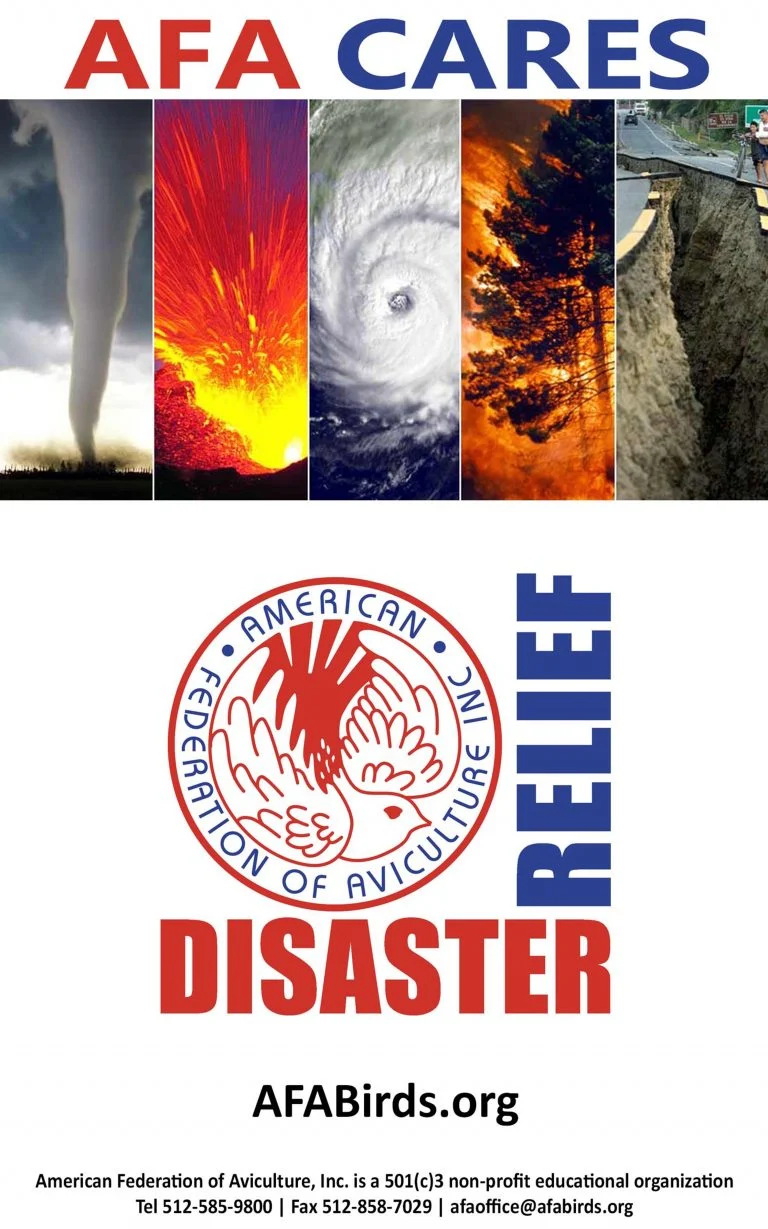
Natural disasters present an unpredictable and profound threat to communities across the globe, testing the resilience of infrastructure, families, and domestic animals alike. While comprehensive emergency planning frequently addresses dogs, cats, and livestock, the specialized needs of captive birds and avicultural collections are often overlooked. Hurricanes, tornadoes, straight-line windstorms, floods, earthquakes, wildfires, and severe winter weather systems demand specialized mitigation strategies tailored to the physiological and psychological vulnerabilities of avian species. In response to these recurring environmental threats, organizations such as the American Federation of Aviculture (AFA) have established robust, nationwide disaster relief networks designed to safeguard birds, support owners, and coordinate emergency rescue operations.
Main Facts of the AFA Disaster Relief Network
The American Federation of Aviculture maintains a decentralized disaster relief infrastructure anchored by Regional Directors and dedicated volunteers stationed strategically throughout the United States. This geographic distribution significantly accelerates response times during emergencies, allowing local volunteers to monitor developing weather patterns and deploy assistance precisely where the need is greatest.
The AFA provides multifaceted support during crises, ranging from direct search and rescue coordination to logistical assistance, resource allocation, and owner reunification. When catastrophic events compromise regional infrastructure—blocking roadways, severing communication lines, and cutting off electricity—the AFA serves as a central clearinghouse for bird owners and rescue personnel. Individuals affected by disasters, or those seeking to volunteer their time, equipment, and expertise, can access immediate guidance by contacting the AFA business office or utilizing dedicated digital response channels.
Background Context: The Vulnerability of Avian Collections in Crises
Aviculturists, breeders, sanctuaries, and pet bird owners face distinct challenges when environmental catastrophes strike. Unlike domestic mammals that can often be easily leashed or herded, birds require secure containment to prevent escape, injury, or fatal stress. Furthermore, different geographical regions expose bird populations to distinct hazards. Coastal areas frequently contend with catastrophic storm surges and hurricane-force winds, while western states face escalating threats from rapidly moving wildfires and heavy smoke plumes. Midwestern regions are routinely subjected to devastating tornadoes, whereas northern states must navigate blinding blizzards and prolonged ice storms that paralyze the power grid.
According to historical emergency management data from animal welfare organizations, thousands of companion animals and exotic pets are displaced, injured, or lost during major weather events annually. Without a pre-established disaster plan, owners attempting to capture, crate, and transport exotic or aviary birds under duress frequently encounter severe obstacles. Panic, lack of proper transport carriers, inaccessible permanent caging, and restricted road access compound the danger, turning manageable evacuations into life-threatening scenarios.
Chronology and Timeline of Emergency Response Phases

Effective disaster management for aviculturists operates on a strict chronology, categorized into pre-disaster mitigation, immediate pre-impact mobilization, active crisis execution, and post-disaster recovery.
Phase 1: Long-Term Mitigation and Planning (Months to Weeks Prior)
Preparation must begin long before a watch or warning is issued. Aviculturists are advised to inventory and stage essential equipment, including pre-assembled or collapsible travel carriers equipped with perches and water dishes. Storing capture tools—such as nets, thick towels, protective gloves, wire cutters, and specialized toolboxes—in an easily accessible location eliminates precious minutes of frantic searching during an emergency. Furthermore, establishing redundant identification systems, including leg bands, microchips, and off-site digital records of ownership, ensures birds can be legally verified and returned if separated from their caretakers.
Phase 2: Pre-Impact Mobilization (24 to 72 Hours Prior)
As a disaster approaches, bird owners face the critical decision of whether to evacuate or shelter in place. Government emergency management guidelines consistently emphasize early evacuation, as roadways rapidly become gridlocked and municipal authorities enforce mandatory closures. During this window, owners must secure auxiliary transportation capable of safely accommodating the volume and size of their collection, ensuring that rented cargo vehicles maintain adequate ventilation. If opting to shelter in place, caretakers must inspect emergency generators, replenish perishable food and water stocks, and document precise GPS coordinates of their property to facilitate emergency locating if street signs are destroyed.
Phase 3: Active Crisis Execution (During the Event)
When the disaster strikes, safety protocols dictate that human life takes absolute precedence. However, if conditions permit and safe access is maintained, trained rescue personnel deploy under the guidance of the AFA Disaster Relief Team. Rescuers navigate restricted access zones, coordinate with local law enforcement, and interface with the Incident Command System (ICS) established by regulatory bodies such as the Occupational Safety and Health Administration (OSHA).
Phase 4: Post-Disaster Recovery and Reunification (Days to Weeks Following)
Following the cessation of immediate danger, the recovery phase begins. This stage involves returning surviving birds to repaired permanent housing, coordinating temporary foster placements for displaced collections, and actively tracking down owners. The AFA aids in mapping relocation sites, distributing emergency food supplies, and ensuring that every rescued bird is properly documented and ultimately reunited with its rightful caretaker.
Supporting Data and Operational Logistics
The logistical complexities of executing an avian rescue operation require strict adherence to established protocols. Rescuers operating within disaster zones must overcome significant administrative and physical barriers. Local law enforcement agencies frequently seal off impacted sectors to protect the public from downed power lines, structural instability, and hazardous materials. To secure legitimate entry, AFA volunteers utilize standardized identification credentials, including official organizational apparel, magnetic vehicle door logos, and name cards.
Navigating the Incident Command System (ICS) is a critical competency for disaster relief workers. Large-scale emergencies in the United States are managed by an Incident Commander who holds ultimate authority over all public safety and rescue operations within the designated disaster perimeter. Rescuers must formally request access through the Incident Commander or designated liaisons, demonstrating clear humanitarian purpose and logistical preparedness.
When entering a compromised facility, rescue teams must be equipped with versatile containment options. While standard transport carriers are ideal, emergency scenarios frequently require the use of alternative holding vessels, including pet crates, plastic storage bins modified with ventilation holes, cardboard boxes, and even heavy-duty paper bags for smaller passerines. Throughout the extraction process, meticulous record-keeping is mandatory; pairing markers are used to label crates, identify bonded pairs, and preserve original leg bands without removal.
Official Statements and Institutional Guidance
Avicultural leadership emphasizes that emergency preparedness is not merely a matter of convenience, but an ethical obligation for anyone maintaining captive birds. Mary Ellen LePage, former Fire Chief for CalFire, highlights the critical necessity of structured planning in mitigating loss during natural disasters. In comprehensive guidelines published for avian caretakers, LePage notes that every environmental hazard demands a calculated response, urging owners to draft clear, written evacuation plans and post them in prominent locations where emergency responders can easily review them.
"Your safety comes first," organizational leadership reiterates, stressing that human caretakers must never risk their lives for animals if conditions have deteriorated beyond safe thresholds. Nevertheless, for those equipped, trained, and authorized to execute rescues, the organized framework provided by the AFA ensures that help can be systematically deployed.
The American Federation of Aviculture maintains an open channel of communication for individuals requiring urgent assistance or wishing to offer aid. The central business office can be reached directly at 512-585-9800 or via electronic mail at [email protected].
Broader Impact and Implications for the Avicultural Community
The implementation of structured disaster relief protocols has far-reaching implications for the broader avicultural community, conservation breeding programs, and the pet bird industry. As global climate patterns shift and extreme weather events increase in frequency and severity, informal, ad-hoc responses to animal emergencies are no longer sufficient. Institutionalizing disaster preparedness elevates the standard of animal welfare across the board, reducing mortality rates and psychological trauma in sensitive avian species.
Furthermore, organized disaster response fosters greater collaboration between private aviculturists, local emergency management agencies, and animal welfare organizations. By establishing clear chains of command, standardized identification methods, and pre-arranged sheltering networks, the avicultural community demonstrates professionalism and accountability. These proactive measures ultimately protect invaluable genetic lines, preserve rare and endangered species housed in private breeding facilities, and provide essential peace of mind to bird owners facing the terrifying uncertainty of natural disasters.

