


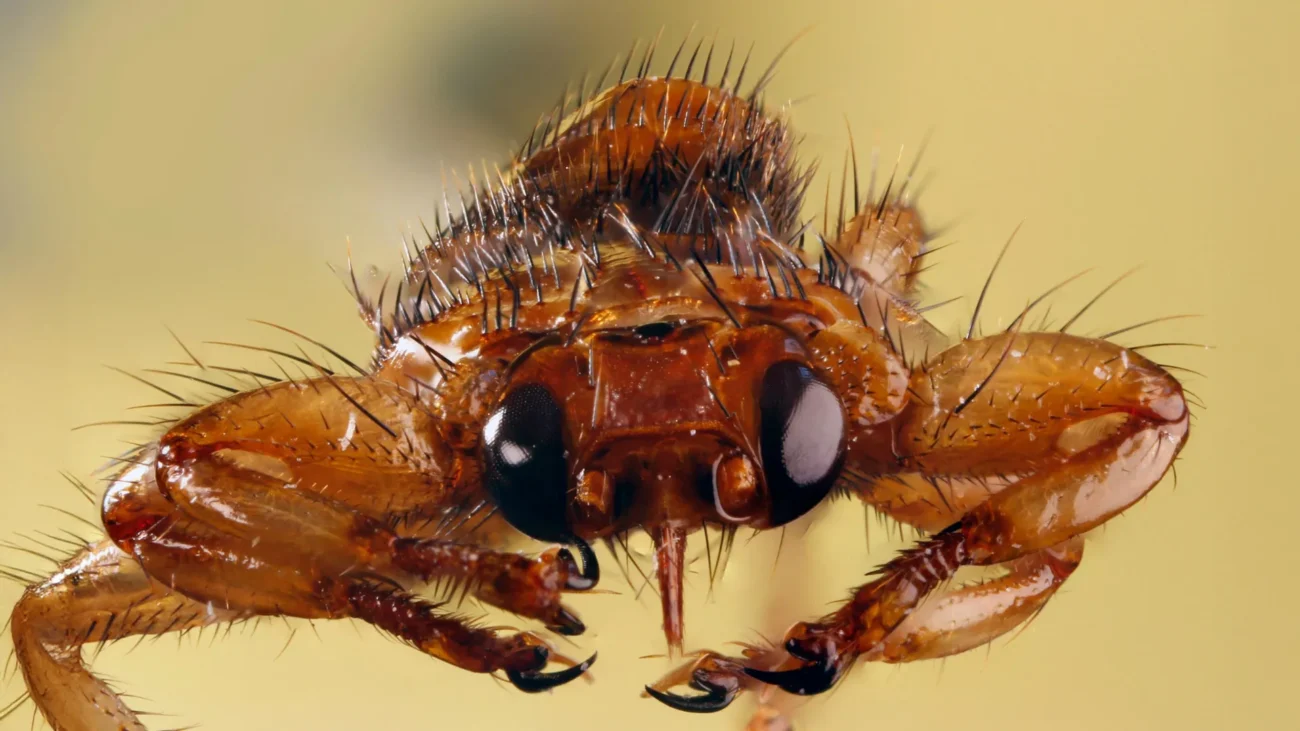
A groundbreaking study has unveiled a remarkable evolutionary adaptation in deer keds, a common biting fly, which appears to deliberately reduce its visual sensitivity after successfully locating a host and permanently abandoning flight. This fascinating shift from aerial hunter to sedentary parasite offers profound insights into the intricate ways organisms optimize their sensory systems to match their ecological niche and survival demands. The research, a collaborative effort between scientists at Aberystwyth University in the United Kingdom and the University of Florence in Italy, was recently published in the esteemed Journal of Experimental Biology, shedding new light on the complex life cycle and sensory strategies of ectoparasites.
From Airborne Predator to Fur-Dwelling Feeder: The Deer Ked’s Metamorphosis
Deer keds (family Hippoboscidae) are a ubiquitous group of wingless or short-winged flies that inhabit terrestrial vertebrates across vast geographical expanses, including Europe, Asia, Africa, and the Americas. As their common name suggests, their primary hosts are cervids, such as deer and elk, but they are not averse to feeding on other mammals, including livestock and, occasionally, humans. Their life cycle is characterized by a dramatic and irreversible transformation.
In their adult, winged stage, deer keds are adept at both flight and vision. These senses are crucial for their initial phase of existence, enabling them to actively search the environment for a suitable host. They employ a combination of visual cues and olfactory signals to navigate and locate their next blood meal. Once a deer ked successfully lands on a warm-blooded host, its lifestyle undergoes a radical and permanent metamorphosis. The insect, in a striking evolutionary decision, promptly sheds its wings. This act of wing autotomy is not a mere accident; it is a deliberate step that signals the commencement of its parasitic existence. From this point forward, the wingless ked will spend the remainder of its life embedded within the host’s fur or feathers, relying on its specialized mouthparts to continuously feed on blood. This transition marks a fundamental shift from an independent, mobile predator to a permanently attached, sedentary parasite.
Unraveling the Sensory Shift: A Genetic Investigation
The profound behavioral and ecological changes associated with this parasitic lifestyle are mirrored by significant alterations in the deer ked’s sensory apparatus. Scientists have long suspected that such dramatic lifestyle shifts would necessitate corresponding adaptations in how organisms perceive their environment. The Aberystwyth and Florence University research team set out to investigate precisely how the deer ked’s sensory system, particularly its vision, adapts to this profound transition from an active, flying forager to a static, blood-feeding parasite.
Dr. Roger Santer, a leading researcher in the Department of Life Sciences at Aberystwyth University and the principal investigator of the study, explained the rationale behind their inquiry. "Vision plays a vital role in animal behavior, but it is also energetically expensive," Dr. Santer stated. "Evolution favors sensory systems that are efficiently matched to an animal’s way of life. Some blood-feeding flies rely heavily on vision, while others live permanently on hosts and have little need for it. Deer keds are especially interesting because they switch between these two lifestyles." This unique position of the deer ked, bridging two distinct modes of existence, made it an ideal model organism for studying the adaptive plasticity of sensory systems.
To meticulously document these changes, the researchers collected and analyzed deer keds at distinct stages of their life cycle. Their sample pool comprised two key groups: winged adult keds that were actively engaged in host-seeking behavior, and wingless adults that had been collected from deer, indicating they had already established themselves as permanent parasites. This comparative approach allowed the scientists to directly assess the sensory adaptations that occur after the flies have successfully settled on a host and begun their parasitic life.
The Opsin Gene Story: Evidence of Reduced Visual Sensitivity
The core of the investigation focused on the genetic underpinnings of visual sensitivity. Specifically, the researchers examined the activity of genes known as opsins. Opsin proteins are fundamental components of photoreceptor cells in the eyes of most animals, and their expression levels are directly correlated with an organism’s visual acuity and sensitivity to light. By comparing the expression patterns of these opsin genes in winged versus wingless deer keds, the team aimed to quantify the extent to which the flies’ visual systems adapt to their altered lifestyle.
The findings were striking and provided compelling evidence for a deliberate reduction in visual processing. "We found that a flying deer ked’s visual system is much like that of a tsetse fly, which famously hunt out mammal hosts in Africa," Dr. Santer elaborated. Tsetse flies are known for their keen eyesight, which they utilize to locate their prey from a distance. This comparison highlights the initial reliance on robust vision in the deer ked’s host-seeking phase.
However, the study revealed a dramatic alteration once the keds became ectoparasites. "After a deer ked loses its wings and becomes an ectoparasite, activity of its opsin genes reduces to around half the previous level," Dr. Santer reported. This significant downregulation of opsin gene expression strongly suggests that the flies do not simply cease to rely on vision, but rather actively reduce their visual sensitivity. The implications are clear: the flies are likely sacrificing some degree of visual acuity to conserve precious metabolic energy. This conserved energy can then be reallocated to other vital functions essential for survival and reproduction in a parasitic environment, such as digestion of blood, immune system maintenance, and reproductive processes.
The research firmly indicates that deer keds do not become blind after finding a host. Instead, they appear to engage in a strategic recalibration of their visual capabilities. Once the need to scan the environment from the air for hosts is eliminated, the energetic cost of maintaining a highly sensitive visual system becomes unnecessary and even detrimental. This evolutionary trade-off prioritizes immediate survival and reproductive success over maintaining a sensory faculty that has become redundant.
Broader Implications: Understanding Parasite Adaptation and Control Strategies
The study’s publication in the Journal of Experimental Biology marks a significant contribution to the field of parasitology and evolutionary biology. It provides novel and concrete evidence of how parasites dynamically adjust their sensory systems in response to dramatic shifts in their ecological roles. This research offers a valuable lens through which to understand the broader principles of adaptation in parasitic organisms, many of which exhibit remarkable specializations to exploit their hosts.
The implications of this research extend beyond academic curiosity. A deeper comprehension of how deer keds and other biting flies, such as mosquitoes and ticks, utilize and adapt their sensory systems could have practical applications in developing more effective strategies for monitoring and controlling these disease vectors. Understanding the specific sensory cues that attract these flies, and conversely, the sensory modalities they downregulate when established on a host, could inform the design of novel traps, repellents, or even methods for disrupting their host-finding behaviors. For instance, if a fly reduces its reliance on vision, other attractants or deterrents might become more potent.
Furthermore, this research adds to the growing body of evidence demonstrating the remarkable plasticity of biological systems. The ability of an organism to undergo such a profound physiological and behavioral transformation, driven by the fundamental need to survive and reproduce, underscores the power of natural selection. The deer ked’s journey from a free-flying explorer to a sedentary parasite, complete with a deliberately dimmed visual system, serves as a compelling testament to the intricate and often surprising ways life adapts to its environment. The study highlights that evolution is not merely about acquiring new traits, but also about strategically discarding or downregulating those that are no longer advantageous, a principle elegantly illustrated by the deer ked’s reduced visual sensitivity. This adaptive strategy ensures that energy resources are precisely channeled to support the functions most critical for survival in its permanently parasitic existence.

