


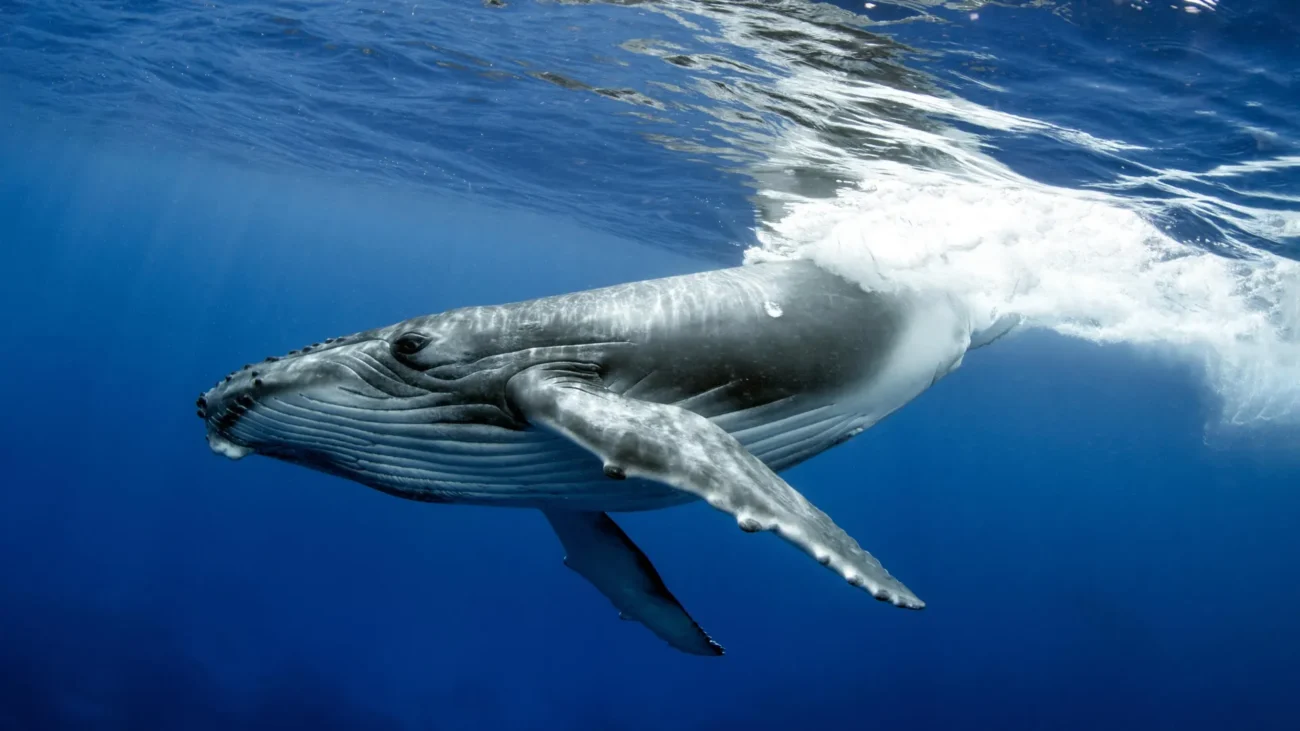
Scientists have documented an extraordinary feat of whale migration for the first time, confirming that humpback whales traveled between breeding grounds in eastern Australia and Brazil across more than 14,000 kilometers of open ocean. This groundbreaking discovery marks the greatest confirmed distance ever recorded between sightings of individual humpback whales anywhere in the world, fundamentally expanding our understanding of these magnificent marine mammals’ migratory capabilities and their interconnectedness across vast oceanic expanses.
The remarkable journey, unveiled through meticulous analysis of whale tail photographs, reveals two individual humpback whales undertaking journeys that defy previous assumptions about the scale and scope of their migrations. The research, published in the prestigious journal Royal Society Open Science, utilized decades of photographic data collected by both professional researchers and a global network of citizen scientists. This collaborative effort underscores the power of long-term ecological monitoring and the invaluable contributions of public engagement in scientific discovery.
A Tale of Two Whales: Documenting the Record-Breaking Journeys
The core of this revelation lies in the unique patterns adorning the flukes, or tails, of humpback whales. Much like human fingerprints, these markings are distinct for each individual, allowing researchers to identify and track specific whales over extended periods and across vast geographical distances.
The first documented extraordinary voyage involved a whale first photographed in Hervey Bay, Queensland, Australia, a well-known humpback whale breeding ground, in 2007. This same individual was observed in the same vicinity in 2013, before an astonishing reappearance in 2019 near São Paulo, Brazil, another significant humpback whale breeding area. The minimum straight-line distance between these two locations is approximately 14,200 kilometers, a distance comparable to traveling from Sydney to London. Scientists emphasize that this is a minimum estimate, as the whale likely traveled even further, given that only the initial and final points of its extensive journey were recorded. The precise migratory route remains a mystery, hinting at even more complex behaviors than currently understood.
An even more astonishing case emerged from the data involving a second whale. This individual was initially photographed in 2003 at Brazil’s Abrolhos Bank, a primary nursery for humpback whales off the coast of Bahia. At the time of its first sighting, it was observed in a lively group of nine adult whales. Twenty-two years later, in September 2025, this same whale was sighted alone in Hervey Bay, Australia. The documented distance between these two sightings was an astounding 15,100 kilometers, establishing a new world record for the longest known movement of an individual humpback whale.
The Power of Persistence: Decades of Research and Citizen Science
The scientific breakthrough was made possible by the diligent collection of 19,283 high-quality fluke photographs. These images, spanning from 1984 to 2025, were amassed from both eastern Australia and Latin America, representing a treasure trove of data on humpback whale movements. The global whale tracking platform Happywhale played a pivotal role in aggregating these images, facilitating a collaborative effort that transcended geographical boundaries.
Researchers employed sophisticated automated image recognition software to sift through the vast database, identifying potential matches between fluke photographs. Each potential match was then meticulously verified by human experts to ensure the accuracy of the findings.
Dr. Cristina Castro, lead researcher from the Pacific Whale Foundation, highlighted the critical role of public participation: "This kind of research highlights the value of citizen science. Every photo contributes to our understanding of whale biology and, in this case, helped uncover one of the most extreme movements ever recorded." This sentiment was echoed by Griffith University PhD Candidate and co-author Stephanie Stack, who stated, "Discoveries like this are only possible because of investment into long-term multi-decadal research programs and international collaboration. These whales were photographed decades apart, by different people, in opposite parts of the world, separated by two different oceans, and yet we can connect their journey."
Rare Exchanges, Profound Implications
Despite the spectacular distances covered by these two individuals, researchers stress that such extensive transoceanic migrations are exceptionally rare. Across more than four decades of data encompassing nearly 20,000 identified humpback whales, only these two individuals were found to have traveled between the Australian and Brazilian breeding regions. This constitutes a mere 0.01 percent of the whales cataloged in the records, underscoring the exceptional nature of these journeys.
The scientific community views these infrequent movements as vital for the long-term health and resilience of whale populations. Ms. Stack elaborated on their significance: "Despite their rarity, these exchanges matter for the long-term health of whale populations. Occasional individuals moving between distant breeding grounds can help maintain genetic diversity across populations and may even carry new song styles from one region to another – humpback whale songs are known to spread culturally across ocean basins, much like music trends in human populations." This cultural transmission of songs is a fascinating aspect of humpback whale behavior, demonstrating a complex social dynamic that can be influenced by these rare migratory exchanges.
Furthermore, these findings lend substantial support to the "Southern Ocean Exchange" hypothesis. This theory posits that humpback whales from different breeding populations may converge in shared feeding grounds within the Antarctic. Subsequently, some of these whales might opt for different migration routes on their return journey, leading them to establish themselves in entirely new breeding regions. This could explain how populations, geographically separated for much of the year, remain connected and maintain a degree of genetic interchange.
The Shadow of Climate Change on Migration Patterns
Looking ahead, researchers suggest that climate change could potentially increase the frequency of these rare intercontinental crossings. Alterations in Antarctic sea ice extent and shifts in the distribution of Antarctic krill, the primary food source for humpback whales, may be contributing to evolving migratory patterns. As environmental conditions change, whales might be compelled to explore new feeding grounds or alter their traditional migration routes in search of sustenance and suitable breeding territories. This dynamic environmental influence on animal behavior highlights the interconnectedness of ecosystems and the far-reaching impacts of global climate shifts.
The study, titled "First evidence of bidirectional exchange between distant humpback whale breeding populations in eastern Australia and Brazil," represents a significant advancement in our understanding of whale ecology and migratory behavior. It not only highlights the extraordinary capabilities of these marine giants but also underscores the critical importance of continued scientific research, international collaboration, and the invaluable contributions of citizen scientists in unraveling the mysteries of our planet’s oceans. The implications of these findings extend beyond mere geographical distances, offering insights into genetic diversity, cultural transmission, and the adaptive strategies of whale populations in a changing world. This research serves as a powerful reminder of the vast, unexplored frontiers that still exist within our oceans and the compelling need to protect these vital marine ecosystems.

