


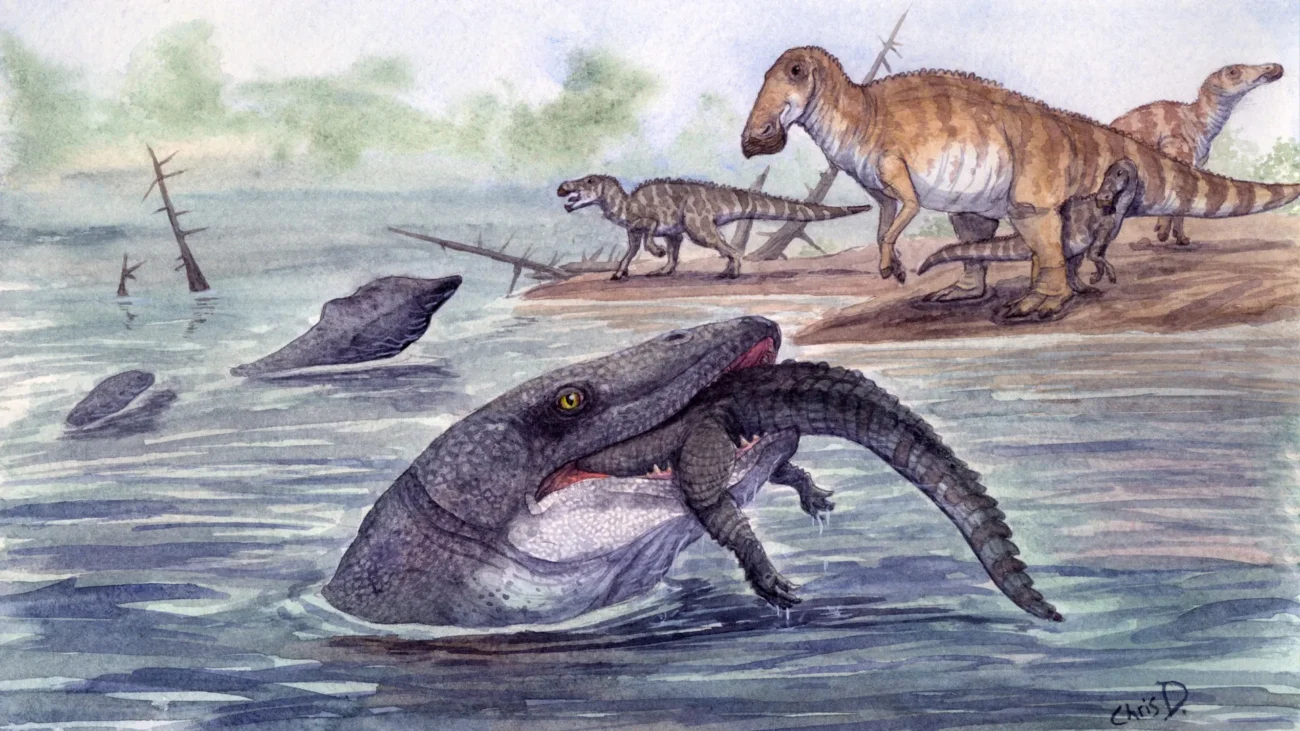
New evidence unearthed in North Dakota is rewriting our understanding of mosasaurs, the colossal marine reptiles that dominated Earth’s oceans for millions of years. Contrary to the long-held belief that these apex predators were exclusively saltwater dwellers, a remarkable mosasaur tooth, discovered in riverine deposits, has provided compelling indications that some species adapted to life in freshwater river systems during the twilight of the Cretaceous period, just before their extinction 66 million years ago. This groundbreaking discovery, led by an international team of researchers from Uppsala University, suggests a significant behavioral and ecological shift in these formidable creatures in the final million years of their existence.
The fossilized tooth, found in 2022, was unearthed from a location rich in paleontological significance. It lay in proximity to a tooth from the fearsome Tyrannosaurus rex and the jawbone of a crocodylian, alongside fossils of the duck-billed dinosaur Edmontosaurus. This unusual assemblage of terrestrial, freshwater, and potentially marine fauna immediately piqued the curiosity of the scientific community. The presence of a mosasaur tooth in an environment typically associated with freshwater life presented a compelling puzzle: how could an animal predominantly believed to inhabit the vast oceans be found preserved alongside creatures of the river and land?
Unraveling the Mystery Through Isotopic Signatures
To decipher this enigma, a collaborative effort involving scientists from the United States, Sweden, and the Netherlands was initiated. The research team focused on the intricate chemical composition of the mosasaur tooth enamel, employing sophisticated isotope analysis techniques. This method allows scientists to reconstruct past environments and diets by examining the ratios of different isotopes—variants of the same element with varying numbers of neutrons—present in fossilized materials.
The fortunate circumstance of the mosasaur tooth, the T. rex tooth, and the crocodylian jawbone all dating to approximately the same period, around 66 million years ago, enabled a direct and comparative chemical analysis. This crucial work was conducted at the Vrije Universiteit (VU) in Amsterdam, a leading institution for geochemical research. The analysis centered on isotopes of oxygen, strontium, and carbon, each providing unique insights into the animal’s life history and habitat.
The mosasaur tooth exhibited unusually high concentrations of the lighter oxygen isotope, oxygen-16 (16O). This signature is a strong indicator of freshwater environments, starkly contrasting with the isotopic profiles typically found in marine settings. Similarly, the ratios of strontium isotopes within the tooth also pointed towards a freshwater origin, further solidifying the hypothesis that this particular mosasaur had spent a significant portion of its life in rivers.
Dietary Clues and Habitat Preferences
Beyond environmental indicators, carbon isotope analysis offered intriguing glimpses into the mosasaur’s diet and its depth-related foraging habits. Dr. Melanie During, one of the study’s corresponding authors and a doctoral candidate at Uppsala University, explained the significance of these findings. "Carbon isotopes in teeth generally reflect what the animal ate," Dr. During stated in an interview. "Many mosasaurs have low 13C values because they dive deep. The mosasaur tooth found with the T. rex tooth, on the other hand, has a higher 13C value than all known mosasaurs, dinosaurs and crocodiles, suggesting that it did not dive deep and may sometimes have fed on drowned dinosaurs."
This higher 13C value implies a feeding strategy closer to the surface, potentially preying on terrestrial animals that had fallen into the water or succumbed to floods. This contrasts sharply with the deep-diving behavior inferred from other mosasaur fossils, which often exhibit isotopic signatures indicative of oceanic foraging.
"The isotope signatures indicated that this mosasaur had inhabited this freshwater riverine environment," Dr. During elaborated. "When we looked at two additional mosasaur teeth found at nearby, slightly older, sites in North Dakota, we saw similar freshwater signatures. These analyses show that mosasaurs lived in riverine environments in the final million years before going extinct." This corroboration from multiple specimens across slightly different timeframes lends substantial weight to the conclusion that freshwater adaptation was not an isolated incident but a discernible trend among certain mosasaur populations in their final evolutionary chapter.
The Gradual Transformation of Ancient Seas
The research team also proposed a compelling explanation for how such a significant habitat shift became possible. Their findings suggest that the Western Interior Seaway, a vast inland sea that once bisected the North American continent from north to south, underwent a profound transformation in its final million years. This seaway, which was a dominant marine feature during the Cretaceous, gradually experienced increasing freshwater input from continental runoff and river systems.
Over time, this influx of freshwater would have progressively diluted the saltwater, changing the seaway’s salinity from fully marine to brackish and eventually to predominantly freshwater. This environmental metamorphosis, analogous to modern estuarine systems or the gradual freshening of the Gulf of Bothnia, likely created a stratified water column. Researchers theorize that a "halocline" would have developed, with a layer of lighter, less dense freshwater floating above the denser, more saline saltwater.
Supporting this environmental model, the isotope data from both the mosasaur teeth and other marine fossils revealed a distinct pattern. "For comparison with the mosasaur teeth, we also measured fossils from other marine animals and found a clear difference," explained Per Ahlberg, a co-author of the study and a senior figure in paleontology at Uppsala University. "All gill-breathing animals had isotope signatures linking them to brackish or salty water, while all lung-breathing animals lacked such signatures. This shows that mosasaurs, which needed to come to the surface to breathe, inhabited the upper freshwater layer and not the lower layer where the water was more saline."
This critical distinction highlights the respiratory needs of mosasaurs. As air-breathing reptiles, they had to surface periodically. The developing freshwater layer would have provided a more hospitable and accessible environment for them, allowing them to avoid the deeper, saltier waters where their marine prey might have been more abundant but their own physiological needs were less optimally met.
Adapting to a Dynamic World: Evolutionary Flexibility
The researchers posit that the mosasaurs whose teeth were analyzed had clearly adapted to these evolving environmental conditions. This adaptation demonstrates a remarkable degree of evolutionary flexibility within a group of animals primarily known for their marine dominance. The ability of large predators to shift between habitats is a recurring theme in evolutionary history, showcasing nature’s capacity for ingenious solutions to changing circumstances.
"Unlike the complex adaptation required to move from freshwater to marine habitats, the reverse adaptation is generally simpler," Dr. During noted, drawing a parallel to modern evolutionary pathways. This suggests that transitioning from a marine to a freshwater environment might have presented fewer physiological hurdles for these creatures than the initial colonization of the oceans by their ancestors.
Modern fauna offer compelling parallels to this observed flexibility. River dolphins, for instance, are entirely freshwater inhabitants today, despite their evolutionary lineage tracing back to marine ancestors. The estuarine crocodile, colloquially known as the saltwater crocodile in Australia, is another prime example, exhibiting an extraordinary capacity to traverse between freshwater rivers and the open ocean, hunting opportunistically in both environments. These modern analogues underscore that significant shifts in habitat and diet are not unprecedented phenomena in the animal kingdom.
A Bus-Sized Predator in Unexpected Territory
Mosasaur fossils are generally abundant in marine deposits spanning North America, Europe, and Africa, with a significant fossil record dating from 98 to 66 million years ago. However, their discovery in North Dakota’s riverine deposits is exceptionally rare, making this finding particularly striking. The sheer size of the mosasaur indicated by the tooth is astounding. Preliminary estimates suggest an animal up to 11 meters (approximately 36 feet) in length, comparable to the size of a modern-day bus. This size estimate is further bolstered by earlier discoveries of mosasaur bones at a nearby site, which also pointed to large individuals.
While the exact genus of the mosasaur cannot be definitively identified from a single tooth, researchers believe it likely belonged to a prognathodontine mosasaur. This subfamily is characterized by their massive heads, incredibly powerful jaws, and robust teeth, indicative of their role as formidable, opportunistic predators capable of tackling substantial prey. Close relatives within the genus Prognathodon are known for their crushing bite, suggesting they could have preyed on hard-shelled organisms as well as larger vertebrates.
"The size means that the animal would rival the largest killer whales, making it an extraordinary predator to encounter in riverine environments not previously associated with such giant marine reptiles," Professor Ahlberg remarked, emphasizing the awe-inspiring implications of this discovery. The presence of such a colossal predator in what were once considered relatively contained river systems challenges our preconceptions of their ecological niche and predatory capabilities. It suggests a dynamic and perhaps perilous environment where even the largest marine predators were adapting to exploit new resources.
The research, a testament to international scientific collaboration, involved institutions including Uppsala University, Eastern West Virginia Community and Technical College, Moorefield, West Virginia, Vrije Universiteit Amsterdam, and the North Dakota Geological Survey. The findings are also drawn from Dr. During’s doctoral thesis, which she successfully defended at Uppsala University in November 2024, marking a significant contribution to the field of paleontology and our understanding of prehistoric life. This ongoing research promises to further illuminate the complex lives of these magnificent extinct reptiles and the dynamic Earth systems they inhabited.

