


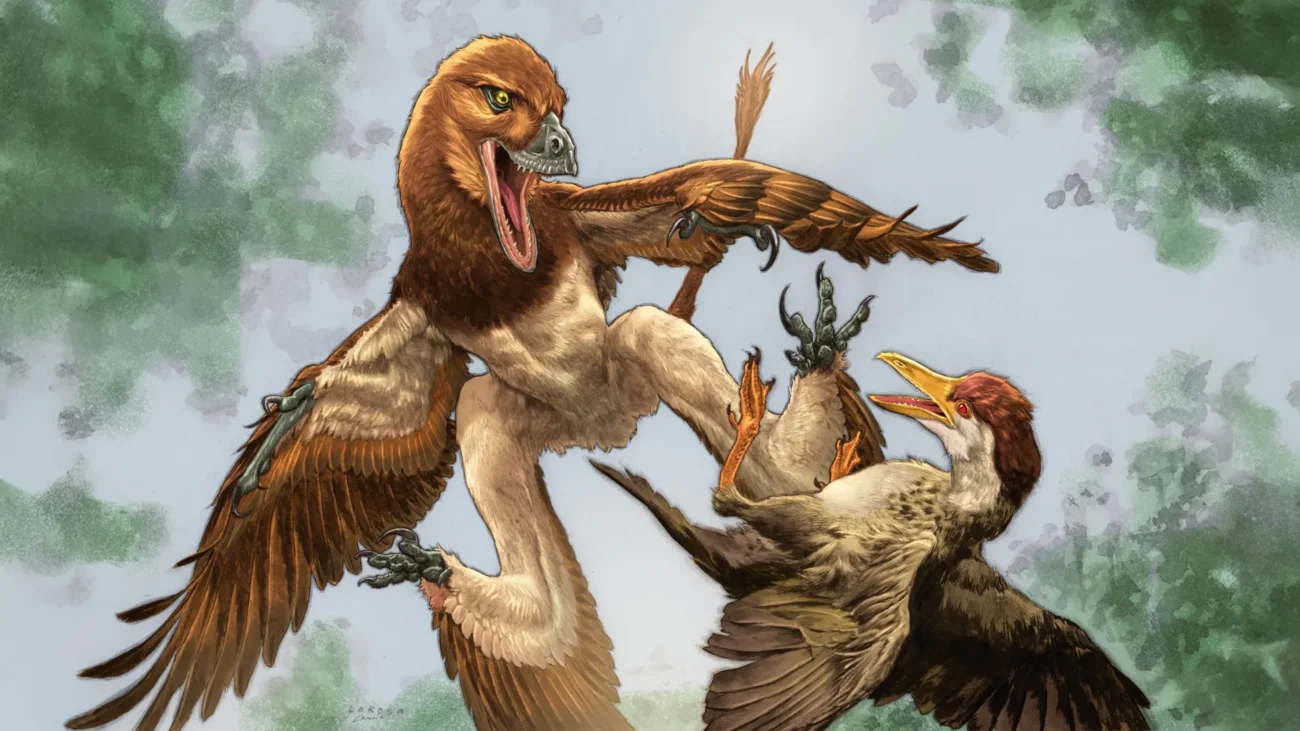
A remarkable fossil site in northwestern China, renowned for its exceptional preservation of prehistoric avian life, has long presented paleontologists with an intriguing enigma: hundreds of bird remains, often found in dense clusters of shattered bones. These peculiar accumulations bear a striking resemblance to the pellet-like regurgitations of modern owls, prompting speculation for years about a larger, non-avian predator that systematically hunted these ancient birds. Until now, however, definitive evidence identifying this elusive predator remained elusive, leaving a significant gap in our understanding of the ancient ecosystems in the region.
This enduring mystery appears to be on the cusp of resolution with the discovery and description of a previously unknown dinosaur species. Unearthed from the very same fossiliferous strata that have yielded the perplexing bird bone aggregations, this newly identified dinosaur offers a compelling candidate for the perpetrator of these avian massacres. The research, published in the prestigious Annals of Carnegie Museum, details an animal that was a feathered relative of the iconic Velociraptor, distinguished by its striking long feathers adorning both its forelimbs and hind limbs. Crucially, distinctive anatomical features within its arm and shoulder bones have led scientists to hypothesize that this dinosaur may very well be the predator responsible for the mysterious bird bone accumulations.
"Scientists have found these weird, broken-up clusters of bird bones at this site, and we didn’t know what made them," stated Dr. Jingmai O’Connor, the associate curator of fossil reptiles at the Field Museum in Chicago and senior author of the paper announcing the new species. "This new microraptor dinosaur, Jianchangmaensis, is our best guess. It’s the only dinosaur found at this site that wasn’t a bird, it was a carnivore, and it was much bigger than everything else that we’ve found there."
A Feathered Enigma Emerges: The Dawn of Jianchangmaensis
The evolutionary lineage of modern birds is deeply intertwined with that of dinosaurs. Today’s avian species are the sole surviving direct descendants of the theropod dinosaurs, having navigated the cataclysmic asteroid impact that reshaped Earth’s biosphere approximately 66 million years ago. However, long before this pivotal event, birds coexisted with a diverse array of other dinosaur groups throughout the Jurassic and Cretaceous periods. Among their closest evolutionary cousins were the dromaeosaurs, a family of feathered dinosaurs celebrated for their agility and predatory prowess. While Velociraptor, immortalized in popular culture by the Jurassic Park franchise, is perhaps the most famous member of this group, it’s important to note that these creatures were likely smaller and significantly more feathered than their cinematic portrayals.
The newly identified species, christened Jianchangmaensis, belongs to a specific subgroup within the dromaeosaurs known as microraptors. Generally, microraptors were diminutive dinosaurs, with some species comparable in size to a crow. However, Jianchangmaensis stands out as an exceptional specimen. "Jian is one of the biggest microraptor specimens that has ever been found," Dr. O’Connor elaborated. "The piece of its upper arm bone that we have is about 4 inches long, so the entire dinosaur probably had something like a four-foot wingspan, around the size of a barn owl." This substantial size, relative to its microraptor kin, immediately positions it as a potentially significant predator within its ecosystem.
A Four-Winged Marvel: Gliding Through Prehistoric Skies
Although paleontologists have thus far recovered only a partial arm bone of Jianchangmaensis, the team has inferred a key characteristic shared with its microraptor relatives. It is strongly suspected that Jian possessed elongated feathers not only on its forelimbs but also on its hind limbs. This unique feather arrangement would have given the dinosaur the striking appearance of possessing four wings, a remarkable adaptation for locomotion in its ancient environment.
Unlike the powered flight of modern birds, scientists believe these four-winged dinosaurs were primarily adapted for gliding. "Jian and the other microraptors probably weren’t capable of true, powered flight, but they could probably glide like a flying squirrel," Dr. O’Connor explained. This gliding ability would have allowed them to efficiently traverse the forested landscapes of the Cretaceous period, likely enabling them to ambush prey from elevated positions or to escape terrestrial threats.
The nomenclature of this fascinating new species is deeply rooted in its characteristics and discovery locale. In ancient Chinese mythology, "Jian" refers to a winged creature, symbolizing its prominent feathering. The species epithet, changmaensis, pays homage to the Changma Basin in China’s Gansu province, the geological formation where the fossil was meticulously unearthed.
Unraveling Ancient Ecosystems: A Crucial Piece of the Puzzle
The discovery of Jianchangmaensis is more than just the identification of a new dinosaur; it is a pivotal development that fills a critical void in our understanding of the ancient ecosystem represented by the Changma fossil site. This region has become globally recognized for its exceptional preservation of fossil birds, offering a rich window into avian evolution.
"Jianchangmaensis reveals that non-avian dinosaurs lived in what is now the Changma Basin, an area famous for its fossil birds," commented Dr. Matt Lamanna, corresponding author of the study and the Mary R. Dawson Curator of Vertebrate Paleontology and senior dinosaur researcher at the Carnegie Museum of Natural History. "Our team has recovered more than a hundred bird fossils at Changma, but only this single non-avian dinosaur specimen. Jian provides critical new insight into the biological history of the Changma region and the ecological context of the ancestors of today’s birds."
The presence of a significant non-avian predator like Jianchangmaensis in a site dominated by bird fossils provides crucial context for the survival strategies and evolutionary pressures faced by early birds. It suggests a dynamic and complex predator-prey relationship, where some dinosaurs were actively hunting their avian relatives.
Implications for Avian Evolution and Paleontological Research
Beyond understanding the immediate predator-prey dynamics at the Changma site, this find has broader implications for how scientists interpret avian evolution. It helps to clarify the evolutionary divergence between birds and their non-avian dinosaur cousins, highlighting the unique adaptations that allowed the avian lineage to not only survive but thrive in the aftermath of mass extinction events.
"You cannot understand life on the planet today without looking at its origins," Dr. O’Connor emphasized. "Birds are arguably the most successful group of land-dwelling vertebrate animals on Earth today. Learning about early birds and their close non-bird dinosaur relatives gives us a better understanding of what made the group of birds that survived so special."
The study’s collaborative nature underscores the global effort in paleontological research. Contributions to this groundbreaking discovery were made by a team of esteemed scientists, including Ling-Qi Zhou from the Gansu Geological Museum, Matthew Lamanna from the Carnegie Museum of Natural History, Ashley Poust from the University of Nebraska State Museum and the University of California Museum of Paleontology, Da-Qing Li from Gansu Agricultural University, Hai-Lu You from the Institute of Vertebrate Paleontology and Paleoanthropology at the Chinese Academy of Sciences, and Jingmai O’Connor from the Field Museum.
The meticulous excavation and analysis of Jianchangmaensis not only solve a long-standing paleontological puzzle but also provide a vivid glimpse into a world where feathered dinosaurs, both predators and their avian prey, shared a dynamic and often perilous existence. This discovery reinforces the intricate tapestry of prehistoric life and underscores the continuous revelations emerging from the Earth’s fossil record, deepening our appreciation for the evolutionary journey that led to the diverse life forms we see today.
Chronological Context of the Discovery and Research
The fossiliferous strata of the Changma Basin have been a subject of paleontological interest for decades, yielding a significant number of exceptionally preserved bird fossils. This rich avian fossil record has consistently pointed towards a predatory element, but definitive proof remained elusive.
Early to Mid-20th Century: Initial explorations and discoveries in China begin to reveal the rich fossil potential of various Cretaceous and Jurassic sites, laying the groundwork for future, more detailed investigations.
Late 20th Century to Early 21st Century: Intensified research in the Changma Basin leads to the recovery of hundreds of bird fossils, with many exhibiting signs of being consumed by a larger predator, often found in concentrated, fragmented masses. Paleontologists hypothesize the existence of a significant non-avian predator based on these observations, but no direct fossil evidence is found.
Recent Years: Expeditions to the Changma Basin yield a crucial fossil specimen of a non-avian dinosaur. This specimen, initially distinct from the numerous bird fossils, becomes the focus of intensive study.
Current Research Publication: The findings are formally described and published in the Annals of Carnegie Museum, introducing Jianchangmaensis to the scientific community and presenting the compelling evidence linking it to the mysterious bird bone accumulations. This publication marks a significant turning point in understanding the paleoecology of the Changma Basin.
Supporting Data and Analysis
The identification of Jianchangmaensis as the likely predator is supported by several key pieces of evidence:
- Size and Diet: As a carnivore significantly larger than the birds found at the site, Jianchangmaensis possessed the physical capability to hunt and consume them. Its estimated four-foot wingspan suggests it was a substantial predator within its environment.
- Geographic Overlap: The discovery of Jianchangmaensis within the same fossil bed as the bird remains is critical. This direct stratigraphic association provides strong evidence of coexistence and interaction.
- Anatomical Features: Specific adaptations in the arm and shoulder bones of Jianchangmaensis are indicative of a predatory lifestyle that could involve manipulating prey. While not directly preserved, the inferred gliding ability would have facilitated ambush predation.
- Absence of Other Predators: The fact that Jianchangmaensis is the only non-avian dinosaur found at this specific site that fits the predator profile is a significant indicator. If other large non-avian predators were present and active, their fossils would likely have been found as well.
The resemblance of the bone clusters to owl pellets is not merely coincidental. Owls are highly efficient predators that consume prey whole and then regurgitate indigestible materials like bones and fur in the form of pellets. The presence of similar, albeit dinosaur-generated, accumulations suggests a comparable hunting strategy, where Jianchangmaensis may have swallowed smaller birds whole or in large pieces, later expelling the remaining bone fragments.
Broader Impact and Implications for Paleontology
The discovery of Jianchangmaensis and its inferred role as a predator of early birds has several far-reaching implications:
- Reconstruction of Paleoecosystems: This finding allows for a more accurate and dynamic reconstruction of the Changma Basin’s ancient ecosystem. It moves beyond a simple catalog of species to understanding the intricate web of life, including predator-prey relationships.
- Understanding Avian Survival: By understanding the pressures faced by early birds from their dinosaur relatives, scientists can better pinpoint the evolutionary traits and ecological niches that contributed to the survival of the avian lineage through major extinction events. This sheds light on what made birds so resilient.
- Dromaeosaur Diversity and Behavior: The discovery adds another layer to our understanding of dromaeosaur diversity, particularly the microraptor subgroup. It provides new insights into their behavior, ecological roles, and adaptations, such as their gliding capabilities.
- The Origin of Birds: The continued study of the relationship between non-avian dinosaurs and birds is fundamental to understanding the origin of birds. Each discovery like Jianchangmaensis provides crucial data points, helping to refine evolutionary trees and behavioral models.
The ongoing research at sites like the Changma Basin, coupled with the detailed analysis of newly discovered species such as Jianchangmaensis, continues to rewrite our understanding of prehistoric life. These discoveries are not just about finding ancient bones; they are about piecing together the grand narrative of evolution, revealing the complex interactions that shaped the planet’s biodiversity over millions of years.

