


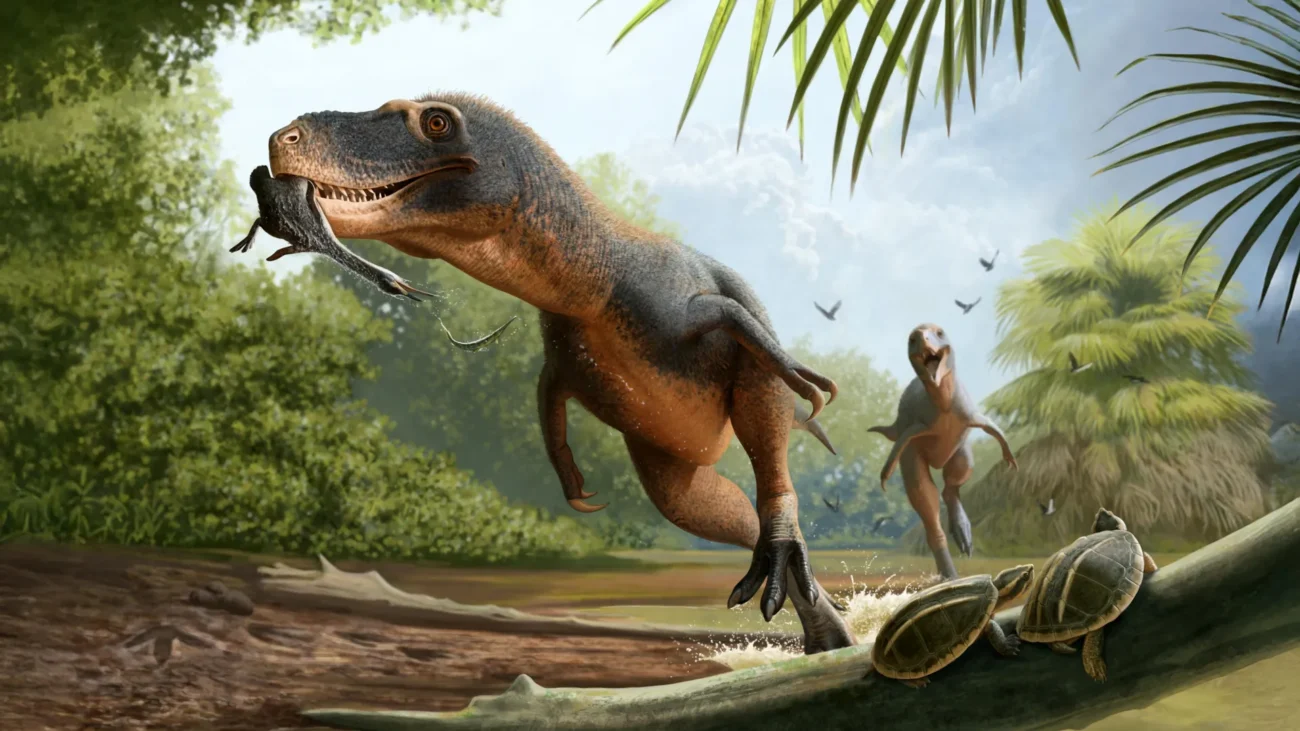
Scientists investigating the dietary habits of apex predators from the Late Cretaceous period have uncovered an extraordinary biological archive preserved within fossilized dinosaur feces. Approximately 66 million years ago, a massive predator—potentially a tyrannosaurid such as T. rex or its close relative Nanotyrannus—consumed an ancient aquatic bird, swallowing it whole or tearing it apart before digestion. The resulting coprolite, discovered in the badlands of northeastern Montana, successfully shielded delicate anatomical structures from the destructive forces of fossilization. Inside this unassuming reddish-brown nodule, researchers identified the finest, most meticulously preserved feather specimens ever recovered from the Mesozoic Era.
Published in the peer-reviewed scientific journal Current Biology, the findings not only illuminate the complex food webs of a doomed ecosystem on the brink of collapse, but they also provide a compelling new perspective on the catastrophic K-Pg extinction event. By evaluating the structural composition of the feathers embedded within the coprolite, a multidisciplinary research team believes they have isolated a critical missing link explaining why certain avian lineages vanished while others survived to populate the modern world.
The 66-Million-Year-Old Enigma of Avian Survival
To understand the magnitude of the Montana discovery, paleontologists must look back deep into the Mesozoic Era, a vast stretch of geological time spanning from roughly 252 million to 66 million years ago. Birds, scientifically classified as avian dinosaurs, represent a highly specialized branch of the dinosaurian family tree. The earliest recognized avian species, the iconic Archaeopteryx, took to the skies approximately 150 million years ago. For the next 100 million years, birds diversified and evolved in tandem with their non-avian counterparts, sharing ecosystems with towering sauropods, armored ankylosaurs, and dominant theropods.
This long-standing ecological balance shattered abruptly at the close of the Cretaceous Period. A colossal asteroid, measuring roughly 10 kilometers in diameter, struck the shallow waters of what is now the Yucatán Peninsula in Mexico. The cataclysmic impact unleashed energy equivalent to billions of atomic bombs, instantly vaporizing bedrock and launching an immense volume of sulfur, dust, and debris into the upper atmosphere.
The immediate aftermath initiated a global environmental catastrophe. Wildfires swept across continents, and a prolonged period of darkness and severe global cooling—commonly referred to as an "impact winter"—took hold. Photosynthesis ground to a halt, collapsing marine and terrestrial food chains. Nearly every dinosaur lineage vanished from the fossil record, alongside a significant majority of ancient bird groups.
Yet, a single, highly resilient branch of the avian family tree managed to endure: Neornithes. This exclusive lineage ultimately gave rise to every living bird species seen on Earth today, from hummingbirds to ostriches. For decades, evolutionary biologists and paleontologists have debated why Neornithes successfully navigated the extinction threshold while countless other avian groups—such as the dominant Cretaceous enantiornithines and specialized diving birds—perished completely.
A Chance Discovery in the Hell Creek Formation
The breakthrough that may finally help solve this paleontological mystery began in 2016 during routine fieldwork in the rugged terrain of the Hell Creek Formation in Montana. David DeMar, Jr., a research scientist and collections manager at the University of Washington Burke Museum, was actively prospecting for fossilized fish remains along a rocky outcrop.
Amidst the debris, an unusual geological specimen caught his attention. It was a dark, reddish-brown nodule, roughly half the size of a standard golf ball. Intrigued by its texture and appearance, DeMar picked up the object and examined its surface through a hand lens. To his profound astonishment, a microscopic fossil feather was exposed along the exterior.
Given that millions of years of geological activity typically obliterate delicate soft tissues, finding a fossilized feather is exceptionally rare. In the Hell Creek Formation specifically, despite more than 150 years of intensive scientific prospecting and excavation, feathers had never before been recovered. Cautiously optimistic, DeMar and his colleagues secured the specimen for rigorous laboratory analysis.
To peer inside the opaque nodule without damaging its fragile internal contents, the research team employed high-resolution micro-computed tomography (micro-CT) scanning. By compiling thousands of individual X-ray slices into a comprehensive three-dimensional digital model, scientists were able to visualize the interior architecture of the coprolite with unprecedented clarity.
Nate Carroll, a co-author of the study and a paleontologist at the Carter County Museum, noted the transformative nature of the imaging process. Having spent years relying on rare finds from Burmese amber deposits for three-dimensional feather data, Carroll was stunned by the fidelity of the Montana specimen. As the digital data processed hour by hour, the internal composition of the fossilized feces revealed an intricate matrix of perfectly preserved feathers, microscopic fish scales, and avian leg bones in vivid 3D relief.
Reconstructing the Diet of an Ancient Diving Bird
Detailed morphological analysis of the internal remains allowed scientists to piece together the final moments of the animal’s life. The bones and feathers recovered from the coprolite belonged to a hesperornithiform, an extinct group of specialized, flightless aquatic birds that ecologically mirrored modern-day loons or grebes.
"Hesperornithiforms were aquatic birds, ecologically similar to loons," explained Jingmai O’Connor, associate curator of fossil reptiles at the Field Museum in Chicago and lead author of the study. "Most couldn’t fly, and instead, they used their specialized feet to dive down into the water to hunt for things like fish. The feathers showed adaptations for being underwater that we see in living aquatic birds."
While hesperornithiforms shared a relatively close evolutionary relationship with the surviving Neornithes lineage, they belonged to a distinct evolutionary branch that ultimately succumbed to the end-Cretaceous extinction. The presence of gar fish scales within the same coprolite confirmed that the hesperornithiform was actively hunting in a freshwater or estuarine environment before falling prey to a large theropod dinosaur, such as T. rex or Nanotyrannus, which patrolled the ancient river valleys of Laramedia.
Rethinking the Aquatic Survival Hypothesis
For years, a prominent hypothesis among evolutionary biologists suggested that the survival of Neornithes was dictated primarily by geography and habitat. Because many early modern birds lived in or around aquatic environments, researchers theorized that freshwater and marine ecosystems offered a degree of buffering against the initial thermal shock and terrestrial devastation following the asteroid impact.
However, the discovery of the hesperornithiform remains complicates this neat geographical narrative. These specialized diving birds lived entirely within aquatic habitats, yet their lineage was completely eradicated during the mass extinction event. This stark contradiction demonstrates that habitat preference alone cannot account for the selective survival of Neornithes.
Instead, O’Connor and her colleagues propose that the fundamental physiological characteristics of the birds’ plumage—specifically the microscopic structure of their feathers and their molting strategies—served as the decisive evolutionary differentiator.
Primitive Plumage Versus Modern Insulation
The newly analyzed feathers represent the first confirmed fossil specimens ever recovered from a hesperornithiform. Upon close microscopic inspection, their structural organization revealed a transitional morphology, falling somewhere between the primitive plumage observed in enantiornithine dinosaurs and the highly evolved, streamlined feathers of modern birds.
While some feathers on the diving bird exhibited modern, waterproof characteristics suitable for aquatic locomotion, others retained smaller, fuzzy, primitive body feathers historically associated with non-avian dinosaurs and enantiornithines. In living birds, body contour and down feathers are vital for thermoregulation, trapping an insulating layer of air next to the skin to maintain metabolic body heat.
If hesperornithiforms and enantiornithines possessed plumage that trapped heat significantly less efficiently than the advanced feathers of Neornithes, this physiological limitation would have proved fatal during the onset of the impact winter. As atmospheric dust and aerosols choked out solar radiation, global temperatures plummeted drastically. Birds equipped with superior thermal insulation were uniquely positioned to endure the severe, prolonged cold, whereas species with primitive or compromised insulation succumbed to hypothermia and starvation.
Gregory Wilson Mantilla, a professor at the University of Washington, curator of vertebrate paleontology at the Burke Museum, and co-author of the research, emphasized the multifaceted value of the discovery. Beyond clarifying the evolutionary mechanics of avian thermoregulation, the specimen provides an unvarnished snapshot of an active Cretaceous food web mere moments before the asteroid impact terminated the age of dinosaurs.
A New Paradigm for Paleontological Research
The successful extraction of pristine biological data from a coprolite has fundamentally shifted methodological approaches within vertebrate paleontology. Traditionally, researchers have relied heavily on exceptionally rare skeletal beds, exceptional Lagerstätten deposits, or amber inclusions to study soft tissues like feathers. Coprolites have historically been overlooked as degraded waste, yet this discovery establishes fossilized feces as extraordinary preservation chambers capable of shielding delicate organic structures from microbial decay and mechanical weathering.
O’Connor noted that the project felt distinctively like a high-stakes detective investigation, requiring the research team to extrapolate complex ecological and evolutionary conclusions from fragmented remains contained within a single stone nodule. She expressed optimism that the scientific community will reevaluate existing museum collections containing unstudied fossilized droppings.
By applying non-destructive micro-CT scanning technologies to coprolites worldwide, paleontologists may unlock an entirely new class of biological archives. These hidden repositories hold the potential to reveal lost chapters of ancient predator-prey dynamics, dietary specializations, and micro-structural evolutionary traits that have remained obscured for tens of millions of years.
The collaborative research effort brought together specialists from prominent institutions, including the Field Museum, the University of Washington, the Burke Museum, the Carter County Museum, the University of Colorado Boulder, the Chinese Academy of Sciences, the University of Alabama, the Natural History Museum of Los Angeles County, and the University of Southern California. Supported by these diverse disciplines, the Montana coprolite stands as a testament to the unexpected pathways through which the deep past continues to inform modern scientific understanding.

