


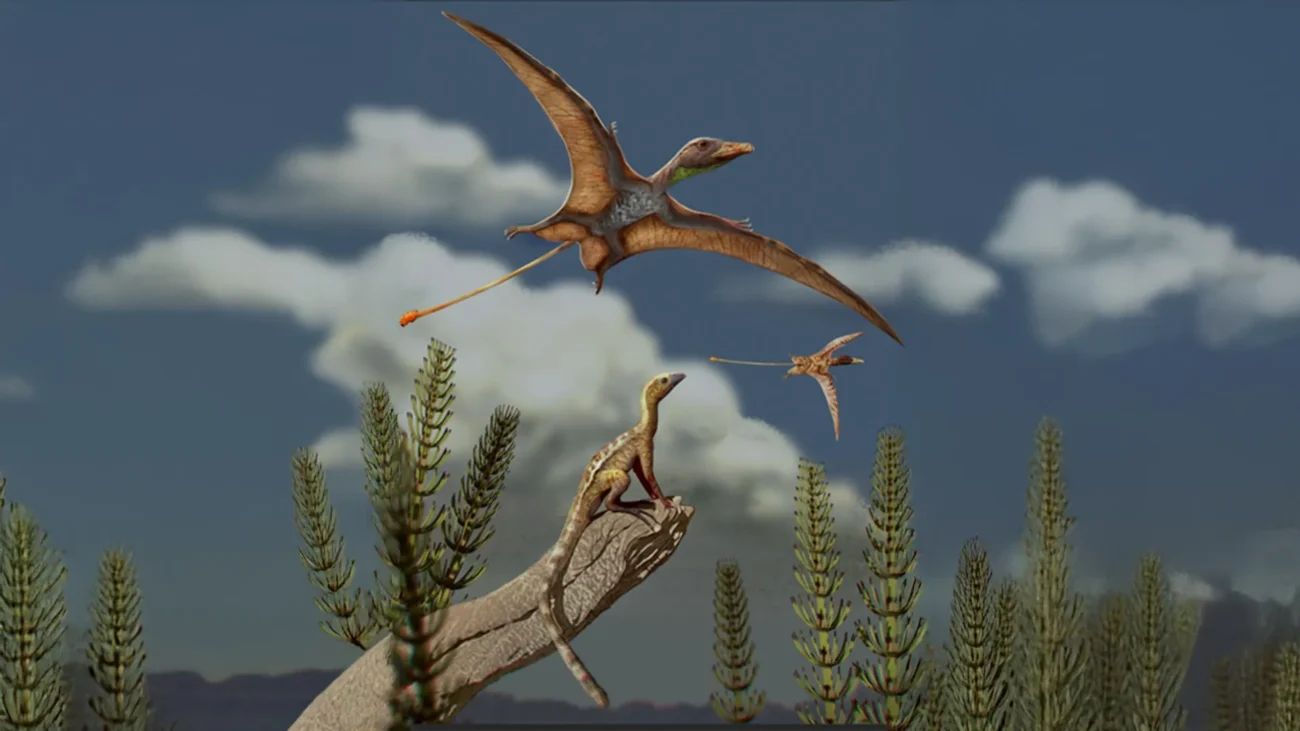
A groundbreaking study led by an evolutionary biologist at Johns Hopkins Medicine suggests that giant reptiles from as far back as 220 million years ago, known as pterosaurs, may have achieved powered flight at the very dawn of their evolutionary history. This stands in stark contrast to the lineage leading to modern birds, which researchers believe developed powered flight through a more gradual process, accompanied by larger and more complex brains. The findings, which utilized advanced imaging techniques to meticulously examine the internal brain cavities of fossilized pterosaurs, were partially supported by the National Science Foundation and published on November 26th in the esteemed journal Current Biology.
The Pterosaur Enigma: Early Flight, Unexpected Brains
The research team’s analysis, spearheaded by Matteo Fabbri, Ph.D., an assistant professor of functional anatomy and evolution at Johns Hopkins University School of Medicine, offers compelling evidence that the enlarged brains observed in birds and their presumed ancestors were not the sole or primary drivers of flight acquisition. Instead, the study points towards a distinct evolutionary trajectory for pterosaurs.
"Our study shows that pterosaurs evolved flight early on in their existence and that they did so with a smaller brain similar to true non-flying dinosaurs," Fabbri stated in a press release. This assertion challenges long-held assumptions about the prerequisites for flight and highlights the diverse evolutionary pathways that can lead to aerial locomotion.
Pterosaurs, often depicted as formidable airborne predators of the dinosaur era, were capable of reaching impressive sizes, with some species weighing up to 500 pounds and boasting wingspans of up to 30 feet. They represent the earliest of the three major vertebrate lineages to independently achieve powered flight, alongside birds and bats. This makes understanding their evolutionary journey crucial for a comprehensive picture of aerial locomotion’s development in the animal kingdom.
The investigation into how pterosaurs achieved this remarkable feat and whether their evolutionary path diverged significantly from that of birds and bats involved a detailed examination of their evolutionary history. The researchers paid close attention to shifts in the shape and size of the brain over time, with a particular focus on the optic lobe. This region of the brain is primarily responsible for processing visual information and has been strongly linked to the development and refinement of flight capabilities in many volant species.
Unlocking Ancient Secrets: CT Scans and Lagerpetid Insights
To delve into the early stages of pterosaur evolution, the team employed sophisticated CT imaging technology. This allowed them to create detailed digital models of the internal cranial cavities, which preserve the imprints of the brain. The focus of their detailed examination was on the lagerpetid, a group of small, bipedal reptiles identified as the closest known relatives of pterosaurs.
Lagerpetids, which were flightless and arboreal, lived during the Triassic period, roughly between 242 and 212 million years ago. Their existence predates the earliest definitive pterosaur fossils. The close evolutionary connection between lagerpetids and pterosaurs was further solidified by a 2020 study, underscoring the importance of lagerpetids in understanding the origins of pterosaur flight.
Mario Bronzati, a researcher at the University of Tübingen in Germany and the corresponding author of the Current Biology paper, highlighted the significance of these early relatives. "The lagerpetid’s brain already showed features linked to improved vision, including an enlarged optic lobe, an adaptation that may have later helped their pterosaur relatives take to the skies," Bronzati explained. This suggests that some of the foundational adaptations for enhanced vision, crucial for aerial navigation, were already present in the precursors to pterosaurs.
Fabbri further elaborated on these findings, noting that pterosaurs also exhibited enlarged optic lobes. However, beyond this shared trait, he pointed out significant differences in brain shape and size compared to their lagerpetid ancestors. "The few similarities suggest that flying pterosaurs, which appeared very soon after the lagerpetid, likely acquired flight in a burst at their origin," Fabbri posited. "Essentially, pterosaur brains quickly transformed, acquiring all they needed to take flight from the beginning." This "burst" model of evolution suggests a relatively rapid acquisition of flight capabilities, driven by a swift adaptation of existing neural structures rather than a slow, incremental development.
Contrasting Evolutionary Paths: Pterosaurs vs. Birds
The evolutionary trajectory of pterosaurs in acquiring flight appears to be markedly different from that of birds. Modern birds are generally understood to have evolved flight through a more protracted and gradual process. This involved the inheritance and subsequent adaptation of several key brain regions from their theropod dinosaur ancestors. These regions include the cerebrum, cerebellum, and optic lobes.
Support for this gradual model of bird flight evolution comes from recent research. A 2024 study from the laboratory of Amy Balanoff, Ph.D., an assistant professor of functional anatomy and evolution at Johns Hopkins Medicine, emphasized the critical role of cerebellum expansion in the origins of bird flight. The cerebellum, located at the posterior part of the brain, plays a vital role in motor control, coordination, and balance – all essential for agile aerial maneuvers.
"Any information that can fill in the gaps of what we don’t know about dinosaur and bird brains is important in understanding flight and neurosensory evolution within pterosaur and bird lineages," Balanoff commented, underscoring the interconnectedness of these research areas. The comparative study of brain evolution across these different volant lineages provides a richer understanding of the diverse biological strategies that have enabled animals to conquer the skies.
A Broader Comparative Analysis: Fossilized Brains Across Diverse Lineages
To further contextualize their findings on pterosaurs, the research team also examined brain cavities from ancient crocodilians and early, extinct birds. This comparative approach allowed them to place the pterosaur brain structure within a wider evolutionary landscape.
The analysis revealed that pterosaurs possessed moderately enlarged brain hemispheres, a feature comparable to those found in other dinosaur groups. This includes the troodontids, bipedal and bird-like dinosaurs that roamed the Earth from approximately 163 to 66 million years ago, as well as Archaeopteryx lithographica, the oldest-known bird, which lived between 150.8 and 125.45 million years ago. These ancient species, while showing some brain enlargement, differ significantly from modern birds, which exhibit markedly larger cranial capacities, reflecting their highly developed cognitive abilities and complex motor control required for sophisticated flight.
The comparison highlights that while pterosaurs achieved flight early with relatively smaller brains, birds underwent a more prolonged period of brain development and refinement of neural structures to support their advanced aerial capabilities. This suggests that different evolutionary pressures and developmental pathways can lead to the same ultimate outcome: powered flight.
Implications and Future Directions
The implications of this research are far-reaching, offering a new perspective on the evolution of flight and the role of brain evolution in this transformative process. The discovery that pterosaurs achieved flight so early in their evolutionary history with a brain structure similar to non-flying dinosaurs challenges the notion that complex brains are an absolute prerequisite for aerial locomotion.
"The few similarities suggest that flying pterosaurs, which appeared very soon after the lagerpetid, likely acquired flight in a burst at their origin," Fabbri reiterated. This suggests a scenario where a pre-existing set of adaptations, particularly enhanced vision, coupled with rapid skeletal and muscular changes, enabled the emergence of flight. The brain, while not as large or complex as in later avian lineages, was evidently sufficient for the demands of early pterosaur flight.
Looking ahead, Fabbri emphasized the need to move beyond simply analyzing the size and shape of fossilized brains. "Future progress will depend on understanding how the brain’s internal structure, not just its size and shape, enabled pterosaurs to achieve flight," he stated. This involves investigating the relative sizes and connectivity of different brain regions, which can offer deeper insights into the neural processing and cognitive abilities that underpinned pterosaur flight. Uncovering these finer details will be essential for establishing the broader biological principles that govern the evolution of flight across diverse animal lineages.
Funding and Collaboration: A Global Effort
This significant research endeavor was made possible through substantial international collaboration and funding from a variety of reputable institutions. Financial support was provided by the Alexander von Humboldt Foundation, the Brazilian Federal Government, The Paleontological Society, Agencia Nacional de Promoción Científica y Técnica, Conselho Nacional de Desenvolvimento Científico e Tecnológico, the European Union’s NextGenerationEU/PRTR initiative, and the National Science Foundation (NSF DEB 1754596, NSF IOB-0517257, IOS-1050154, IOS-1456503), as well as the Swedish Research Council.
The extensive list of contributing scientists underscores the multidisciplinary and global nature of paleontological research. In addition to Fabbri and Bronzati, the study benefited from the expertise of researchers from institutions including the New York Institute of Technology, the American Museum of Natural History, the Federal University of Santa Maria in Brazil, the University of Ohio, the Bernardino Rivadavia Museum of Natural Science, São Paulo State University, Yale University, Universidad Nacional de La Plata in Argentina, Museo Nacional de Ciencias Naturales in Spain, the University of São Paulo, the University of Birmingham, Virginia Tech, Stony Brook University, and Eberhard Karls University of Tübingen. This collaborative spirit is vital for tackling complex scientific questions that span vast geological timescales and require diverse analytical approaches. The findings of this study not only illuminate the evolutionary history of pterosaurs but also provide a crucial comparative baseline for understanding the evolution of flight in other lineages, ultimately enriching our understanding of life’s remarkable journey on Earth.

