


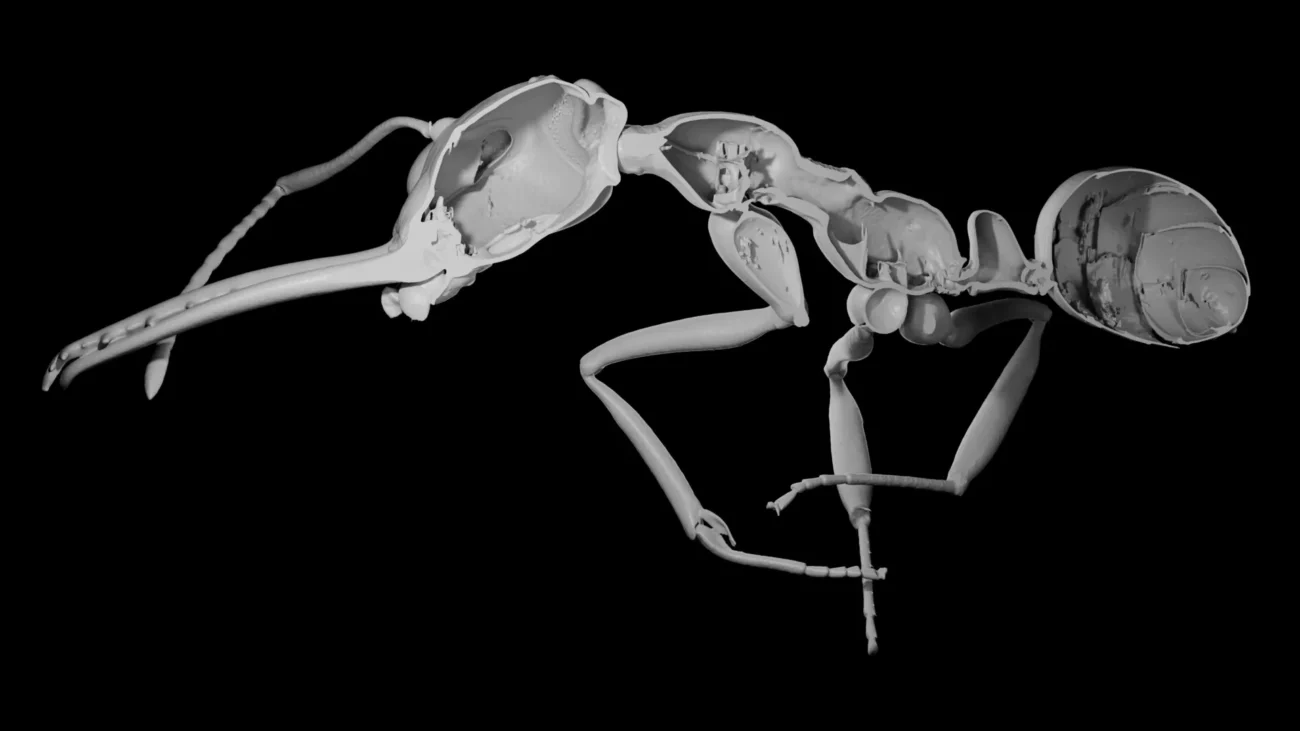
New research published in Science Advances on December 19, 2025, offers a compelling explanation for the remarkable success of ant societies, revealing a fundamental evolutionary tradeoff: quantity over individual quality. This extensive study, involving analyses of over 500 ant species, suggests that many ant colonies have prioritized producing a larger workforce of less physically robust individuals, rather than a smaller number of heavily defended ones. This strategy, the researchers propose, has been a key driver in the evolution of complex social structures and the extraordinary diversification of ants, offering insights that extend even to human societal development.
The Quantity-Quality Conundrum in Evolution
The central premise of the research, spearheaded by Dr. Evan Economo of the University of Maryland and Arthur Matte, a Ph.D. student at the University of Cambridge, addresses a long-standing biological question: how do individuals change and adapt as the societies they inhabit become more complex? The prevailing hypothesis has been that in highly social species, individual organisms might become "simpler" or "cheaper" in biological terms. This means they require fewer resources for their construction and maintenance, allowing for their production in greater numbers, even if each individual possesses fewer specialized or robust traits compared to solitary counterparts.
"There’s this question in biology of what happens to individuals as societies they are in get more complex," explained Dr. Economo, who also holds the James B. Gahan and Margaret H. Gahan Professorship at UMD. "For example, the individuals may themselves become simpler because tasks that a solitary organism would need to complete can be handled by a collective." This concept, while intuitive, had not been rigorously tested across a broad spectrum of social insects until this groundbreaking study.
Ants: A Model for Social Evolution
Ants, with their vast range in colony sizes—from a few dozen to millions of individuals—and their ubiquitous presence across virtually every terrestrial ecosystem, present an ideal model system for studying the evolution of complex societies. Their evolutionary success, marked by immense diversification and the formation of supercolonies, has long fascinated scientists, yet the precise biological mechanisms underpinning these achievements remained somewhat elusive.
"Ants are everywhere," commented lead author Arthur Matte. "Yet the fundamental biological strategies which enabled their massive colonies and extraordinary diversification remain unclear." The research team hypothesized that a significant factor influencing colony size might be the degree to which ants invest in their cuticle—the tough, protective outer layer of their exoskeleton.
The Biological Cost of Body Armor
The cuticle serves a multitude of vital functions for ants. It acts as a crucial barrier against predators, environmental desiccation, and pathogens. Furthermore, it provides the structural scaffolding necessary for muscle attachment and movement. However, the production of this protective layer is metabolically expensive, demanding significant amounts of limited nutrients such as nitrogen and various minerals. A thicker, more robust cuticle, while offering enhanced individual protection, necessitates a greater allocation of these precious resources. This, in turn, could impose a ceiling on the total number of individuals a colony can sustain.
The researchers proposed that by investing less in the individual robustness of each worker, particularly in the thickness of their cuticle, colonies could reallocate those saved nutrients and energy towards producing a larger volume of workers. This shift from investing heavily in a few, highly protected individuals to a strategy of mass production of less-protected ones could be the evolutionary lynchpin for the development of large, complex ant societies.
Unpacking the Data: A Global Ant Census
To test their hypothesis, the research team embarked on an ambitious data collection and analysis project. They compiled and meticulously analyzed a substantial dataset comprising over 500 ant species. This dataset was built upon high-resolution 3D X-ray scans, allowing for precise measurements of both total body volume and cuticle volume for each species.
The results, when fed into sophisticated evolutionary models, painted a clear and striking picture. The investment in cuticle thickness varied considerably across the surveyed species, ranging from a mere 6% of an ant’s total body mass dedicated to its exoskeleton to as much as 35%. The evolutionary models revealed a consistent pattern: species that allocated a smaller proportion of their body mass to cuticle development were significantly more likely to form larger colonies.
The Collective Advantage: Strength in Numbers
While individual ants with thinner cuticles may be more vulnerable to immediate threats, the study’s authors argue that this perceived weakness might actually foster the evolution of more complex and successful societies. Reduced reliance on individual armor may be intrinsically linked to the development of other advantageous social traits. These include enhanced cooperative foraging strategies, sophisticated shared nest defense mechanisms, and a pronounced division of labor, all of which tend to become more refined and efficient as colony size increases.
"Ants reduce per-worker investment in one of the most nutritionally expensive tissues for the good of the collective," Matte elaborated. "They’re shifting from self-investment toward a distributed workforce, resulting in more complex societies. It’s a pattern that echoes the evolution of multicellularity, where cooperative units can be individually simpler than a solitary cell, yet collectively capable of far greater complexity."
Beyond colony size, the research also uncovered a surprising correlation between lower cuticle investment and higher rates of diversification. Diversification, a key metric in evolutionary biology that reflects the rate at which new species emerge, is often used as a proxy for evolutionary success. Dr. Economo noted the significance of this finding, stating, "Very few traits have been connected to diversification in ants, making this result especially striking."
The Speciation Spark: Why Less Armor Might Mean More Species
The precise mechanisms by which reduced cuticle investment might promote speciation remain an area of active inquiry, but the researchers propose several compelling hypotheses. One leading theory suggests that ants with lower nutritional demands, a direct consequence of investing less in their exoskeleton, are better equipped to colonize and thrive in environments where resources are scarce.
"Requiring less nitrogen could make them more versatile and able to conquer new environments," said Matte, whose foundational work on this project began during his master’s program while interning in Dr. Economo’s lab at the Okinawa Institute of Science and Technology in Japan. This increased adaptability in resource-limited niches could lead to reproductive isolation and the subsequent formation of new species.
Furthermore, as ant societies evolved greater complexity, group-level defensive strategies, such as coordinated nest defense and communal disease control, may have diminished the selective pressure for heavily armored individuals. This could have initiated a reinforcing feedback loop: lower cuticle investment enabled larger colonies, and larger colonies, in turn, provided a collective shield that further reduced the evolutionary imperative for individual toughness.
Dr. Economo humorously characterized this evolutionary shift as "the evolution of squishability," wryly observing that not all insects are equally robust, a fact many children discover through direct interaction. This principle of prioritizing collective capabilities over individual resilience is not unique to ants. The researchers suggest that other social organisms, such as termites, may have undergone similar evolutionary trajectories, although further research is needed to confirm these parallels.
Echoes in Human History and Beyond
The implications of this research extend far beyond the realm of entomology, offering valuable perspectives on the broader principles of societal evolution, including those observed in human history. The researchers draw parallels to historical shifts in human warfare, where the era of heavily armored, individualistic knights eventually gave way to the dominance of specialized soldiers like archers and crossbowmen, whose strength lay in numbers and coordinated tactics.
Dr. Economo also referenced Lanchester’s Laws, a set of mathematical equations developed during World War I to model the outcome of battles. These laws explore the conditions under which a larger force of weaker combatants can overcome a smaller force of stronger ones, illustrating the enduring principle of quantity prevailing over quality in certain strategic contexts.
"The tradeoff between quantity and quality is all around. It’s in the food you eat, the books you read, the offspring you want to raise," Matte reflected. "It was fascinating to retrace how ants handled it through their long evolution. We could see lineages taking different directions, being shaped by different constraints and environments, and ultimately giving rise to the extraordinary diversity we observe today."
This comprehensive study, "The evolution of cheaper workers facilitated larger societies and accelerated diversification in ants," published in Science Advances, not only illuminates the intricate evolutionary pathways of ants but also provides a profound framework for understanding the dynamics of social organization and adaptation across the biological spectrum. The research was supported by grants from the Okinawa Institute of Science and Technology, the Japan Society for the Promotion of Science KAKENHI, the University of Cambridge, and the Research Grant Council of Hong Kong.

