


The avian kingdom is a testament to the boundless creativity of evolution, and few features capture this artistry more dramatically than a bird’s tail. Far from being mere decoration, a long tail serves a multitude of critical functions, from intricate steering mechanisms and effective braking systems to vibrant signal flags and elaborate displays designed to impress. These trailing plumes are not just aesthetically striking; they are living narratives of a species’ survival strategies, its unique habitat, and the relentless forces of evolutionary selection. Across the globe, numerous bird species have developed tail feathers that extend far beyond what might seem practical for everyday existence, showcasing an evolutionary arms race where extravagance often translates to reproductive success.
This article delves into some of the most spectacular examples of avian tail artistry, exploring the evolutionary pressures that have shaped these remarkable appendages and the diverse roles they play in the lives of these magnificent creatures.
The Long-tailed Widowbird: A Masterclass in Sexual Selection
In the vast savannas and grasslands of Africa, the Long-tailed Widowbird (Euplectes progne) stands out as a prime example of evolutionary extravagance driven by sexual selection. During the breeding season, the males of this species undergo a breathtaking transformation, growing tail feathers that can reach an astonishing length of up to 20 inches (approximately 50 cm). In flight, these elongated feathers trail behind them like glossy black streamers, creating a silhouette that is both dramatic and highly conspicuous.
The evolutionary advantage of such seemingly cumbersome appendages is rooted in the preferences of the females. Scientific studies and field observations have consistently shown that female Long-tailed Widowbirds exhibit a clear preference for males with longer tails. This preference acts as a powerful selective pressure, favoring males who can produce and sustain these impressive displays. Generation after generation, this trait has become more pronounced, making the Long-tailed Widowbird one of the clearest and most compelling examples of sexual selection in action. The length of a male’s tail is often interpreted by females as an indicator of his genetic quality, health, and overall fitness, making it a crucial factor in his reproductive success.
Conversely, the females of the species maintain a more modest appearance. They are typically smaller and possess shorter, more practical tails, allowing them to blend seamlessly into their grassy habitat. This difference in appearance between the sexes, known as sexual dimorphism, is a common strategy in the animal kingdom, where one sex (often the male) evolves elaborate traits to attract mates, while the other (often the female) prioritizes camouflage and practicality for survival and nesting. The understated plumage of the female also aids in protecting her and her offspring from predators while she incubates eggs or forages for food.
The Resplendent Quetzal: An Emerald Jewel of the Cloud Forest
Deep within the misty cloud forests of Central America, the Resplendent Quetzal (Pharomachrus mocinno) appears almost ethereal, a creature of myth and legend brought to life. This iconic bird is renowned for its extraordinarily long upper tail coverts, which can extend over two feet (approximately 60 cm) behind the male’s body. These shimmering green plumes, when caught in the dappled sunlight filtering through the dense canopy, create a spectacle of unparalleled beauty.
Unlike the widowbirds, which inhabit open grasslands where long tails might present a significant liability, the Resplendent Quetzal’s habitat is characterized by dense arboreal environments. This necessitates a delicate balance between aesthetic splendor and functional agility. The quetzal’s long tail feathers, while breathtakingly beautiful, must still allow for precise maneuvering through the intricate network of branches and foliage. This evolutionary compromise highlights how tail length and form are intricately linked to the specific ecological niche a species occupies. The ability to navigate its environment effectively while simultaneously displaying its magnificent tail is a testament to the quetzal’s remarkable evolutionary adaptations.

Historically, the Resplendent Quetzal has held profound cultural significance for ancient Mesoamerican civilizations. For the Maya and Aztec peoples, the quetzal’s vibrant plumage, particularly its long tail feathers, symbolized freedom, divinity, and immense wealth. These sacred birds were often revered, and their feathers were highly prized, used in ceremonial headdresses and regalia for royalty and priests. Even today, the quetzal remains an enduring icon of the rainforest, a living symbol of the region’s rich biodiversity and its deep cultural heritage. The bird’s scientific name, Pharomachrus mocinno, honors the Spanish naturalist José Mariano Mociño, who first described the species.
The Ribbon-tailed Astrapia: Defying Gravity in New Guinea’s Highlands
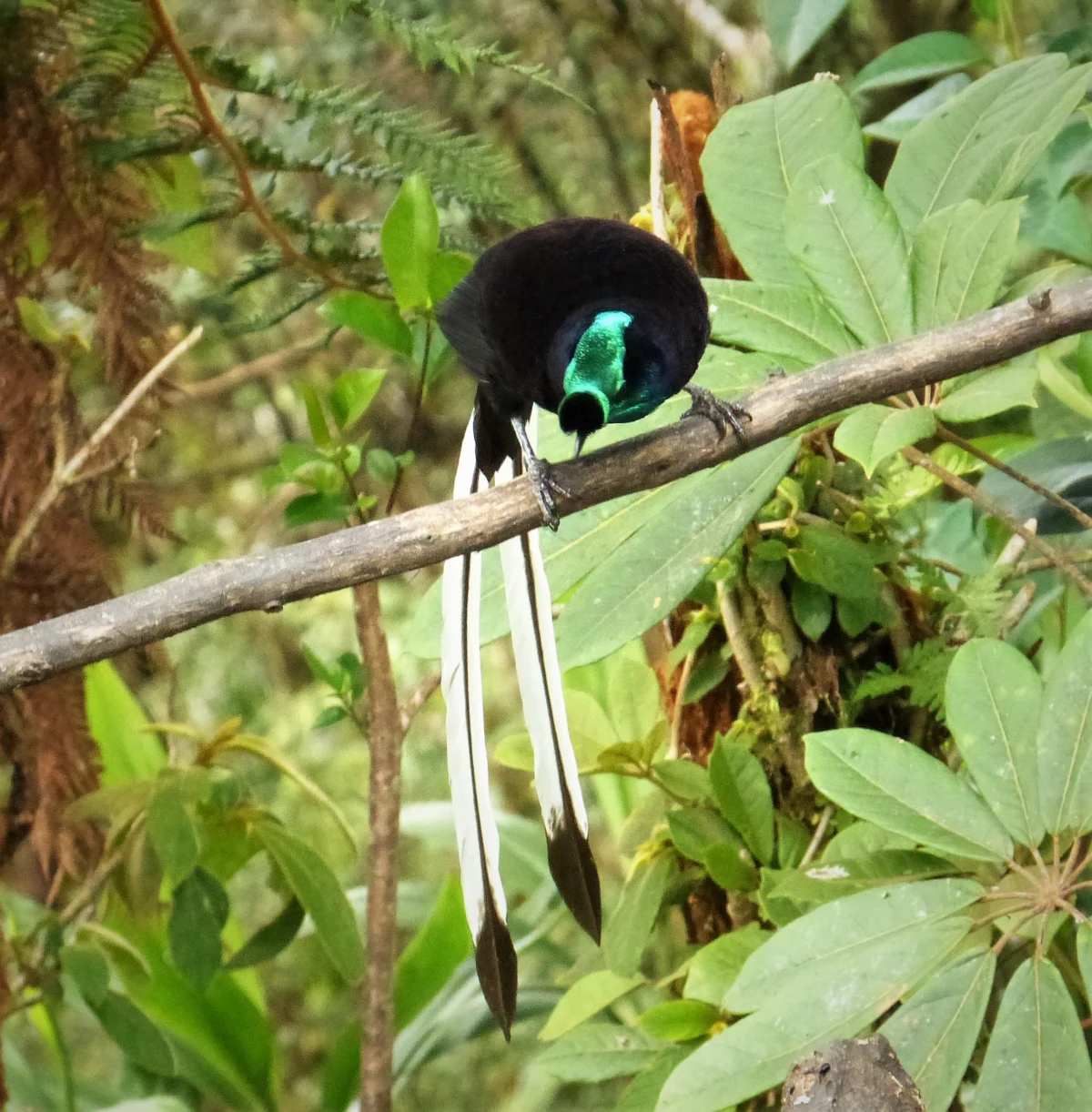
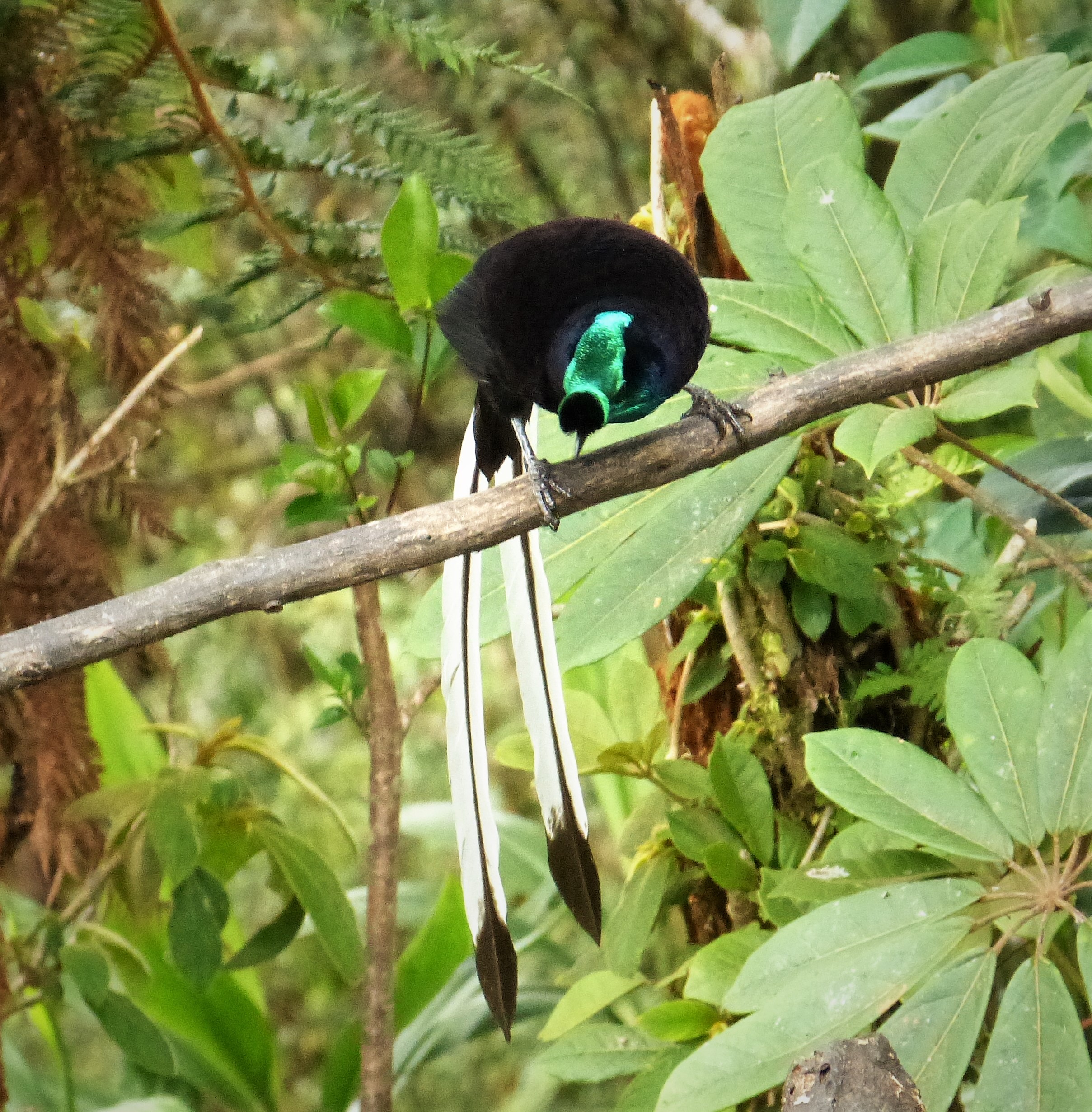
High in the rugged, moss-draped mountains of New Guinea, a bird of paradise known as the Ribbon-tailed Astrapia (Astrapia mayeri) showcases a tail that seems to challenge the very principles of physics. This remarkable species boasts two astonishing white tail feathers that can exceed a staggering length of one meter (over three feet). When the male moves through the dense, humid undergrowth, these extraordinary ribbons float and undulate behind him, catching the available light and drawing immediate attention.
The courtship displays of the male Ribbon-tailed Astrapia are a masterful fusion of posture, intricate movements, and the mesmerizing sway of these incredible plumes. This elaborate performance is designed to captivate the female, demonstrating his fitness and desirability. The sheer risk involved in carrying such prominent and lengthy ornaments is considerable. In a predator-rich environment, long, trailing feathers can easily become entangled, slow down escape, or make the bird an easier target. However, the substantial reproductive reward—the ability to attract a mate and pass on his genes—outweighs these inherent dangers, a classic evolutionary trade-off. The development of such extreme traits underscores the intense selective pressures that can shape species in isolated and unique environments.
The Astrapia genus is known for its spectacular plumage, and the Ribbon-tailed Astrapia is no exception. Its habitat in the Star Mountains, a remote and rugged range, has likely contributed to the evolution of its unique tail. Observations suggest that the display of these feathers is most effective in the filtered light of the montane forests, where their whiteness would stand out against the darker background.

The Scissor-tailed Flycatcher: A Prairie Acrobat
In the expansive open skies of North America, particularly the central prairies, the Scissor-tailed Flycatcher (Tyrannus forficatus) presents its own unique avian spectacle. Its tail is its most defining feature, deeply forked and capable of opening and closing like a pair of shears. In some individuals, these tail streamers can be longer than the bird’s entire body, creating a dramatic visual effect as it navigates its territory.
Unlike some purely ornamental tails, the scissor-tail is a highly functional tool, perfectly adapted to the flycatcher’s aerial lifestyle. These birds are adept hunters, snatching insects from the air with remarkable agility. The extended, bifurcated tail feathers act as sophisticated rudders, allowing for instantaneous changes in direction, sharp turns, and rapid deceleration as the bird pursues its prey. This precision in flight is crucial for their survival and foraging success.
The Scissor-tailed Flycatcher’s appearance is further enhanced by its salmon-pink flanks, which, when contrasted against the vast blue of the prairie sky and accentuated by its streaming tail, make it an instantly recognizable and unforgettable sight. Its migratory patterns take it from the southern United States and Mexico, breeding in the central plains and migrating south for the winter. This migratory behavior also means that the tail’s functionality is essential for long-distance flight and navigating diverse weather conditions.
The Lyrebird: A Maestro of Mimicry and Display
Australia’s Superb Lyrebird (Menura novaehollandiae) offers a unique blend of auditory and visual artistry, with its tail playing a central role in its elaborate courtship rituals. The male lyrebird possesses a tail composed of 16 feathers, with the two outermost, lyre-shaped feathers being the most striking. During its performance, the male raises these feathers and curves them over its head, creating a shape that strikingly resembles a classical lyre.

This visual display is synchronized with an extraordinary vocal performance. Lyrebirds are renowned for their incredible ability to mimic a vast range of sounds, including the calls of other bird species, the sounds of animals, and even mechanical noises such as car alarms and camera shutters. The dramatic unveiling of the lyre-shaped tail serves to draw the attention of the female, while the complex and varied vocalizations aim to impress her with the male’s intelligence and versatility. In this instance, the tail and voice work in perfect concert, a dual-pronged strategy for reproductive success.
The lyrebird’s habitat is primarily the temperate rainforests of southeastern Australia. Their ground-dwelling nature means that while their tails are not used for flight maneuverability in the same way as a flycatcher’s, they are crucial for terrestrial displays and communication within their densely vegetated environment. The remarkable mimicry abilities of the lyrebird are believed to have evolved as a way to deter predators by confusing them with a cacophony of sounds, and to impress mates by showcasing their cognitive abilities and their mastery of the forest’s soundscape.
The Indian Paradise Flycatcher: A Vision of Grace
The Indian Paradise Flycatcher (Terpsiphone paradise) is a breathtaking avian resident of the Indian subcontinent, immediately recognizable by the male’s stunning, ribbon-like tail feathers. These elongated plumes, often measuring up to 30 centimeters (approximately 12 inches) in length, create a graceful, streaming effect as the bird flies. As the males mature, they undergo a remarkable color transformation, transitioning from a rufous hue to a striking, snowy white plumage. Females, in contrast, retain a consistent reddish-brown coat and a considerably shorter tail, emphasizing the pronounced sexual dimorphism seen in many of these long-tailed species.
These active insectivores are typically found in well-wooded habitats, where they perform acrobatic aerial maneuvers with astonishing agility. Their diet consists primarily of flies, beetles, and other flying insects, which they expertly snatch mid-air. The long tail feathers, while visually arresting, do not appear to hinder their foraging capabilities; instead, they may even contribute to their aerial acrobatics, aiding in sudden turns and dives as they pursue their insect prey. The contrast between the male’s brilliant white or rufous tail streamers and the lush green of their forest habitat creates a truly unforgettable sight for any observer fortunate enough to witness it.

The species’ distribution spans across India, Pakistan, Bangladesh, and parts of Southeast Asia. Their migratory behavior means that their impressive tails are not just for local courtship but also serve them during their long journeys, potentially aiding in stability or communication over vast distances. The visual impact of these birds is so profound that they have inspired art and folklore across their range for centuries.
The Evolutionary Calculus of Long Avian Tails
The evolution of elongated and elaborate avian tails is a fascinating subject, representing a complex evolutionary balancing act. The undeniable visual benefits of these magnificent appendages must consistently outweigh their considerable physical costs. For many species, an extended or ornate tail serves as a primary tool in mate selection. It acts as a potent signal of genetic quality, robust health, and overall fitness, communicating desirable traits to potential partners. This is particularly evident in species like the Long-tailed Widowbird and the Ribbon-tailed Astrapia, where tail length is a direct determinant of mating success.
Beyond their role in courtship, these tails are critical instruments for flight control. Species like the Scissor-tailed Flycatcher utilize their forked and extended feathers to enhance maneuverability during high-speed aerial pursuits of insects. The ability to make sudden, precise turns and adjustments is vital for both foraging and evading predators.
Furthermore, these tails function as essential devices for communication and species recognition. They can signal social status to rivals, helping to establish dominance hierarchies, or assist in identifying correct mates within dense environments, preventing hybridization.

However, these spectacular "ornaments" are not without their drawbacks. They impose significant trade-offs on the birds that possess them. Increased drag can impede escape from predators, making them more vulnerable to attacks from raptors or terrestrial carnivores. The energetic cost of growing and maintaining such extensive plumage can also be substantial, requiring a higher metabolic rate and increased food intake.
Consequently, evolution only favors and preserves these dramatic features when the reproductive and survival advantages—the "benefits"—consistently surpass the energetic demands and the heightened risks from predators—the "costs." This delicate equilibrium ensures that only the most advantageous traits, those that ultimately enhance a species’ ability to survive and reproduce, are passed down through generations. The sheer diversity of tail forms and functions observed in birds is a testament to the myriad ways evolution has found to solve these complex challenges.
Conclusion: The Unforgettable Artistry of Nature
Birds with exceptionally long tails push the boundaries of our understanding of avian capabilities and the possibilities of flight. From the African grasslands and the North American prairies to the mountainous terrains of New Guinea and the verdant forests of Australia, these birds carry banners of silk, wire, and flame through the air. Each trailing plume is not merely a physical attribute but a testament to countless generations of evolutionary choices, driven by the fundamental imperatives of survival and reproduction.
When one of these magnificent creatures passes by, its streaming tail catching the light and painting vibrant colors against the landscape, it commands attention and inspires awe. Observing these birds can fundamentally alter our perception of efficiency in the natural world. Survival is not always about minimizing resources or adhering to strict practicality. Sometimes, the most successful strategy is to be utterly unforgettable. A long tail can serve as a bold advertisement, a captivating performance, or an irrefutable badge of quality. It has the power to transform a simple flight into a breathtaking work of art, demonstrating that in the grand theater of nature, sometimes the most enduring success is achieved through sheer, unforgettable spectacle.

